PIM to Google Shopping: How to Connect Your Product Data
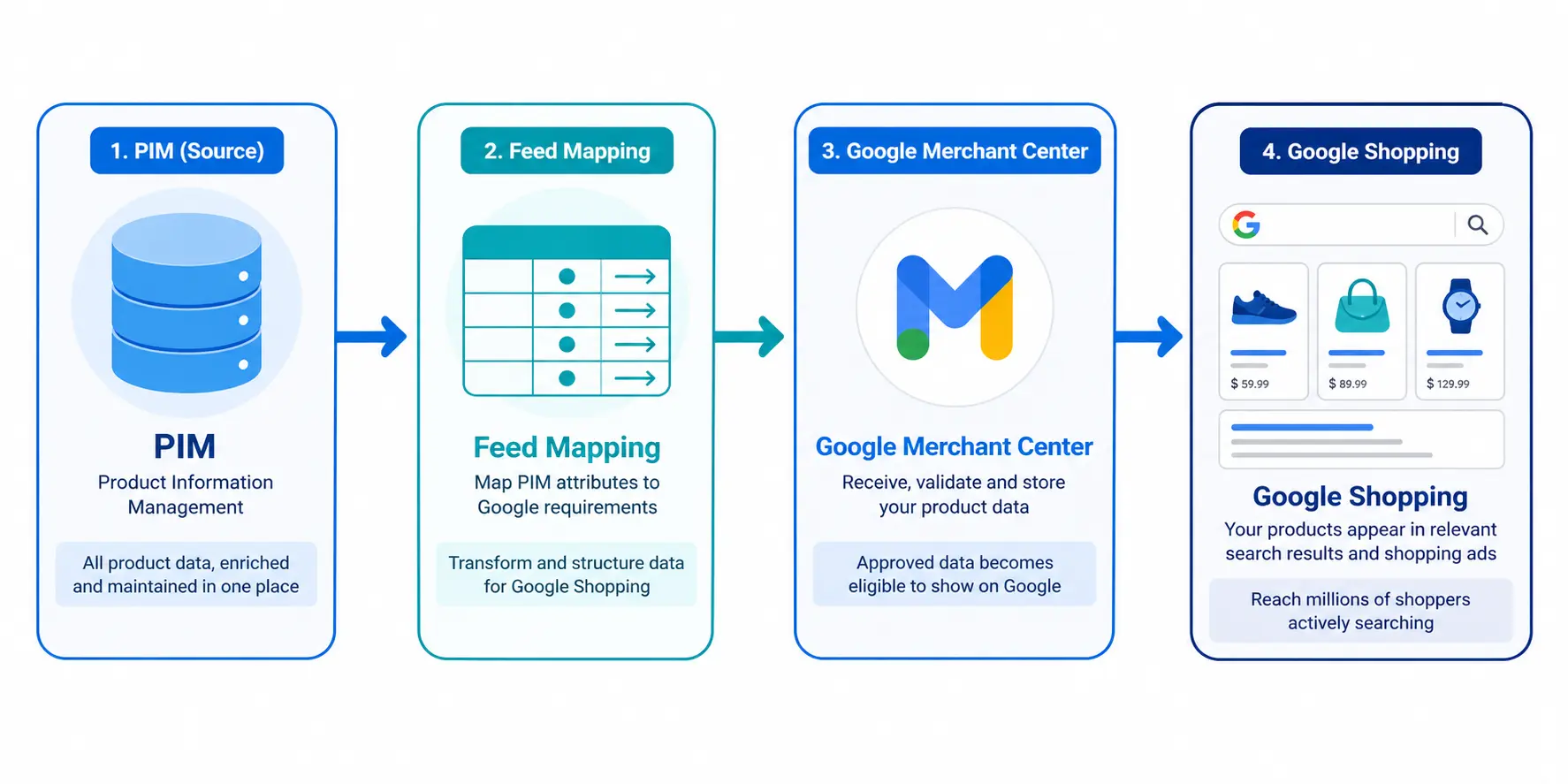
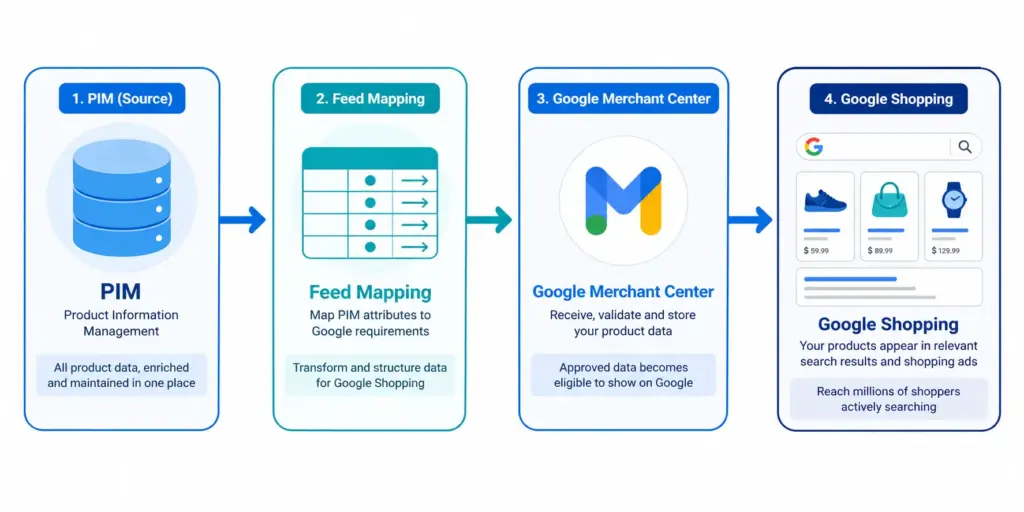
Managing product data in a PIM and managing a Google Shopping feed are often treated as two separate problems. They are not. Your PIM is the source of truth. Google Shopping is a channel that consumes that truth. The connection between them determines whether your Shopping feed performs or constantly breaks.
This guide covers how to build that connection correctly — from attribute mapping to feed delivery to ongoing automation.
Why PIM-to-Shopping Connections Break
Most PIM-to-Shopping problems come from one of three sources:
- Attribute mismatch: Your PIM stores data under different field names than Google expects. “Product Name” in your PIM needs to become a correctly structured “title” in the feed — not just passed through as-is.
- Missing transformation logic: Google requires assembled values like a constructed title or formatted price. If your PIM passes raw values without transformation rules, the feed output is incomplete.
- Stale feed delivery: Prices and stock change constantly. A feed that updates weekly generates price mismatch disapprovals every time your site runs a sale or a product goes out of stock.
For a full reference on what Google Shopping feeds require before you start mapping, the Google Shopping Feed Guide covers every required and recommended attribute.
Step 1: Build Your Attribute Mapping Document
Before writing a single line of integration code or configuring any connector, build a mapping document. This is a simple table: left column is your PIM field name, right column is the Google Shopping attribute it maps to.
| PIM Field | Google Shopping Attribute | Transformation Required? |
|---|---|---|
| Product ID / SKU | id | No — pass through directly |
| Product Name | title | Yes — assemble from Brand + Attributes + Type |
| Long Description | description | Optional — strip HTML tags |
| Product URL | link | No — pass through directly |
| Primary Image URL | image_link | No — ensure 800×800px minimum |
| Retail Price | price | Format as 29.99 GBP |
| Sale Price | sale_price | Include sale_price_effective_date |
| Stock Status | availability | Map: In Stock → in stock, Out of Stock → out of stock |
| EAN / Barcode | gtin | Validate format before passing |
| Manufacturer | brand | No — pass through directly |
| Google Category ID | google_product_category | Must be leaf-node ID, not text string |
| Colour | color | Normalise to human-readable value |
| Size | size | Add size_system attribute separately |
| Parent SKU | item_group_id | Apply to all variants of same style |
Step 2: Set Up Title Construction in Your PIM
The product title is the single most impactful attribute in a Google Shopping feed. A PIM-to-Shopping integration that just passes your PIM product name to Google as a title is almost always wrong — PIM product names are written for internal use, not for search query matching.
Define a title construction formula in your PIM and generate the Shopping title programmatically from individual attribute fields:
Formula: Brand + Gender + Material + Product Type + Colour + Size
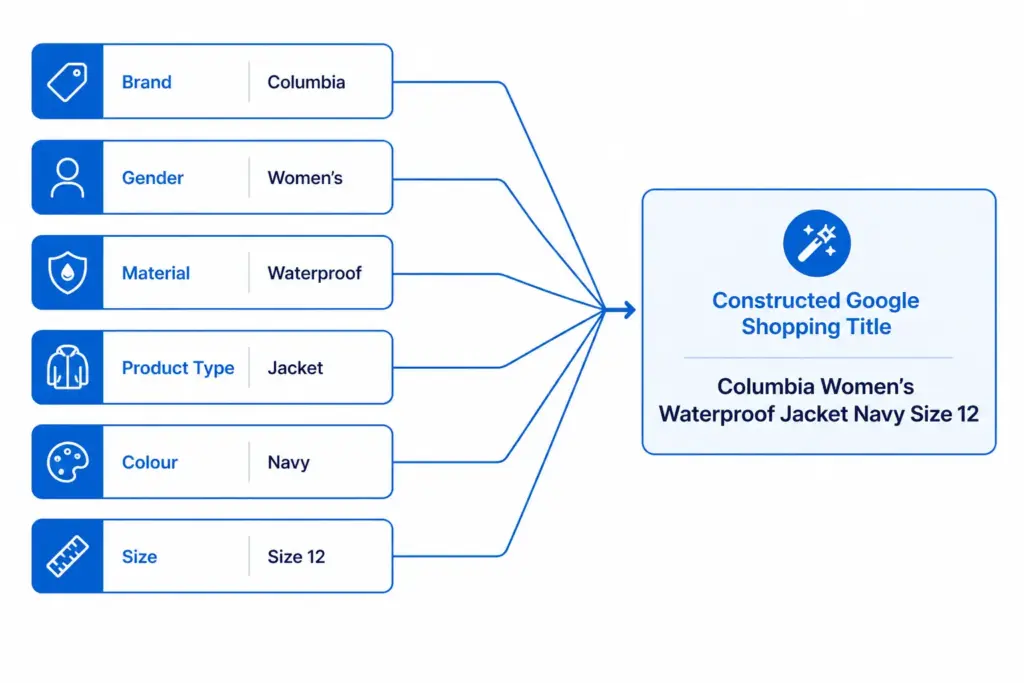
Store this as a channel-specific field in your PIM — a generated “Google Shopping Title” field that is separate from your internal product name and your website title. This allows you to optimise each independently.
Step 3: Handle Channel-Specific Content
One of the core advantages of a PIM over a spreadsheet is channel-specific content management. Your Google Shopping description, title, and certain attributes should differ from your website content and your Amazon content.
- Google Shopping title: Optimised for search query matching — include all key attributes
- Website title: Optimised for readability and brand tone — may be shorter or styled differently
- Amazon title: Follows Amazon’s own title requirements — different format again
- Description: Google Shopping descriptions are indexed but rarely shown. Focus on keyword density. Website descriptions should read naturally for humans.
Without channel-specific fields in your PIM, teams either use the same content everywhere (suboptimal) or maintain separate spreadsheets per channel (which defeats the purpose of having a PIM).
Step 4: Choose Your Feed Delivery Method
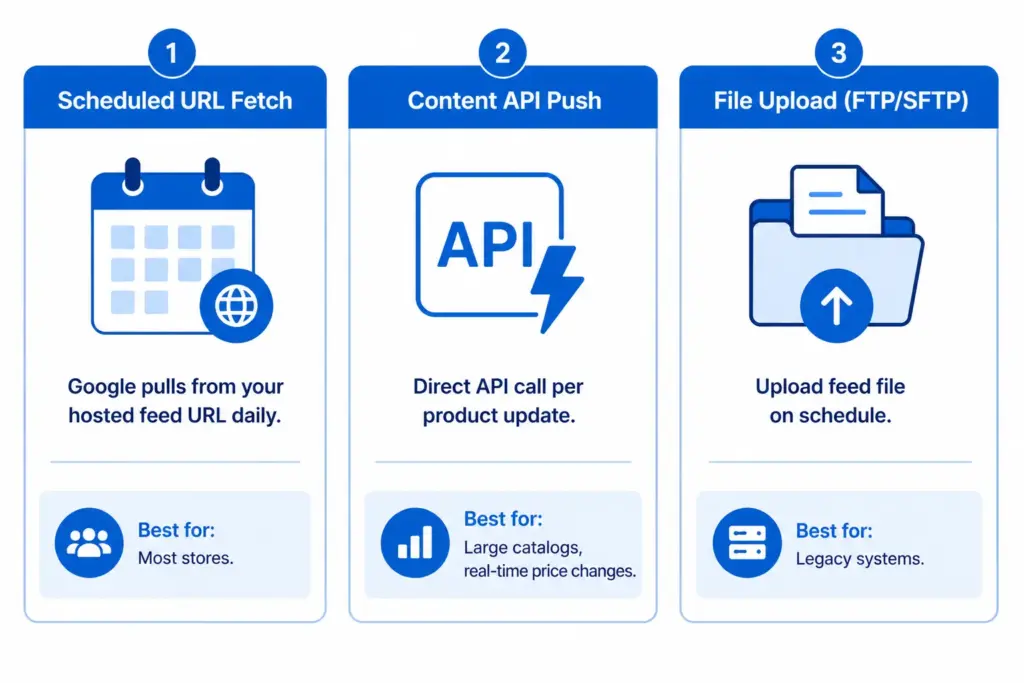
Option A: Scheduled URL Fetch (recommended for most stores)
Your PIM generates a feed file (XML or TSV) at a hosted URL. You register this URL in Google Merchant Center and set a fetch schedule — Google pulls a fresh copy at your specified frequency. Daily is the minimum; twice daily is better for stores with frequent price or stock changes.
Option B: Google Content API
Your PIM pushes product data directly to Google via the Content API, updating individual products as they change rather than uploading the full catalog on a schedule. This is the right approach for catalogs over 50,000 SKUs or stores with real-time price changes that cannot wait for a daily feed cycle.
Option C: Manual or FTP file upload
Export a feed file from your PIM and upload it to Merchant Center on a schedule via FTP/SFTP. Slower and more manual than option A, but workable for smaller catalogs with infrequent changes. Not recommended if your prices or stock change daily.
The Google Shopping Feed Generator handles feed file generation and delivery setup without custom development. For supplemental feed use cases — like adding custom labels without modifying your primary feed — see the Supplemental Feeds guide.
Step 5: Set Up Feed Refresh Frequency
Feed freshness is one of the most common causes of Shopping disapprovals for stores that have otherwise clean feeds. Google requires that your feed reflects current prices and availability. When your site runs a flash sale or a product goes out of stock, your feed must update to match.
- Price and availability: Update at minimum daily. Twice daily for stores with frequent promotions.
- Product content (titles, descriptions, images): Weekly updates are sufficient — these rarely change.
- New products: Submit immediately on launch via supplemental feed or Content API, rather than waiting for the next full feed cycle.
Step 6: Validate and Monitor
After your first feed submission, go directly to Merchant Center Diagnostics. It shows exactly which products are disapproved, which have warnings, and what attribute is causing each issue. Work through disapprovals first — these products are not appearing in Shopping at all. Then address warnings — these products appear but with limited performance.
Run GTINs through the GTIN Validator before submission — invalid GTINs are the most common single cause of mass disapprovals on first feed submissions.
Set up email alerts in Merchant Center for feed processing errors so you are notified when a feed fetch fails rather than discovering it a week later when performance drops.
Ready to streamline your PIM-to-Shopping workflow? Check where your current product data setup stands with the PIM Readiness Score — free, 5 minutes. Or start building and exporting feeds directly with the Feed Generator tool.
Frequently Asked Questions
Can I connect any PIM to Google Shopping?
Yes. Any PIM that can export a structured data file (XML, TSV, CSV) or call an API can be connected to Google Shopping. The key requirement is that your PIM can map its internal field names to Google’s required feed attributes and apply transformation rules where needed — particularly for title construction and value normalisation.
How often should my Google Shopping feed update?
At minimum daily for price and availability fields. Stores with frequent promotions or high-velocity stock changes should update twice daily. Product content fields like titles, descriptions, and images can update weekly — these change infrequently enough that daily updates add overhead without benefit.
What is the difference between a primary feed and a supplemental feed?
A primary feed contains all core product data. A supplemental feed adds or overrides specific attributes on top of the primary feed without replacing it. Supplemental feeds are useful for adding custom labels, overriding prices for specific markets, or adding attributes you cannot modify in your primary data source. Full details in the Supplemental Feeds guide.
Do I need a developer to connect my PIM to Google Shopping?
Not necessarily. If your PIM has a built-in Google Shopping connector or can export a correctly formatted feed file, no development is required. The LynkPIM Feed Generator handles feed generation and hosted delivery without custom development — no coding required.
What happens if my PIM product titles are not optimised for Google Shopping?
Unoptimised titles reduce Shopping relevance — your products appear in fewer auctions and at lower positions than competitors with complete titles. Google matches your title against search queries, so a title like “Men’s Jacket” loses every specific query to a competitor with “Columbia Waterproof Rain Jacket Men Navy Size L”. Title optimisation is the single highest-impact feed improvement for most stores.
Leave a Reply