How to Automate Your Google Shopping Feed Updates (2026 Guide)
Manual Google Shopping feed management is one of the highest-risk activities in ecommerce operations. Every time a price changes, a product goes out of stock, or a promotion goes live — and the feed is not updated within 24 hours — you risk price mismatch disapprovals that remove products from Shopping entirely. Full automation eliminates this risk.
This guide covers every automation method available in 2026, when to use each, and how to set them up correctly.
Why Manual Feed Updates Fail
Manual feed management fails not because teams are careless but because the speed of change in ecommerce catalogs outpaces human update cycles. Prices change for flash sales. Stock depletes. New products launch. Promotions end. Any one of these events — if not reflected in the feed within 24 hours — creates a price mismatch or availability mismatch that Merchant Center catches during its next crawl.
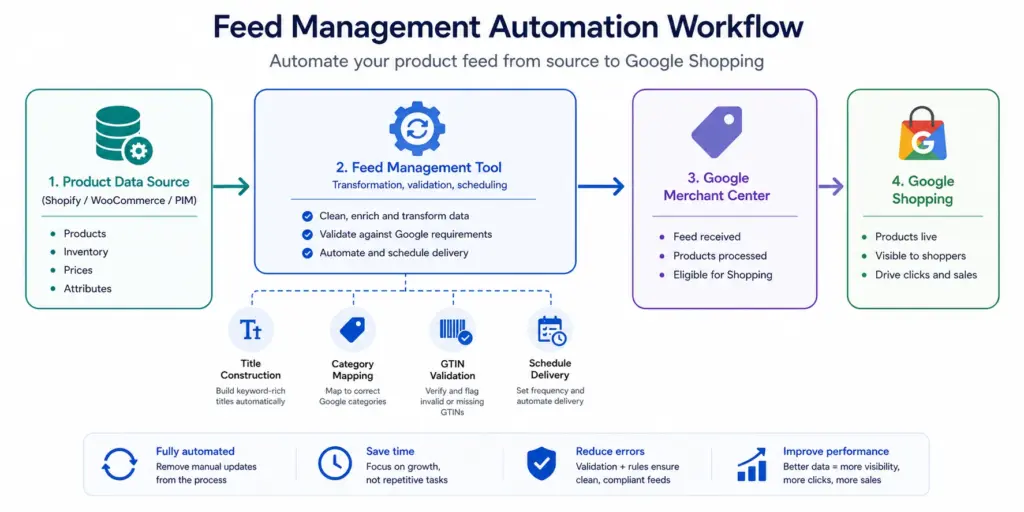
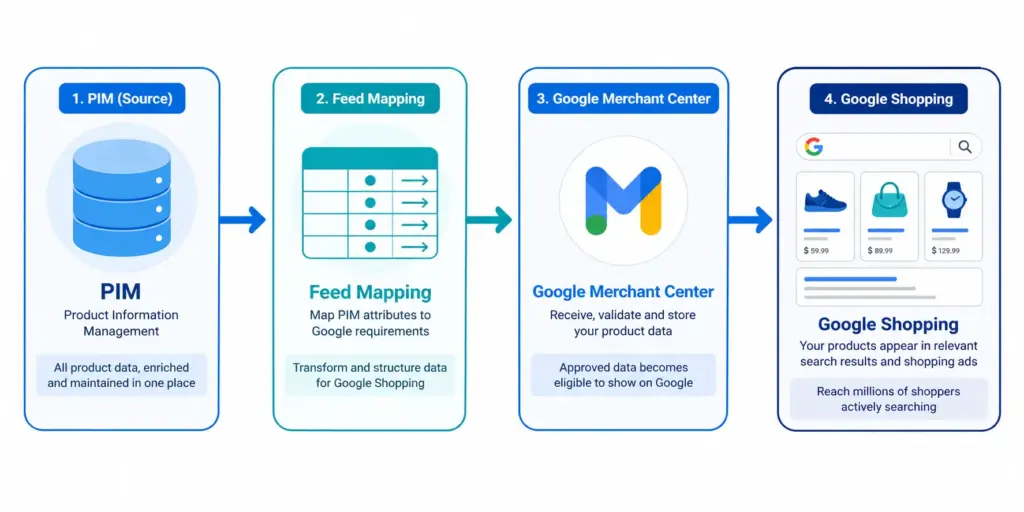
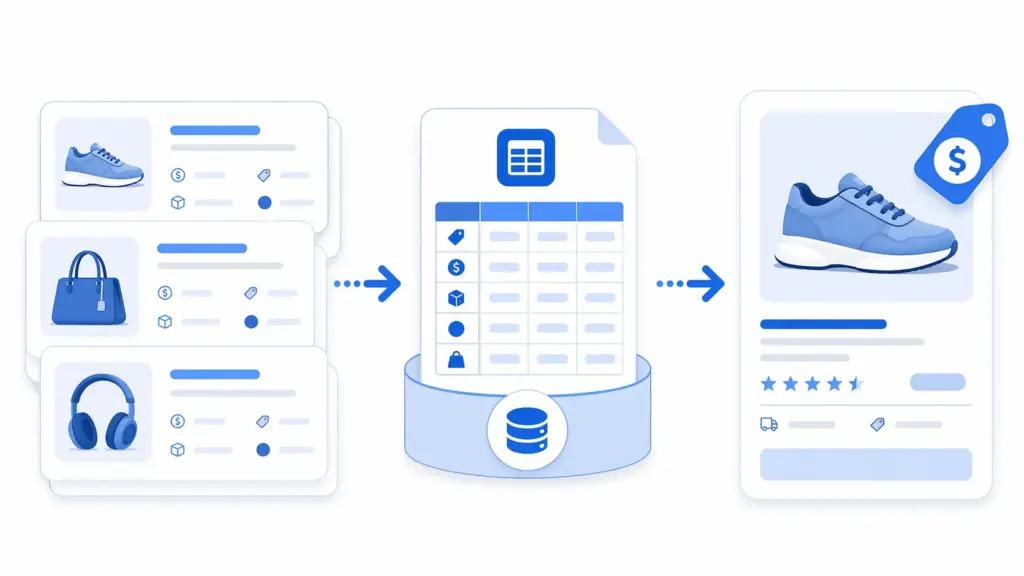
The solution is not faster manual processes. It is removing humans from the update loop entirely for routine data changes. For the context on how feeds connect to your product data source, see the PIM to Google Shopping Integration guide.
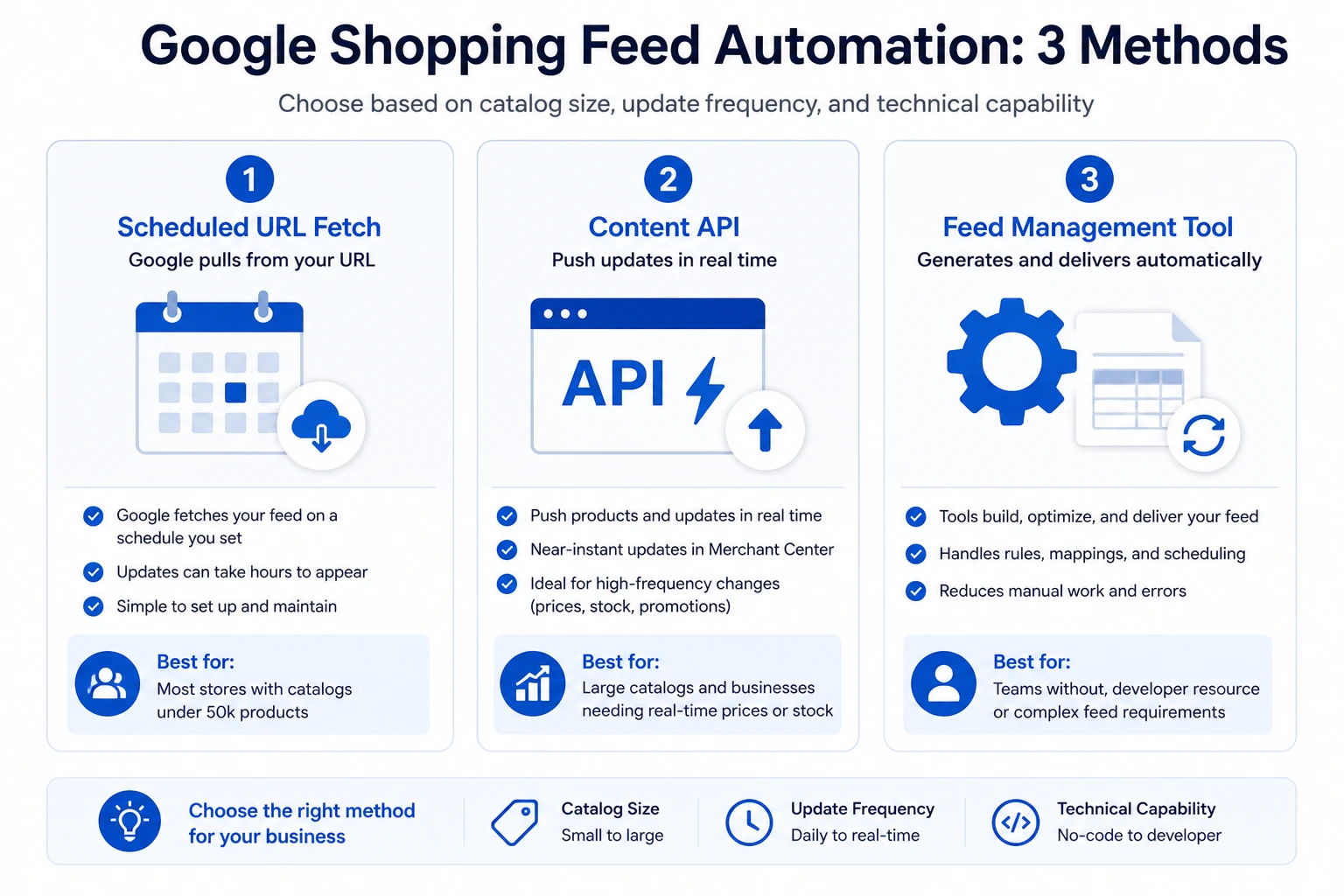
Method 1: Scheduled URL Fetch (Recommended for Most Stores)
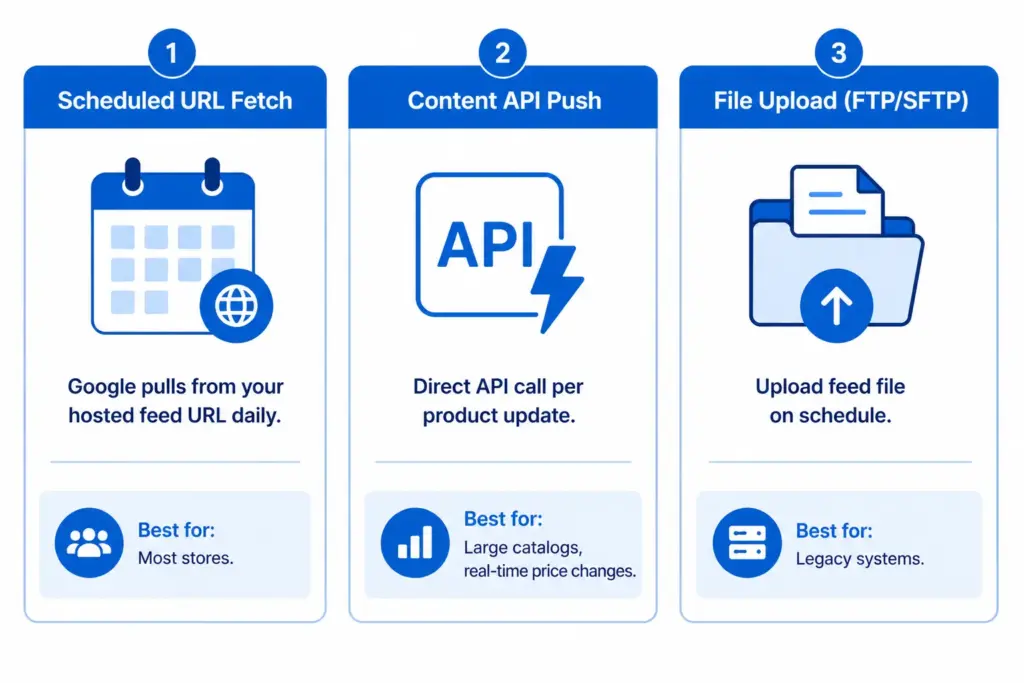
Your system generates a feed file at a stable URL. Google Merchant Center fetches that URL on a schedule you configure — daily, twice daily, or more frequently. Every fetch pulls a fresh copy of your full product data.
How to set it up
In Merchant Center, go to Products → Feeds → [your primary feed] → Settings
Under Fetch Schedule, set the frequency to Daily at minimum
Set the fetch time to a low-traffic period — typically 2:00–4:00 AM in your primary market timezone
For stores with frequent promotions or high stock turnover, set to Twice daily
Save and trigger a manual fetch to confirm the URL is accessible and the feed processes without errors
Best for: Most ecommerce stores. Works with any platform that can generate a feed file at a stable URL — Shopify, WooCommerce, Magento, custom platforms.
Limitation: The whole feed updates at once on a schedule. If a product goes out of stock at 10am and your next fetch is at 2am, the product will show as in stock in Shopping for 16 hours. For stores with fast-moving inventory, this window creates availability mismatch risk.
Method 2: Google Content API (Real-Time Updates)
The Content API allows your system to push product updates to Merchant Center immediately when a product changes — no waiting for a scheduled fetch. A price change in your platform can trigger an API call that updates the product in Merchant Center within minutes.
When to use the Content API
Catalogs over 50,000 products where full-feed fetches become slow or resource-heavy
Stores with real-time pricing (dynamic pricing, live stock-based pricing)
High-velocity inventory where products sell out within hours
Stores running multiple daily promotions that change prices frequently
Content API setup requirements
The Content API requires developer resource to implement — it is not a no-code option. Your platform needs to be configured to send API calls to Merchant Center when product data changes. Google’s Content API documentation is the reference for implementation. The Feed Generator handles API delivery without custom development for most store configurations.
Feed management tools sit between your product data source and Merchant Center. They pull product data from your platform or PIM, apply transformation rules (title construction, category mapping, attribute normalisation), generate the feed file, and deliver it to Merchant Center on schedule — with no manual steps after initial setup.
Best for: Teams without developer resource, stores managing feeds across multiple channels (Google + Amazon + Facebook), and catalogs where feed transformation logic is complex enough that maintaining it manually is impractical.
Separating Price/Availability from Content Updates
Not all feed data needs to update at the same frequency. Treating your feed as a single monolithic file that updates everything at once is inefficient and sometimes counterproductive.
Data Type
Update Frequency
Delivery Method
Price, sale_price, availability
Daily minimum — twice daily for promotions
Primary feed or price-only supplemental feed
New products
Same day as launch
Supplemental feed or Content API push
Titles, descriptions
Weekly
Primary feed
Images
On change
Primary feed
Custom labels
Weekly or monthly
Custom label supplemental feed
Using a supplemental feed for price and availability updates is a practical option for stores whose primary feed platform cannot be updated on a daily schedule. See the Supplemental Feeds guide for setup details.
Setting Up Merchant Center Alerts
Automation without monitoring is incomplete. Feed automation can fail — URLs become inaccessible, file formats break, authentication tokens expire. Set up Merchant Center email alerts so processing failures are caught within hours, not days.
In Merchant Center, go to Settings → Email Preferences
Add a shared team email address (not just a personal one) so alerts are seen even when you are out of office
For full automation of feed generation, delivery, and monitoring from one place — including price validation before submission — the Google Shopping Feed Generator handles all three without custom development. Start with the LynkPIM free plan.
Frequently Asked Questions
How often should Google Shopping feeds update?
Price and availability fields should update at minimum daily. Stores with frequent promotions or fast-moving inventory should update twice daily. Product content fields (titles, descriptions, images) can update weekly — these change infrequently and do not cause disapprovals if slightly delayed. The critical rule: your feed price must match your landing page price at all times.
What is the difference between Scheduled URL Fetch and the Content API?
Scheduled URL Fetch pulls a complete feed file from a hosted URL on a schedule — best for catalogs under 50,000 products with predictable update patterns. The Content API allows your system to push individual product updates to Merchant Center in real time as products change — better for large catalogs, real-time prices, or stores with unpredictable inventory movements.
What happens if my Google Shopping feed fails to update?
If your feed fails to fetch for more than 30 days, Google may deactivate it and your products stop appearing in Shopping. Shorter delays cause price mismatch disapprovals when your site prices change but your feed does not update. Set up Merchant Center email alerts for feed processing errors so failures are caught within hours, not days.
Google Product Category Taxonomy: The Complete 2026 Guide
Google’s product category taxonomy is one of the most impactful — and most misused — attributes in Google Shopping feeds. Every product in your feed needs a google_product_category value. Get it right and your products appear in the correct auctions for relevant searches. Get it wrong and you are competing for irrelevant traffic at the wrong price.
This guide covers how Google’s taxonomy works, how to find the right category for any product, and the most common mapping mistakes costing stores auction performance.
What Is Google’s Product Category Taxonomy?
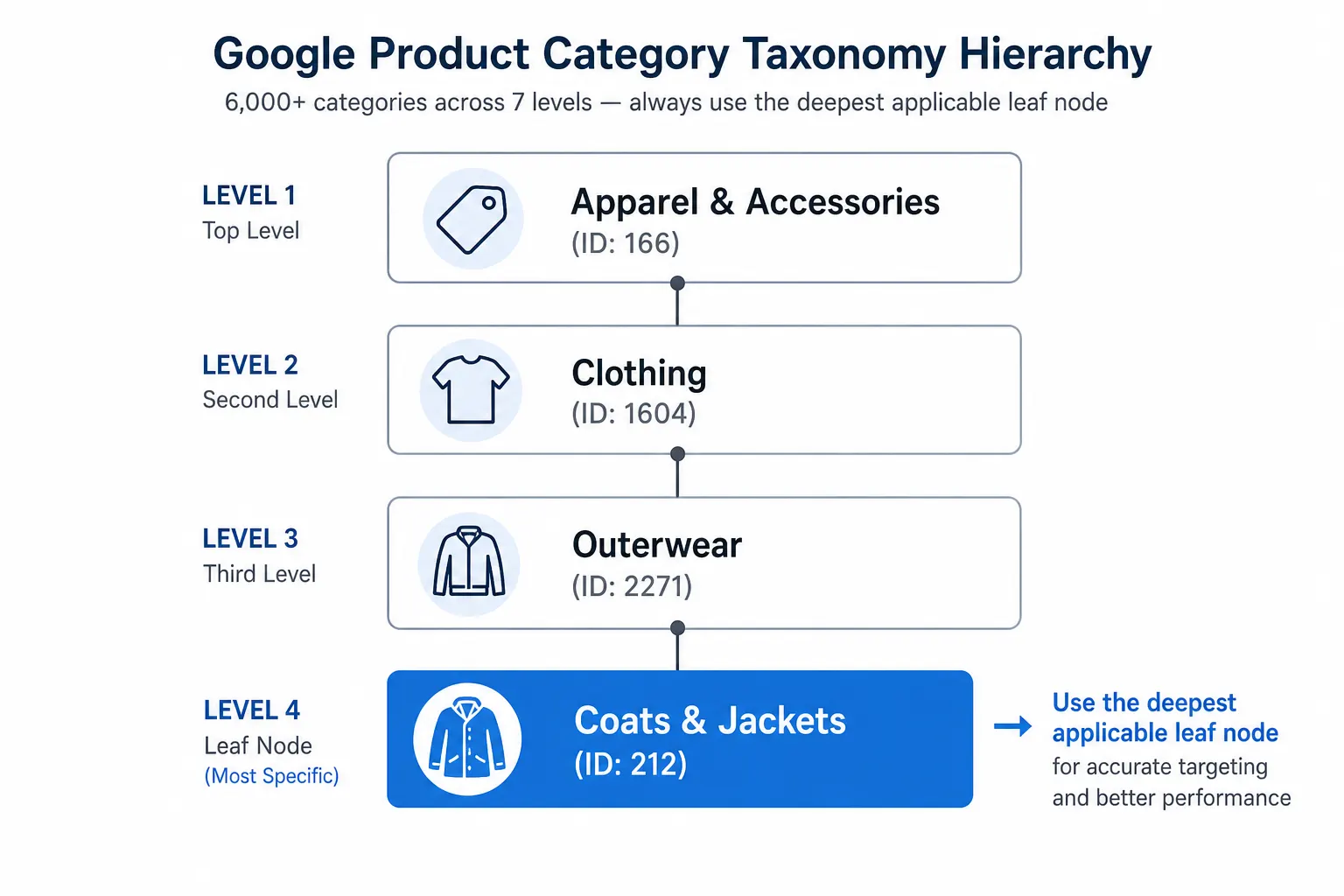
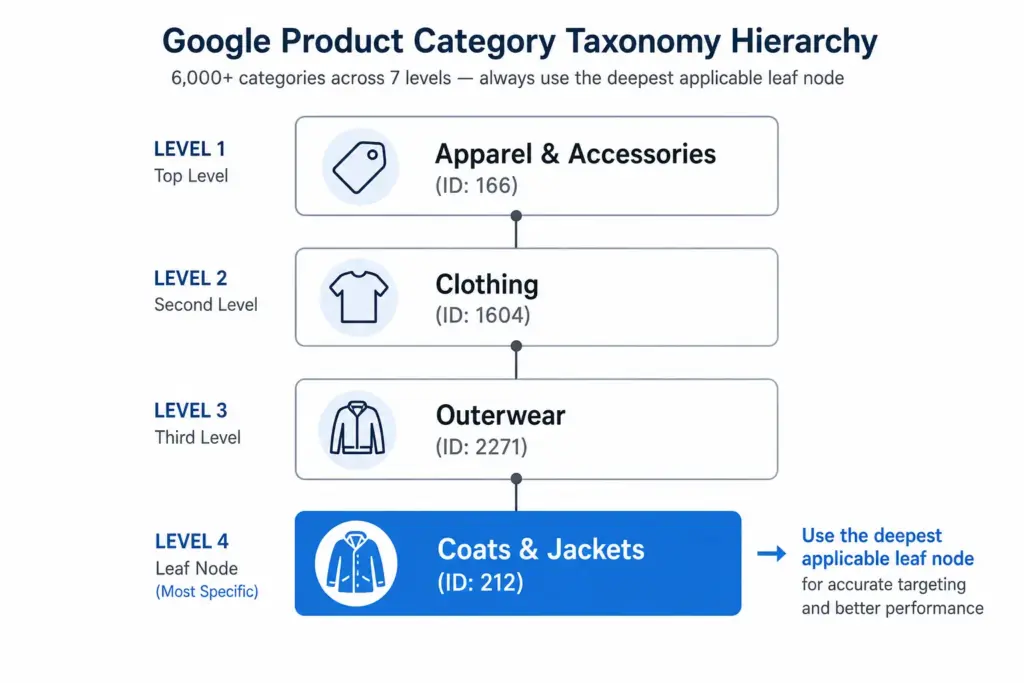
Google’s product taxonomy is a hierarchical classification system with over 6,000 categories across up to 7 levels of depth. Every product sold through Google Shopping must be classified within this taxonomy using the google_product_category feed attribute.
Unlike your own internal product taxonomy — which you design for your team and customers — Google’s taxonomy is fixed. You do not modify it. You map your products to it. The full taxonomy file is publicly available and updated periodically. Understanding how it relates to your own internal category structure is covered in detail in the Google Product Category vs Internal Taxonomy guide.
How google_product_category Affects Shopping Performance
The category value you assign determines which auction pool your product enters. Google uses it to:
Match products to relevant search queries — a product in the correct leaf-node category is matched to more specific searches
Set category-specific requirements — some categories (apparel, alcohol, healthcare) have additional required attributes that only apply once Google knows your product’s category
Power Shopping filters — the filter options available to buyers on Shopping results pages are partly driven by the category the product is in
Determine tax and shipping rules — in some markets, tax treatment is category-dependent
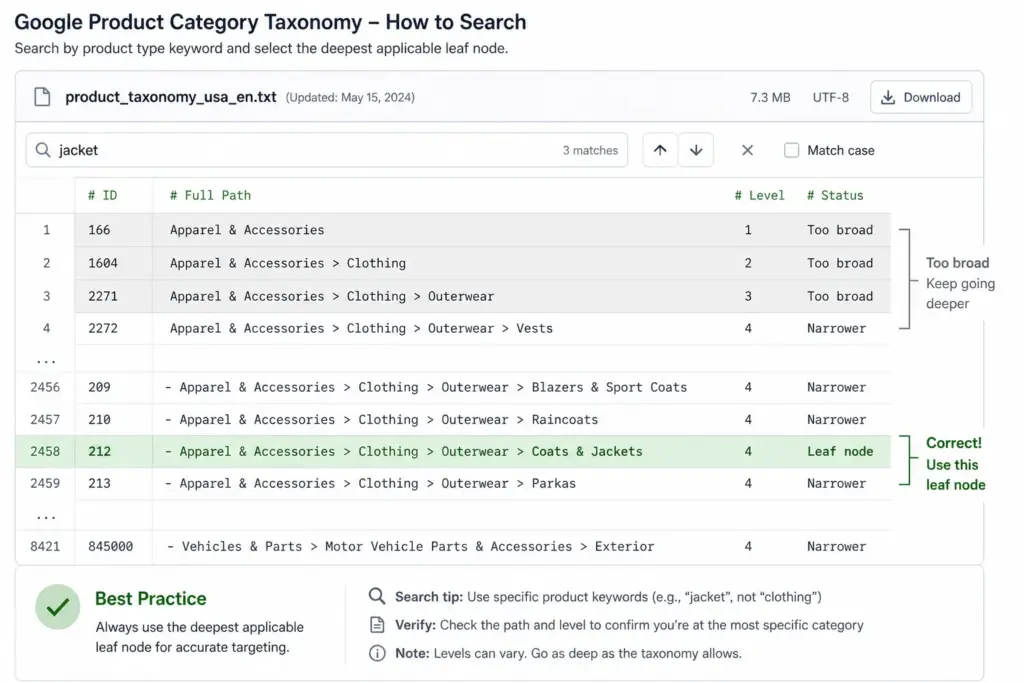
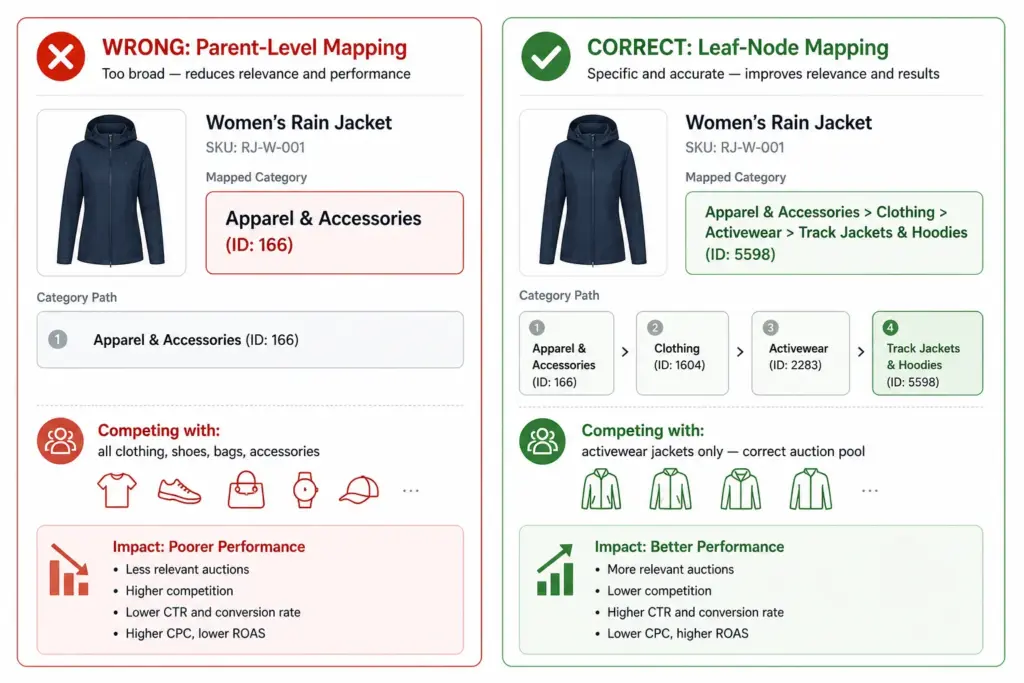
The difference between a parent category and a leaf node is significant. A product mapped to “Apparel & Accessories” (ID: 166) enters a much broader auction pool than the same product mapped to “Apparel & Accessories > Clothing > Outerwear > Coats & Jackets” (ID: 212). The leaf-node product appears for more specific queries at lower CPCs and with higher relevance scores.
The taxonomy Attribute: ID vs Text String
Google accepts google_product_category in two formats:
Numeric ID:212 — the unique identifier for that category node. Stable across taxonomy updates.
Full path string:Apparel & Accessories > Clothing > Outerwear > Coats & Jackets — human-readable but can break if Google renames any node in the path.
Use the numeric ID. If Google restructures a category path or renames a node, the numeric ID continues to resolve correctly. The text path string will return an error or be ignored if the exact wording changes.
product_type — a free-form field you define using your own category naming. Does not affect Google matching. Can be used for campaign segmentation in Google Ads (similar to custom labels). Optional but recommended.
Both can coexist in the same feed. Use google_product_category to tell Google what your product is. Use product_type to reflect your own internal category naming for campaign management purposes.
Is google_product_category required in Google Shopping feeds?
Yes, it is required for all products. Products submitted without it may still appear but Google auto-assigns a category — almost always a broad parent level that will underperform compared to the correct leaf-node mapping.
Should I use the numeric ID or the text string?
Use the numeric ID. It is stable across taxonomy updates — if Google renames or restructures a category path, the ID continues to resolve correctly. The text path string can break silently if Google changes the exact wording of any node.
What happens if I use the wrong google_product_category?
Wrong or overly broad categories reduce Shopping relevance — your products appear for fewer relevant queries and compete in incorrect auction pools. A jacket in “Apparel & Accessories” (parent) is in a completely different and far broader auction than the same jacket in “Apparel & Accessories > Clothing > Outerwear > Coats & Jackets” (leaf node).
How often does Google update its product taxonomy?
Typically 1–2 times per year. Numeric IDs remain valid across updates but text path strings may become outdated. Review the taxonomy file annually and after major Google Merchant Center announcements.
What is the difference between google_product_category and product_type?
google_product_category uses Google’s fixed taxonomy and directly affects auction relevance and matching. product_type is a free-form field you define using your own naming — it does not affect Google matching but can be used for campaign segmentation in Google Ads similar to custom labels.
Supplemental Feeds in Google Merchant Center: What They Are and When to Use Them
Most Google Shopping guides focus on primary feeds — the main data source that contains all your product information. Supplemental feeds are less discussed but solve a very specific and common problem: what do you do when you need to add or change attributes in your feed without being able to modify your primary data source?
This guide covers exactly what supplemental feeds are, the most valuable use cases, and how to set one up correctly.
What Is a Supplemental Feed?
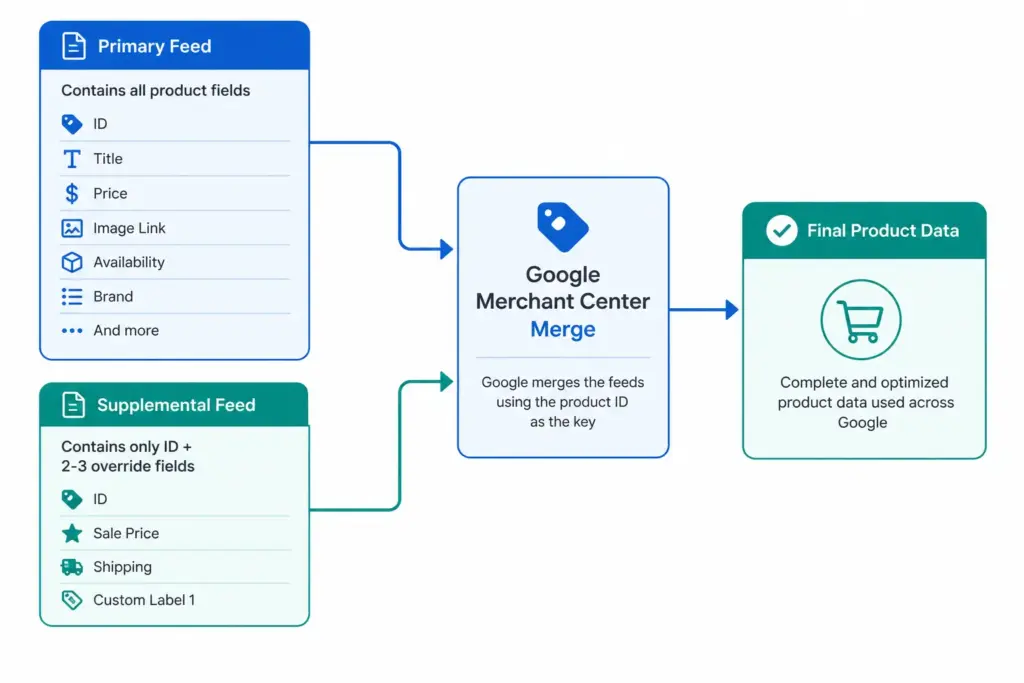
A supplemental feed is a secondary data source in Google Merchant Center that adds or overrides specific product attributes on top of an existing primary feed. It does not replace the primary feed — it merges with it, using the product ID as the matching key.
You can have multiple supplemental feeds attached to one primary feed. Each supplemental feed only needs to contain the product ID column and the specific attributes you want to add or change.
For foundational context on how primary feeds work, the Google Shopping Feed Guide covers the complete attribute set before you layer supplemental data on top.
Primary Feed vs Supplemental Feed — Key Differences
Primary Feed
Supplemental Feed
Contains
All required product attributes
Only attributes being added or overridden
Required?
Yes — at least one required
No — optional
Can stand alone?
Yes
No — must link to a primary feed
Update frequency
Daily minimum for price/availability
Depends on use case
Override behaviour
Base data
Overwrites primary feed value for the same attribute
Multiple allowed?
Yes (one per target country/language)
Yes — multiple supplemental feeds per primary
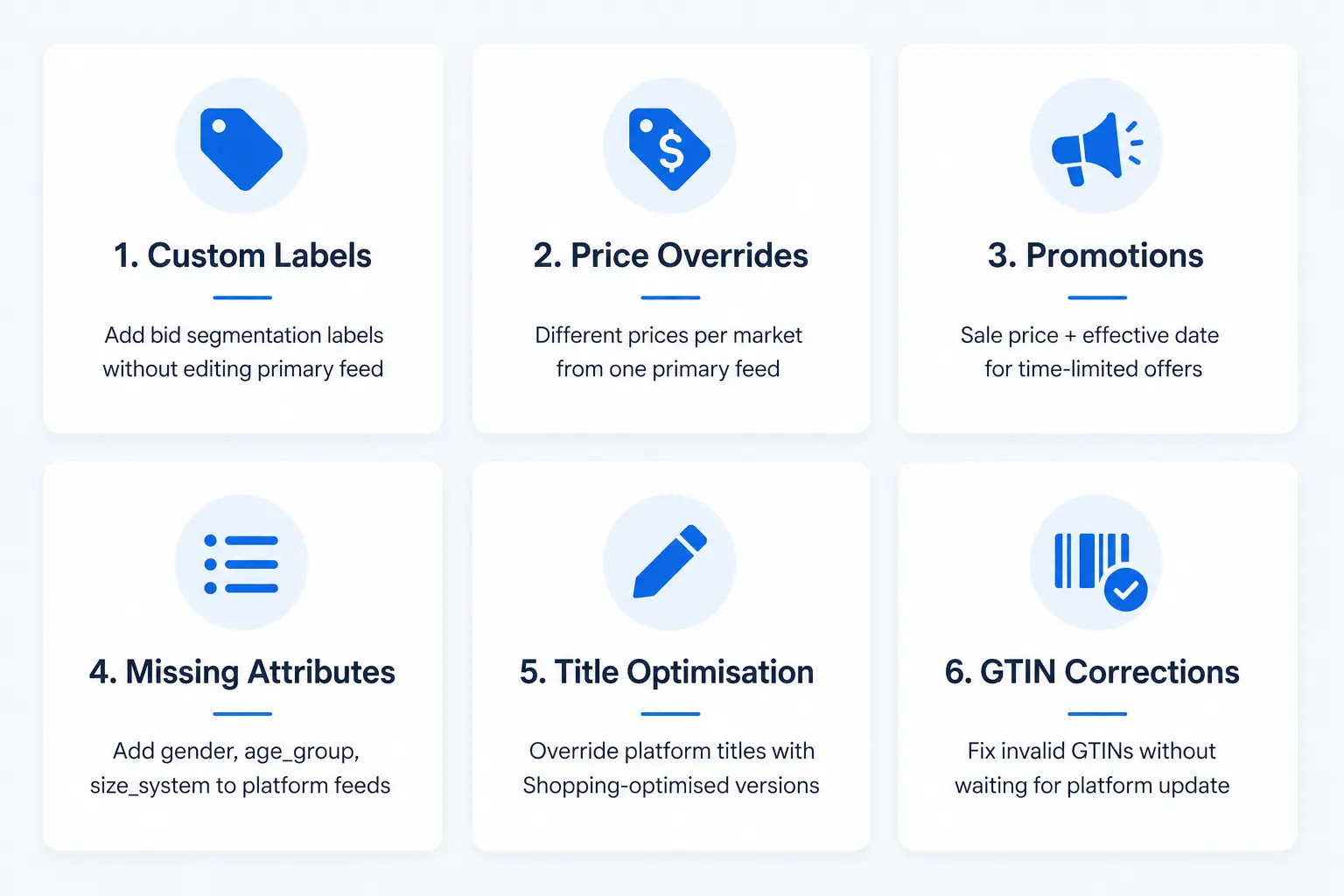
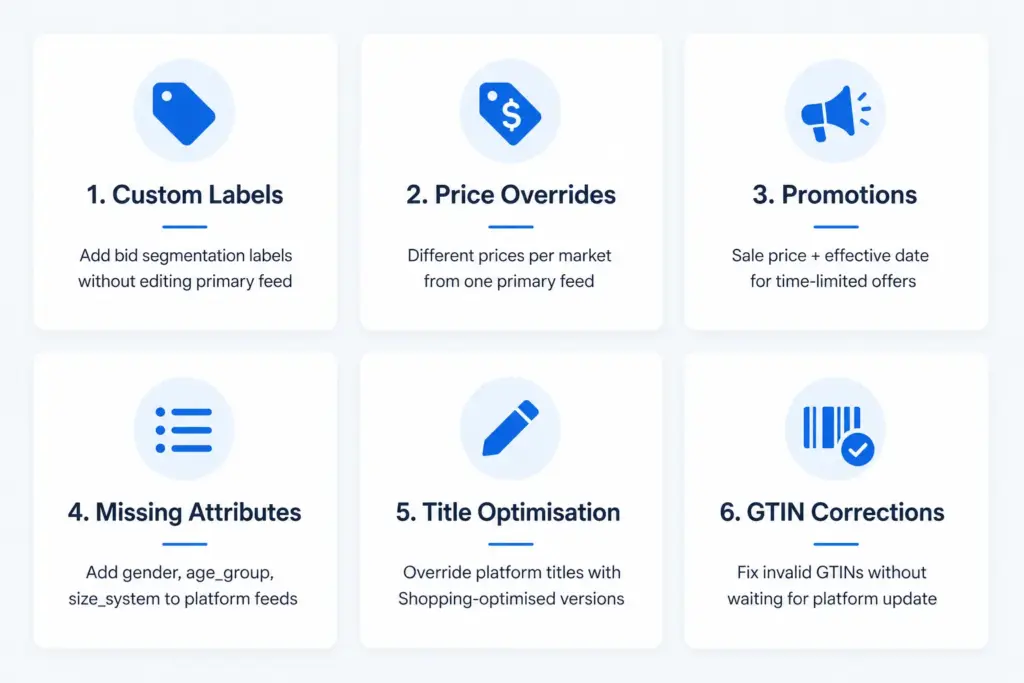
The 6 Most Valuable Supplemental Feed Use Cases
1. Adding Custom Labels Without Editing Your Primary Feed
This is the most common supplemental feed use case. You want to add custom_label_0 through custom_label_4 values for bid segmentation, but your primary feed is generated by your ecommerce platform and you cannot add columns to it.
Solution: Create a supplemental feed in Google Sheets with two columns — id and custom_label_0. Assign label values per product. Merchant Center merges the labels onto matching product IDs from your primary feed. No primary feed changes required. For the full custom labels strategy, see the Custom Labels guide.
2. Price Overrides for Specific Markets
If you run the same primary feed across multiple target countries but need different prices per market, a supplemental feed per market containing id and price allows you to override prices without duplicating your entire primary feed.
3. Promotion and Sale Price Management
When you run a time-limited promotion, rather than modifying your primary feed, create a supplemental feed containing id, sale_price, and sale_price_effective_date. Upload it for the promotion period and remove or update it when the promotion ends. Cleaner than modifying your primary feed and easier to manage as a scheduled operation.
4. Adding Missing Attributes to Platform-Generated Feeds
Ecommerce platforms like Shopify and WooCommerce generate basic Shopping feeds, but often omit attributes like age_group, gender, size_system, or product_type. A supplemental feed lets you add these without switching your primary feed source or installing additional plugins.
5. Title and Description Optimisation
If your primary feed generates product titles from your ecommerce platform’s product names (which are written for website display, not Shopping), a supplemental feed can override the title field with Shopping-optimised versions — without changing your website product names.
6. Correcting GTIN Issues on Specific Products
If a subset of your products has invalid or missing GTINs in your primary feed, you can supply correct GTIN values via supplemental feed while you fix the underlying data issue in your PIM or platform. First validate your GTINs with the GTIN Validator to confirm which ones need correcting.
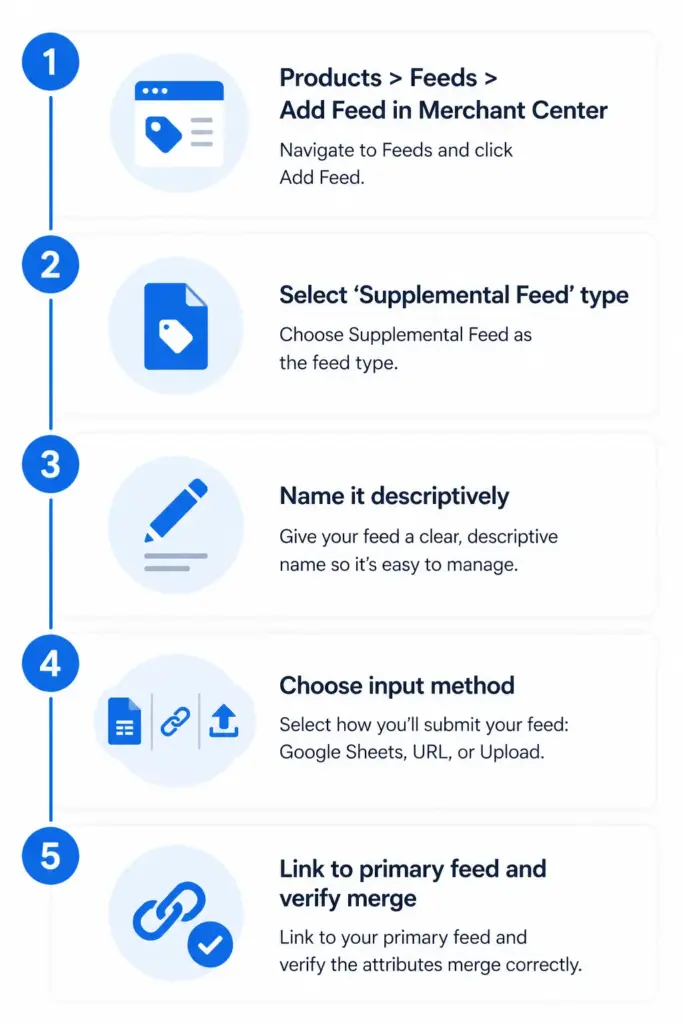
How to Set Up a Supplemental Feed in Merchant Center
In Google Merchant Center, go to Products → Feeds → + (Add Feed)
Select Supplemental feed as the feed type
Give it a descriptive name — e.g. “Custom Labels — Margin Tier” or “Promotion Sale Prices May 2026”
Choose input method: Google Sheets (easiest for manual management), scheduled fetch from a URL, or file upload
Select which primary feed this supplemental feed applies to
Build your feed file — include only id column plus the attributes you are adding or overriding
Submit and verify — check individual product pages in Merchant Center to confirm supplemental attributes are applied
Supplemental Feed Rules and Limitations
Supplemental feeds cannot add products — only modify or supplement existing products from the primary feed
If a supplemental feed supplies the same attribute as the primary feed, the supplemental value wins
There is no limit on the number of supplemental feeds per primary feed, but keep them organised with clear naming conventions
Supplemental feeds must use the same product IDs as the primary feed — mismatched IDs result in no merge
Google Sheets supplemental feeds update when you edit the sheet — useful for quick manual changes during promotions
For stores managing supplemental feed logic across multiple channels and markets, keeping these overrides centralised in a PIM rather than scattered across multiple Merchant Center supplemental feed files is significantly easier to maintain. See how the PIM to Google Shopping integration handles this at scale, or try the Feed Generator to build and manage your feeds from one place.
Frequently Asked Questions
Can a supplemental feed add new products to Google Shopping?
No. Supplemental feeds can only modify or add attributes to products that already exist in your primary feed. New products must first be included in the primary feed before a supplemental feed can reference them.
What happens if supplemental and primary feeds supply the same attribute?
The supplemental feed value overwrites the primary feed value for that attribute on all matching products. This is the intended behaviour — it is how supplemental feeds override titles, prices, or other fields you cannot change in your primary source.
How many supplemental feeds can I have in Merchant Center?
There is no published hard limit. In practice, keep supplemental feeds organised with descriptive names — “Custom Labels March 2026”, “Sale Prices Bank Holiday” — and consolidate overlapping feeds where possible. Multiple supplemental feeds affecting the same products in contradictory ways can be difficult to troubleshoot.
Can I use a Google Sheet as a supplemental feed?
Yes. Google Sheets is one of the supported input methods for supplemental feeds in Merchant Center. It is the easiest option for manually managed data like custom labels or promotion prices — edits to the sheet reflect in the feed without requiring any file export or upload step.
What is the minimum a supplemental feed needs to contain?
At minimum the id column (matching product IDs from your primary feed) plus at least one additional attribute you are adding or overriding. A file with only IDs and no additional attributes will merge successfully but have no visible effect on your product data.
PIM to Google Shopping: How to Connect Your Product Data
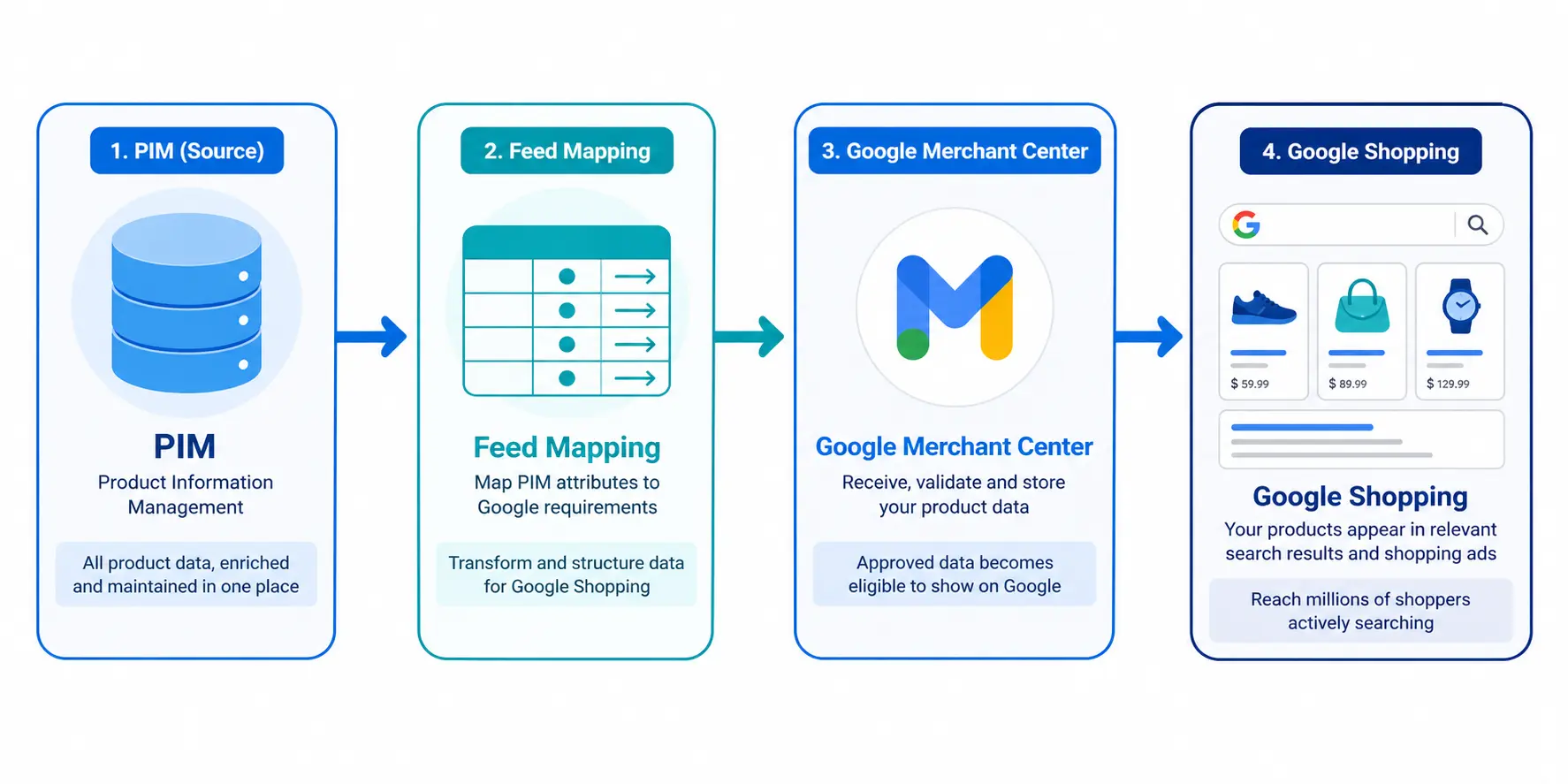
Managing product data in a PIM and managing a Google Shopping feed are often treated as two separate problems. They are not. Your PIM is the source of truth. Google Shopping is a channel that consumes that truth. The connection between them determines whether your Shopping feed performs or constantly breaks.
This guide covers how to build that connection correctly — from attribute mapping to feed delivery to ongoing automation.
Why PIM-to-Shopping Connections Break
Most PIM-to-Shopping problems come from one of three sources:
Attribute mismatch: Your PIM stores data under different field names than Google expects. “Product Name” in your PIM needs to become a correctly structured “title” in the feed — not just passed through as-is.
Missing transformation logic: Google requires assembled values like a constructed title or formatted price. If your PIM passes raw values without transformation rules, the feed output is incomplete.
Stale feed delivery: Prices and stock change constantly. A feed that updates weekly generates price mismatch disapprovals every time your site runs a sale or a product goes out of stock.
For a full reference on what Google Shopping feeds require before you start mapping, the Google Shopping Feed Guide covers every required and recommended attribute.
Step 1: Build Your Attribute Mapping Document
Before writing a single line of integration code or configuring any connector, build a mapping document. This is a simple table: left column is your PIM field name, right column is the Google Shopping attribute it maps to.
PIM Field
Google Shopping Attribute
Transformation Required?
Product ID / SKU
id
No — pass through directly
Product Name
title
Yes — assemble from Brand + Attributes + Type
Long Description
description
Optional — strip HTML tags
Product URL
link
No — pass through directly
Primary Image URL
image_link
No — ensure 800×800px minimum
Retail Price
price
Format as 29.99 GBP
Sale Price
sale_price
Include sale_price_effective_date
Stock Status
availability
Map: In Stock → in stock, Out of Stock → out of stock
EAN / Barcode
gtin
Validate format before passing
Manufacturer
brand
No — pass through directly
Google Category ID
google_product_category
Must be leaf-node ID, not text string
Colour
color
Normalise to human-readable value
Size
size
Add size_system attribute separately
Parent SKU
item_group_id
Apply to all variants of same style
Step 2: Set Up Title Construction in Your PIM
The product title is the single most impactful attribute in a Google Shopping feed. A PIM-to-Shopping integration that just passes your PIM product name to Google as a title is almost always wrong — PIM product names are written for internal use, not for search query matching.
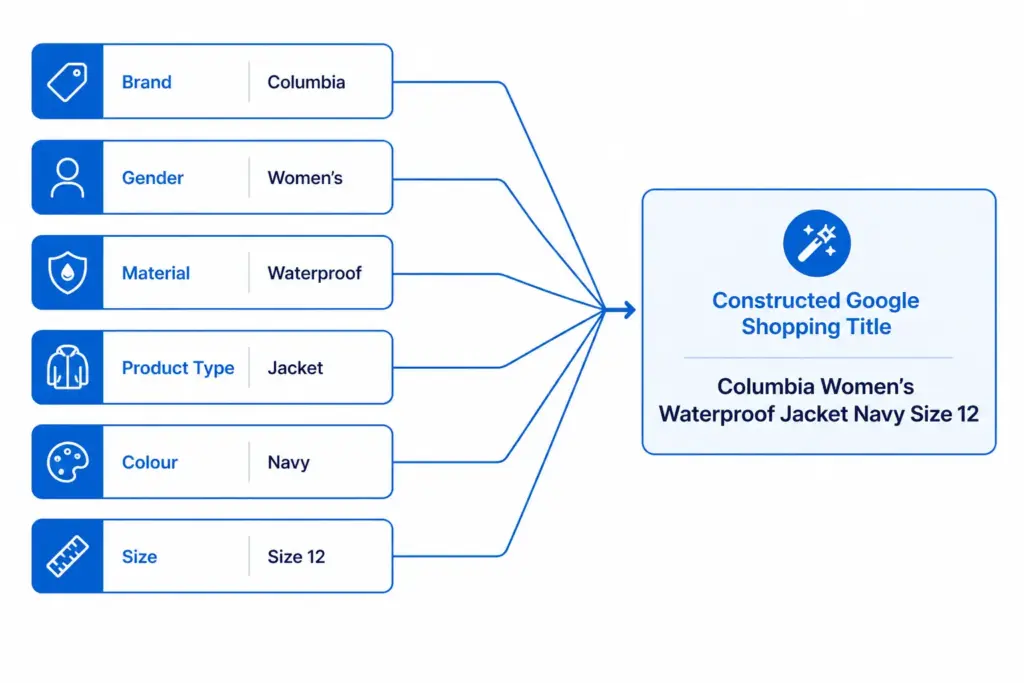
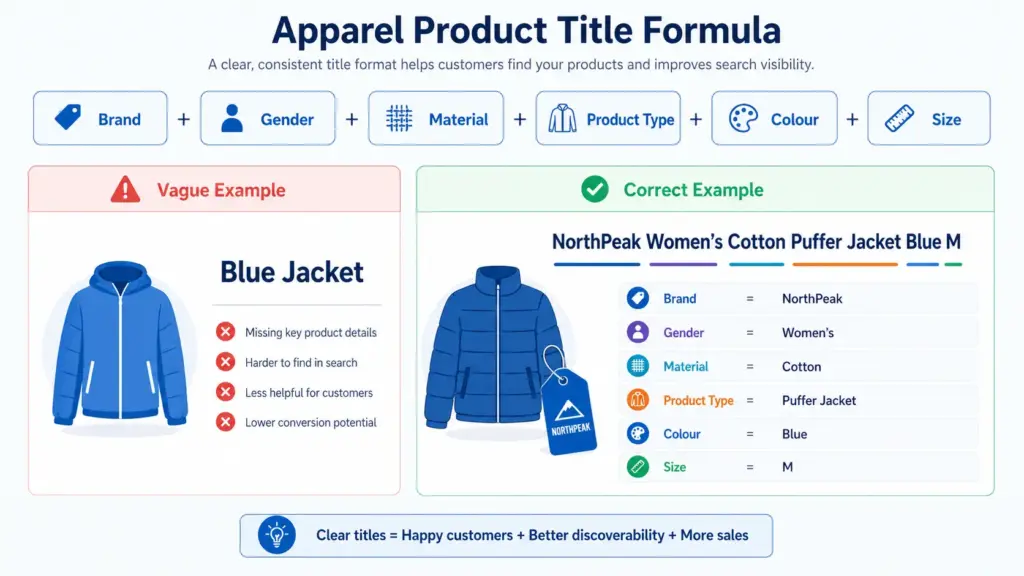
Define a title construction formula in your PIM and generate the Shopping title programmatically from individual attribute fields:
Formula: Brand + Gender + Material + Product Type + Colour + Size
Store this as a channel-specific field in your PIM — a generated “Google Shopping Title” field that is separate from your internal product name and your website title. This allows you to optimise each independently.
Step 3: Handle Channel-Specific Content
One of the core advantages of a PIM over a spreadsheet is channel-specific content management. Your Google Shopping description, title, and certain attributes should differ from your website content and your Amazon content.
Google Shopping title: Optimised for search query matching — include all key attributes
Website title: Optimised for readability and brand tone — may be shorter or styled differently
Amazon title: Follows Amazon’s own title requirements — different format again
Description: Google Shopping descriptions are indexed but rarely shown. Focus on keyword density. Website descriptions should read naturally for humans.
Without channel-specific fields in your PIM, teams either use the same content everywhere (suboptimal) or maintain separate spreadsheets per channel (which defeats the purpose of having a PIM).
Step 4: Choose Your Feed Delivery Method
Option A: Scheduled URL Fetch (recommended for most stores)
Your PIM generates a feed file (XML or TSV) at a hosted URL. You register this URL in Google Merchant Center and set a fetch schedule — Google pulls a fresh copy at your specified frequency. Daily is the minimum; twice daily is better for stores with frequent price or stock changes.
Option B: Google Content API
Your PIM pushes product data directly to Google via the Content API, updating individual products as they change rather than uploading the full catalog on a schedule. This is the right approach for catalogs over 50,000 SKUs or stores with real-time price changes that cannot wait for a daily feed cycle.
Option C: Manual or FTP file upload
Export a feed file from your PIM and upload it to Merchant Center on a schedule via FTP/SFTP. Slower and more manual than option A, but workable for smaller catalogs with infrequent changes. Not recommended if your prices or stock change daily.
The Google Shopping Feed Generator handles feed file generation and delivery setup without custom development. For supplemental feed use cases — like adding custom labels without modifying your primary feed — see the Supplemental Feeds guide.
Step 5: Set Up Feed Refresh Frequency
Feed freshness is one of the most common causes of Shopping disapprovals for stores that have otherwise clean feeds. Google requires that your feed reflects current prices and availability. When your site runs a flash sale or a product goes out of stock, your feed must update to match.
Price and availability: Update at minimum daily. Twice daily for stores with frequent promotions.
Product content (titles, descriptions, images): Weekly updates are sufficient — these rarely change.
New products: Submit immediately on launch via supplemental feed or Content API, rather than waiting for the next full feed cycle.
Step 6: Validate and Monitor
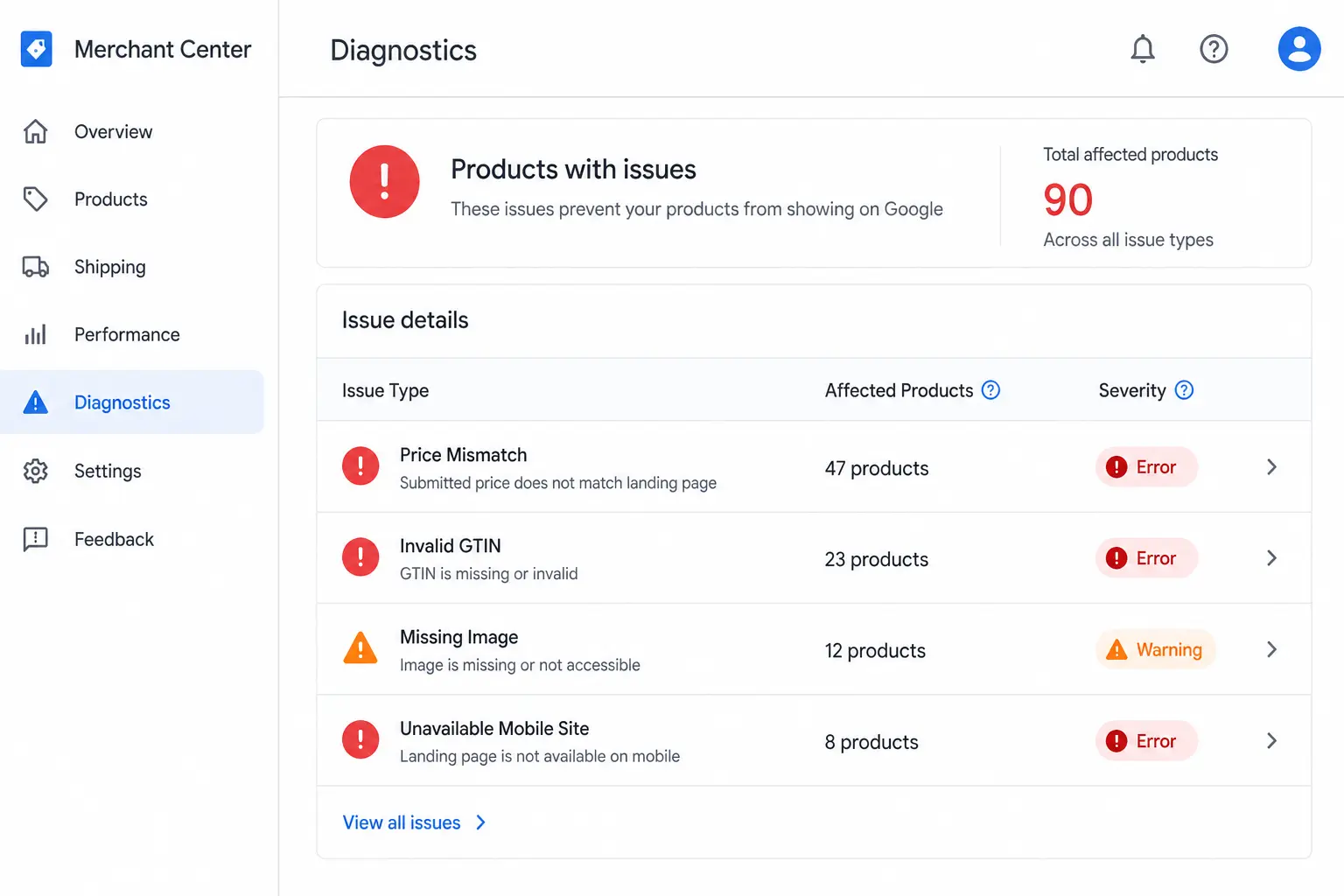
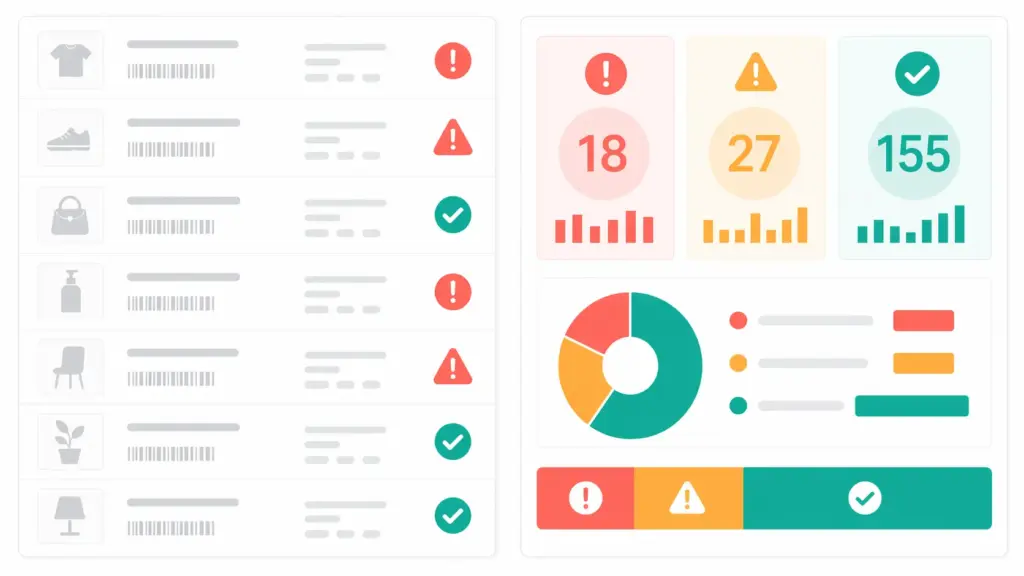
After your first feed submission, go directly to Merchant Center Diagnostics. It shows exactly which products are disapproved, which have warnings, and what attribute is causing each issue. Work through disapprovals first — these products are not appearing in Shopping at all. Then address warnings — these products appear but with limited performance.
Run GTINs through the GTIN Validator before submission — invalid GTINs are the most common single cause of mass disapprovals on first feed submissions.
Set up email alerts in Merchant Center for feed processing errors so you are notified when a feed fetch fails rather than discovering it a week later when performance drops.
Ready to streamline your PIM-to-Shopping workflow? Check where your current product data setup stands with the PIM Readiness Score — free, 5 minutes. Or start building and exporting feeds directly with the Feed Generator tool.
Frequently Asked Questions
Can I connect any PIM to Google Shopping?
Yes. Any PIM that can export a structured data file (XML, TSV, CSV) or call an API can be connected to Google Shopping. The key requirement is that your PIM can map its internal field names to Google’s required feed attributes and apply transformation rules where needed — particularly for title construction and value normalisation.
How often should my Google Shopping feed update?
At minimum daily for price and availability fields. Stores with frequent promotions or high-velocity stock changes should update twice daily. Product content fields like titles, descriptions, and images can update weekly — these change infrequently enough that daily updates add overhead without benefit.
What is the difference between a primary feed and a supplemental feed?
A primary feed contains all core product data. A supplemental feed adds or overrides specific attributes on top of the primary feed without replacing it. Supplemental feeds are useful for adding custom labels, overriding prices for specific markets, or adding attributes you cannot modify in your primary data source. Full details in the Supplemental Feeds guide.
Do I need a developer to connect my PIM to Google Shopping?
Not necessarily. If your PIM has a built-in Google Shopping connector or can export a correctly formatted feed file, no development is required. The LynkPIM Feed Generator handles feed generation and hosted delivery without custom development — no coding required.
What happens if my PIM product titles are not optimised for Google Shopping?
Unoptimised titles reduce Shopping relevance — your products appear in fewer auctions and at lower positions than competitors with complete titles. Google matches your title against search queries, so a title like “Men’s Jacket” loses every specific query to a competitor with “Columbia Waterproof Rain Jacket Men Navy Size L”. Title optimisation is the single highest-impact feed improvement for most stores.
How to Fix Disapproved Products in Google Merchant Center (2026 Guide)
A disapproved product in Google Merchant Center is completely invisible in Google Shopping — it does not appear in any auction, regardless of your bid. Every disapproval is lost revenue until it is fixed. This guide covers the most common disapproval reasons in 2026, how to diagnose them in Merchant Center Diagnostics, and how to fix each one.
Step 1: Find Your Disapprovals in Merchant Center Diagnostics
Every disapproval and warning in your Merchant Center account is visible in one place: Products → Diagnostics. This is your starting point for every feed fix. Do not attempt to diagnose issues from inside your feed file — always check Diagnostics first.
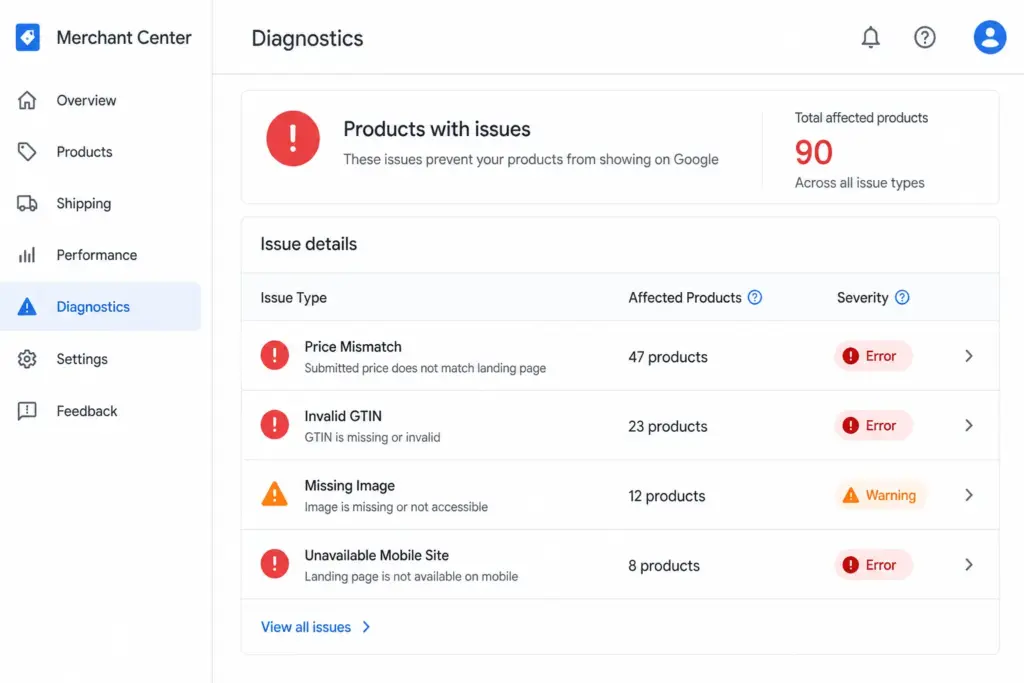
The Diagnostics tab shows:
Every active issue grouped by type
The number of products affected by each issue
The severity — Error (disapproved) vs Warning (limited performance)
A link to see exactly which products are affected
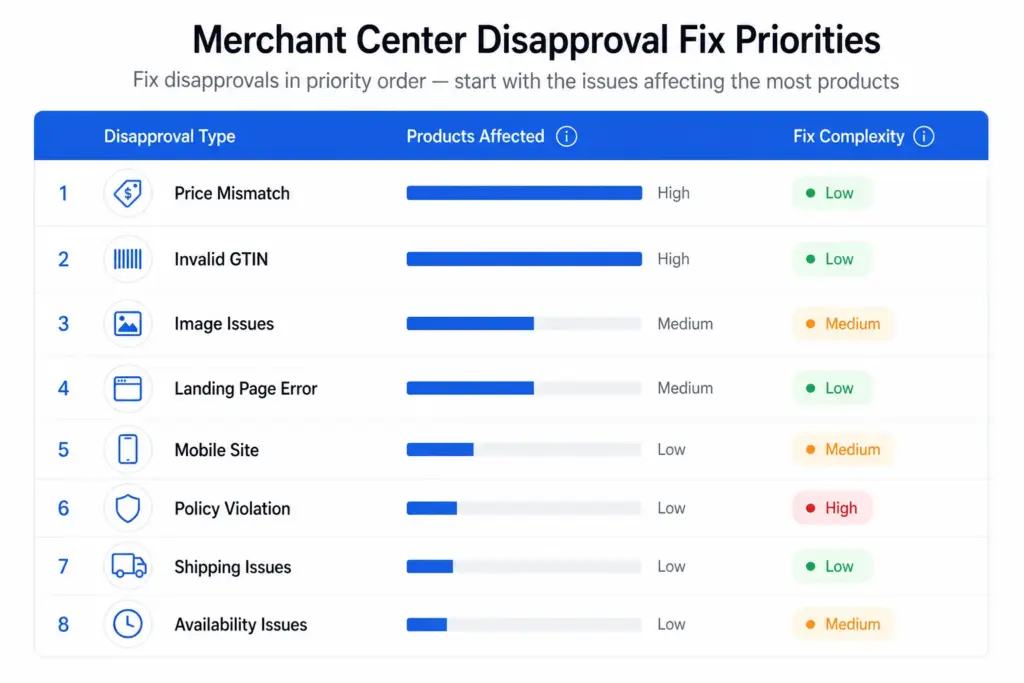
Fix errors first — these products are completely absent from Shopping. Warnings are second priority — these products appear but underperform. For a complete reference on feed attribute requirements before you fix, see the Google Shopping Feed Guide.
The 8 Most Common Disapproval Reasons and How to Fix Each
1. Price Mismatch
What it means: The price in your feed does not match the price on the product landing page. Google crawls your landing pages and compares them against your feed. Even a 1p discrepancy triggers a disapproval.
Common causes: Flash sales or promotions that updated the website price but not the feed. Manual feed updates that were delayed. Currency or tax display differences between feed and page.
Fix: Update your feed to match the current landing page price. Set your feed to fetch at least daily — twice daily during promotion periods. Use sale_price and sale_price_effective_date attributes for promotions rather than changing the price field.
2. Invalid or Missing GTIN
What it means: Your product has an invalid GTIN (wrong check digit, wrong length, test/placeholder value) or is missing a GTIN that should exist.
Fix: Validate all GTINs before submitting using the GTIN Validator. For custom or handmade products with no GTIN, set identifier_exists to FALSE — do not leave the GTIN field blank. Full GTIN requirements are covered in the GTIN compliance guide.
3. Image Not Meeting Requirements
What it means: Your product image is too small (below 100×100px for non-apparel, 250×250px for apparel), contains a watermark or promotional text, uses a placeholder image, or shows a white square instead of the product.
Fix: Replace with a clean product image — minimum 800×800px recommended. No overlays, no text, no borders. Image must show the actual product, not a lifestyle image for Shopping ads (lifestyle can be used as additional images via additional_image_link).
4. Landing Page Not Working
What it means: Google cannot crawl your landing page — it returns a 404, requires login, redirects to a different product, or loads incorrectly on mobile.
Fix: Verify the link URL in your feed returns a 200 status, loads correctly on mobile, and matches the specific product (not a category page or homepage). If the product has been deleted, remove it from your feed.
5. Unavailable Mobile Site
What it means: Google’s mobile crawler cannot access your landing page. Often caused by a separate mobile site (m.yoursite.com) returning errors, or a responsive site that breaks on mobile crawler user agent strings.
Fix: Test your landing page URLs using Google’s Mobile-Friendly Test. Ensure your server is not blocking Googlebot-Image or mobile crawler user agents. If you have a separate mobile domain, ensure it is live and returning 200s.
6. Mismatched Value (Price, Availability, Condition)
What it means: A feed attribute value does not match what Google finds on the landing page — most commonly availability (feed says “in stock”, page says “out of stock”) or condition (feed says “new”, page indicates “refurbished”).
Fix: Ensure availability updates in your feed match real-time stock status on your site. Set up automated feed updates triggered by stock changes rather than scheduled batch updates.
7. Prohibited or Restricted Content
What it means: Your product falls into a Google Shopping policy-restricted category — alcohol, pharmaceuticals, adult products, gambling products — without the required account-level policy compliance setup.
Fix: Review Google Merchant Center’s shopping policies for restricted verticals. Apply for restricted product programme access if eligible. Some categories are prohibited entirely and cannot be fixed.
8. Incorrect Tax or Shipping Setup
What it means: Your Merchant Center account does not have tax and shipping configured for the target country, or your shipping settings conflict with what is shown on the landing page.
Fix: Go to Merchant Center → Settings → Shipping and Tax. Configure shipping settings for every country you are targeting. Ensure stated delivery times match what is shown at checkout on your site.
How to Prevent Disapprovals Recurring
Daily feed updates minimum — price and availability changes must propagate to your feed within 24 hours
Validate GTINs before submission — run every GTIN through the GTIN Validator before uploading a new feed
Set up Merchant Center email alerts — Merchant Center can email you when feed processing errors occur. Turn this on under Settings → Notifications
Monitor Diagnostics weekly — new disapprovals can appear when Google re-crawls your landing pages and finds discrepancies
Use sale_price for promotions — never change your regular price field for a promotion. Use sale_price + sale_price_effective_date so the price reverts automatically
For teams managing large catalogs where feed errors appear regularly, the root cause is almost always data quality at the source — inconsistent pricing, stale stock status, or GTIN errors that need fixing in your product data before they reach the feed. The Feed Generator and LynkPIM free plan help you manage feed quality upstream before issues reach Merchant Center.
Frequently Asked Questions
How long does it take for Google to approve products after fixing a disapproval?
Data-related disapprovals (price mismatch, missing attributes) are typically resolved within 24–48 hours of submitting the corrected feed. Policy-related disapprovals that require a manual review request typically take 1–3 business days after submitting the review request in Merchant Center Diagnostics.
What is the difference between a disapproved product and a product with limited performance?
A disapproved product is not shown in Google Shopping at all — it has been rejected and will not appear in any auction. A product with limited performance is shown but with reduced visibility and auction eligibility, typically due to missing recommended attributes like GTIN or brand. Fix disapprovals first — they represent complete loss of visibility.
What is the most common reason products are disapproved in Merchant Center?
Price mismatch — where the price in the feed does not match the price on the landing page — is the most common data-related disapproval cause for most ecommerce stores. Invalid or missing GTINs are the second most common. Both are entirely preventable with daily feed updates and GTIN validation before submission.
Can I request a review after fixing a policy disapproval?
Yes. After fixing the issue that caused a policy disapproval, go to Products > Diagnostics in Merchant Center and use the Request Review button for the relevant issue. Google will review your account and products within 1–3 business days. Do not request review before fixing the underlying issue — repeated reviews without resolution can escalate the restriction.
Google Shopping Feed for Apparel: All Requirements Explained (2026)
Apparel is the most attribute-heavy category in Google Shopping. Miss a required field and your products either disapprove or lose out in auctions to competitors whose feeds are complete. This guide covers every attribute Google requires or strongly recommends for clothing, footwear, and accessories — with the exact values and format Google expects.
Why Apparel Feeds Are Different
Google’s feed requirements for apparel go beyond the standard required attributes that apply to all products. Clothing and shoes have mandatory variant attributes, specific size system declarations, and stricter image requirements. A feed that works fine for non-apparel will generate warnings and limited performance for clothing.
For a full foundation on how Shopping feeds work, the Google Shopping Feed Guide covers the base layer before you add apparel-specific requirements on top.
Required Attributes for All Apparel Products
Attribute
Required?
Notes
id
Yes
Unique per variant, not per style
title
Yes
Include colour, size, material in title
description
Yes
150+ characters recommended
link
Yes
Must land on the specific variant page
image_link
Yes
800×800px minimum, no overlays
price
Yes
Must match landing page exactly
availability
Yes
in stock / out of stock / preorder
google_product_category
Yes
Use specific leaf node, not parent category
brand
Yes
Required for all apparel
item_group_id
Required for variants
Same value for all variants of one style
color
Required for variants
Up to 3 values separated by /
size
Required for variants
One value per product
age_group
Required for variants
adult / kids / newborn / infant / toddler
gender
Required for variants
male / female / unisex
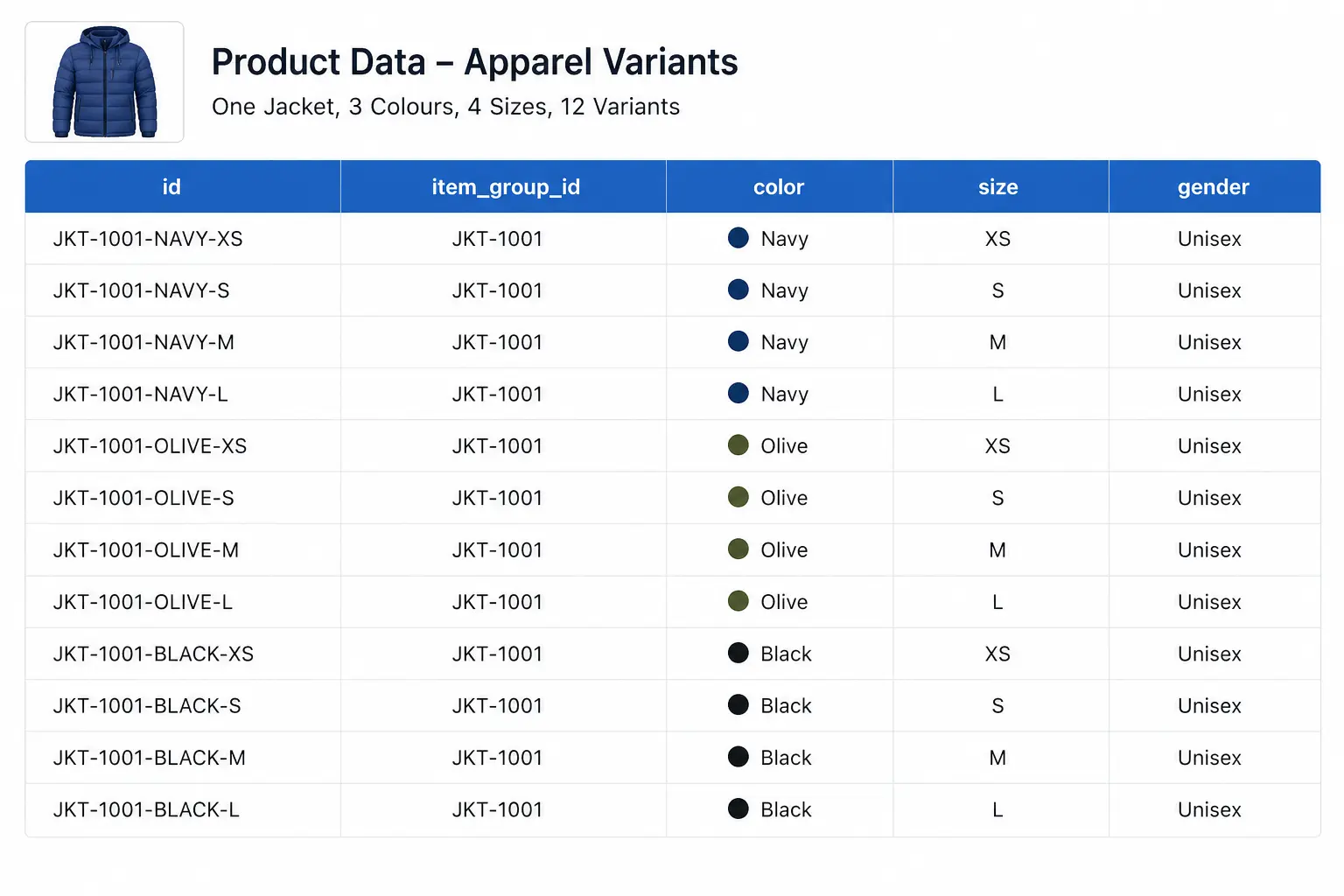
item_group_id — The Most Important Apparel Attribute
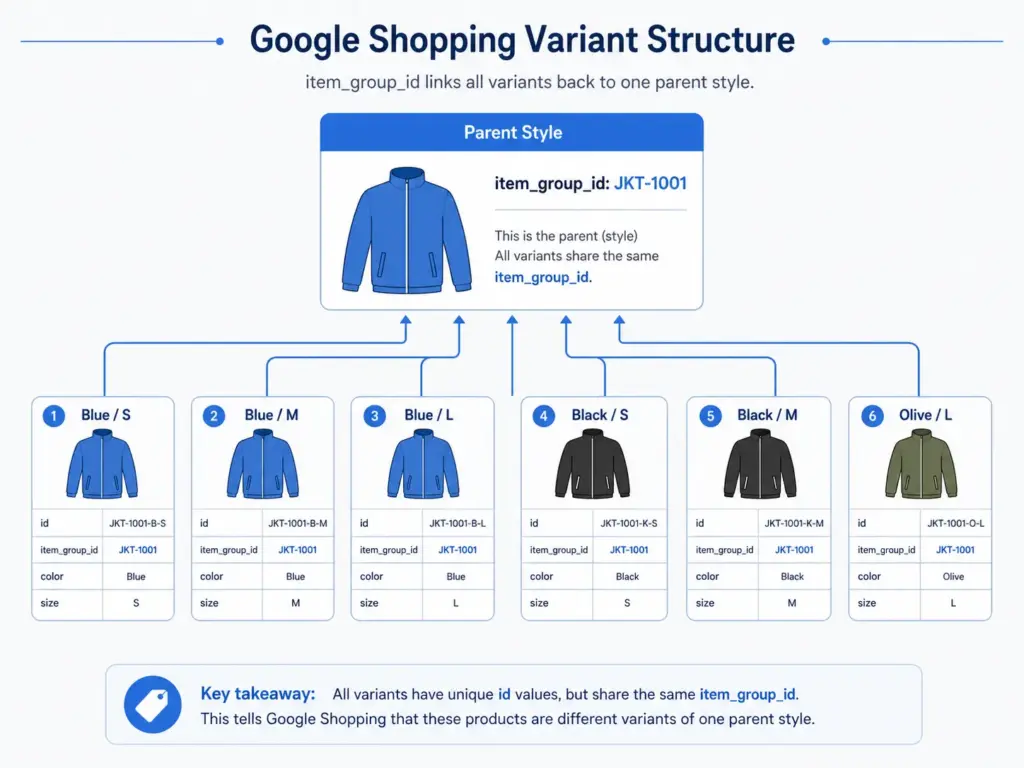
If you only fix one thing in your apparel feed, fix item_group_id. This attribute tells Google which products are variants of the same style. Without it, Google treats a navy size S jacket and a navy size L jacket as two completely unrelated products — and cannot display them as one listing with size options.
The rule: every size, colour, and material variant of the same product must share the same item_group_id value. The parent SKU is the natural choice — if your base product code is JK-2401, all variants carry JK-2401 in item_group_id regardless of their individual IDs.
For GTIN compliance per variant, see the GTIN requirements guide — each variant needs its own valid GTIN in apparel.
Colour Requirements
Colour values must be descriptive and human-readable. Google rejects values that are not recognisable colour names.
Acceptable: Navy, Coral, Charcoal, Slate Blue, Off White
Not acceptable: #003366, Color-4, 01, N/A
Multi-colour: Separate up to 3 values with a forward slash — Navy/White/Red
Maximum length: 100 characters per colour value
Size Requirements and Size Systems
Size values should reflect the labelled size on the product, not a numeric internal code. Use the size_system and size_type attributes to add context to your size values.
size_system
Declares which regional size standard you are using. Accepted values include: AU, BR, CN, DE, EU, FR, IT, JP, MEX, UK, US. This matters for international catalogs — a “10” in US women’s shoes is not the same as a “10” in UK shoes.
size_type
Describes the cut: regular, petite, plus, tall, big, maternity. Use this when your sizing differs from standard. It helps Google match your products to queries like “plus size summer dress”.
Image Requirements for Apparel
Apparel has stricter image rules than other categories because product appearance drives click decisions more directly.
Minimum 800×800px — 1000×1000px or larger recommended for Shopping ads
White or neutral background strongly preferred
No watermarks, promotional text, or overlays of any kind
The image must show the specific colour variant — do not use one image for all colour variants
Use additional_image_link (up to 10 images) — alternate angles, flat lay, and detail shots all improve CTR
Google Product Category for Apparel — Go Deep
Broad category values are one of the most common apparel feed mistakes. “Apparel & Accessories” as a category value is almost useless for relevance. Google’s taxonomy goes 5–7 levels deep for clothing and footwear — use the deepest applicable level.
Example: Columbia Women’s Waterproof Softshell Jacket Navy Size 12
For seasonal products, add the season before the product type: Columbia Women’s Summer Lightweight Running Jacket Coral Size 10
Before You Submit — Validate Your Feed
Apparel feeds have the highest disapproval rates of any Shopping category because of the variant attribute requirements. Before submitting, check:
Every variant has a valid GTIN — use the GTIN Validator to check in bulk
All variants of the same style share the same item_group_id
Colour values are human-readable, not codes or hex values
Size values are declared with size_system if selling internationally
Images are per-colour-variant, not one image reused for all variants
Managing apparel variant data at scale — especially across multiple channels — is where spreadsheet-based approaches break down. Learn how LynkPIM handles variant management without the manual overhead. For campaign performance after your feed is clean, see how to use custom labels for bid segmentation.
Frequently Asked Questions
Is GTIN required for all apparel products?
Yes, for products that have manufacturer-assigned GTINs. Custom or handmade products with no GTIN should set identifier_exists to FALSE in the feed — do not leave GTIN blank without this declaration or you will receive a Limited Performance warning.
Do I need separate products for each size and colour?
Yes. Each unique size/colour/material combination is a separate product in your feed with its own ID. They are linked back to the parent style via item_group_id.
Can I use the same image for different colour variants?
Technically Google will not always disapprove this, but it will hurt your CTR significantly and may trigger a mismatched colour warning. Use colour-specific images wherever possible.
Custom Labels in Google Shopping: How to Use Them for Bid Segmentation (2026 Guide)
Custom labels are one of the most underused levers in Google Shopping. While most advertisers compete on the same bids across their entire catalog, smart merchants use custom labels to segment by margin, seasonality, and performance — bidding high only where it pays off.
This guide covers exactly how to set up custom labels, which segmentation strategies deliver the most impact, and how to manage them efficiently when your catalog changes.
What Are Custom Labels in Google Shopping?
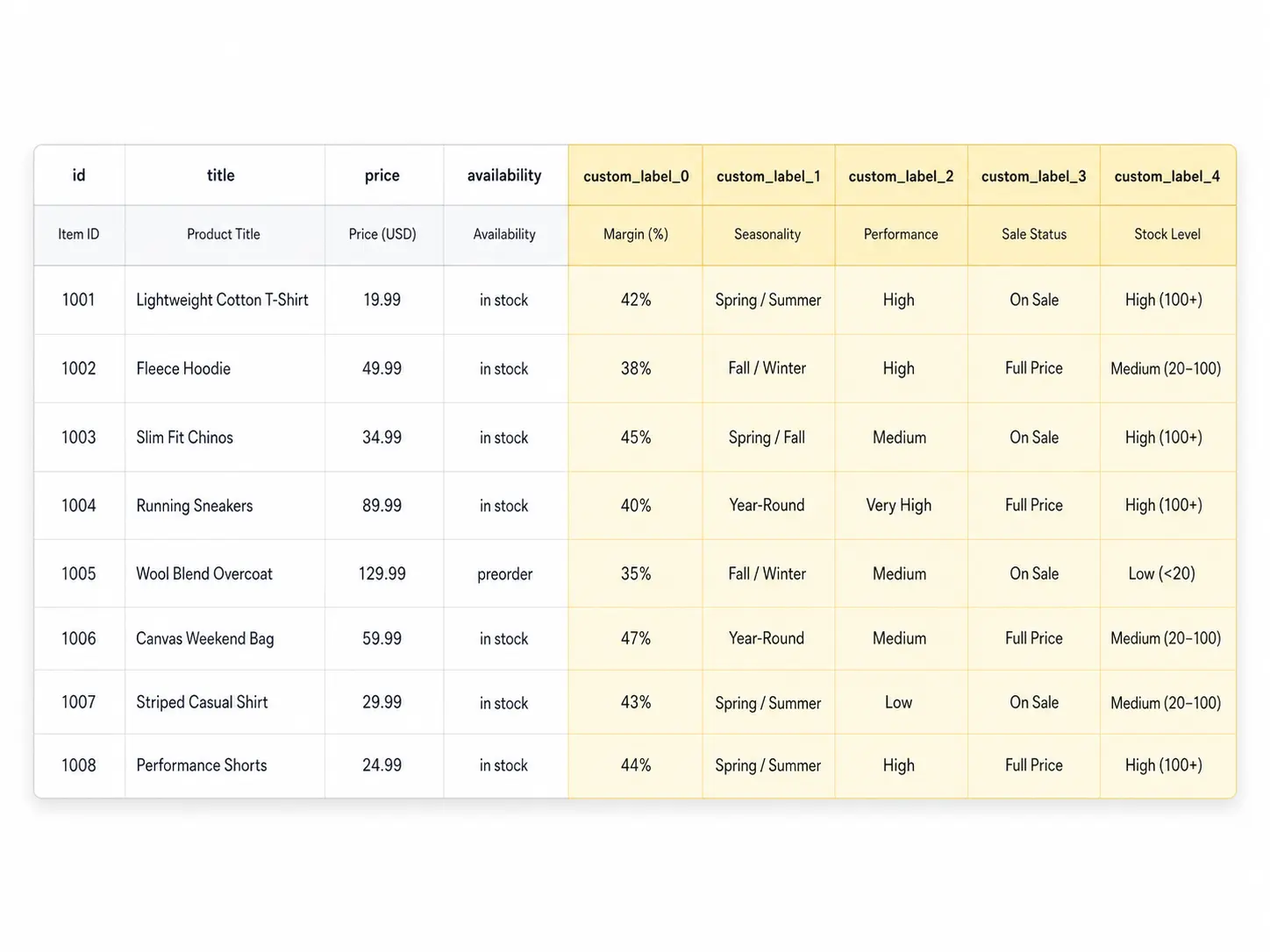
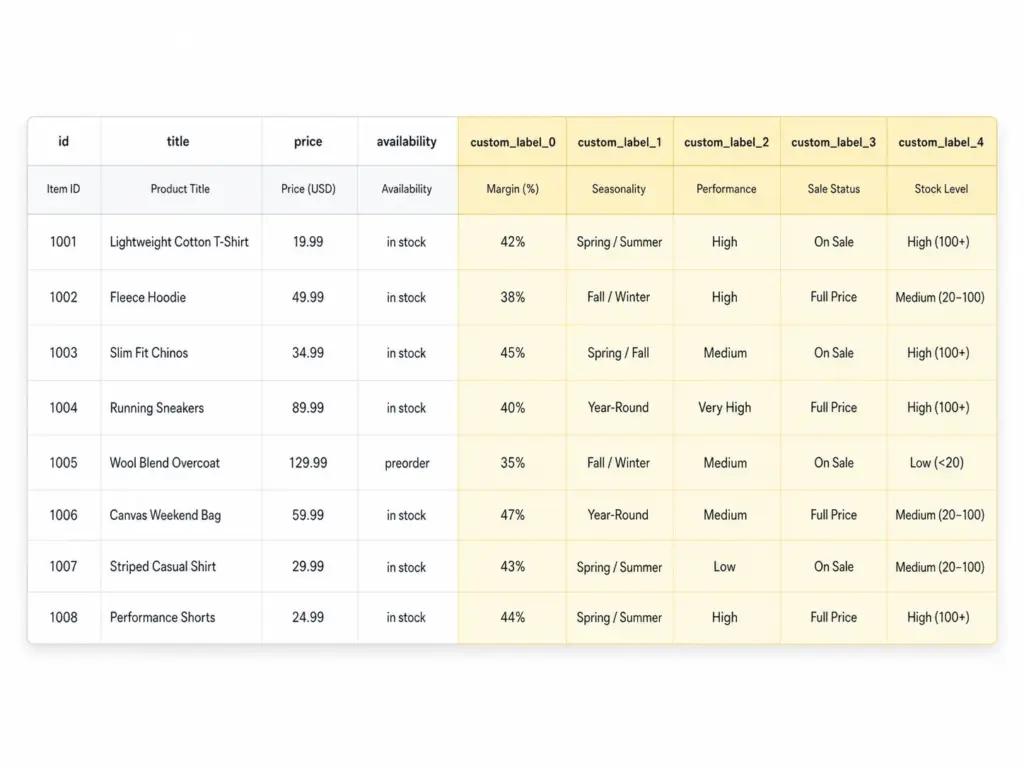
Custom labels (custom_label_0 through custom_label_4) are five optional attributes in your Google Shopping feed that you define yourself. Google does not use them for matching or relevance — they exist purely for your campaign segmentation inside Google Ads.
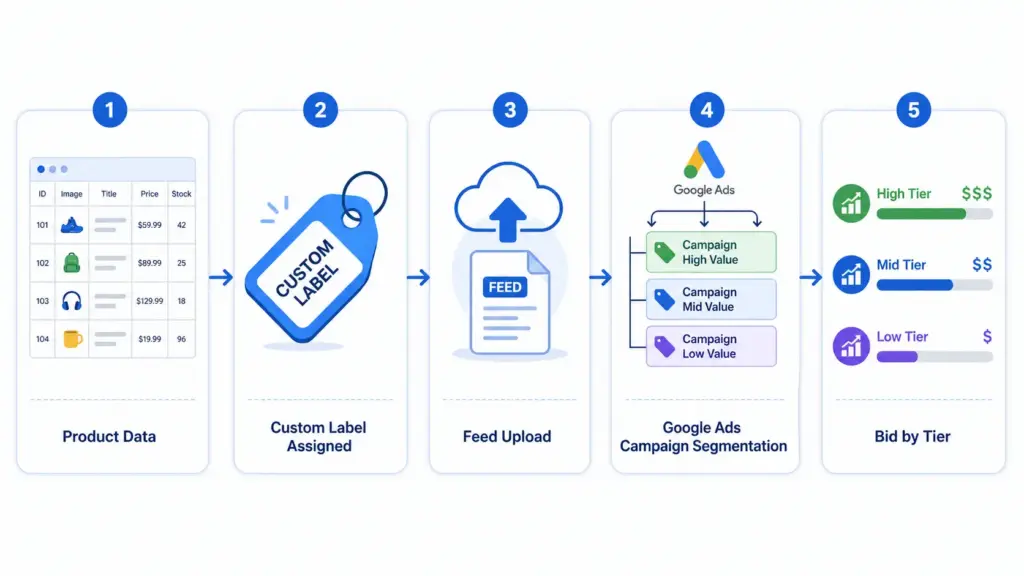
Each label accepts a free-text value up to 100 characters. You assign values in your product feed, then use those values to create product groups inside your Shopping campaigns and set different bids per group. Learn how labels fit into the broader feed structure in the Google Shopping Feed Guide.
The 5 Custom Labels and How to Use Each One
Label
Recommended Use
Example Values
custom_label_0
Margin tier
high-margin, mid-margin, low-margin
custom_label_1
Seasonality
evergreen, summer-2026, clearance
custom_label_2
Performance bucket
top-performer, new-product, slow-mover
custom_label_3
Sale / promotion status
on-sale, full-price, bundle
custom_label_4
Stock level
in-stock, low-stock, backorder
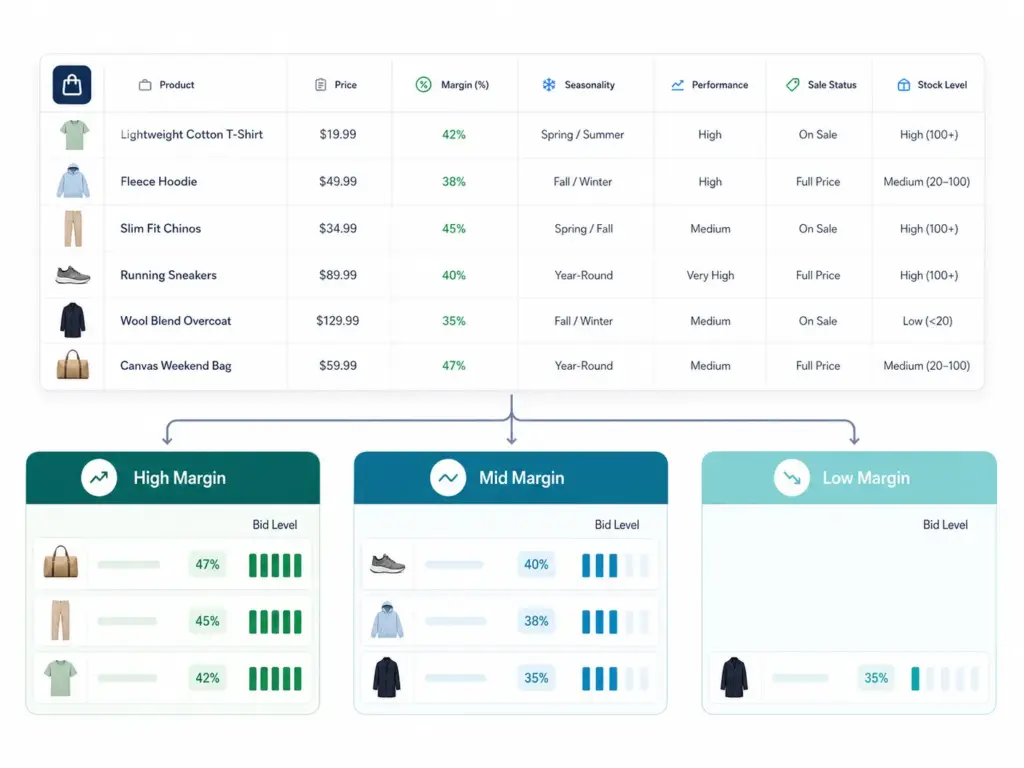
You do not need to use all five. Start with margin (custom_label_0) — it produces the highest ROI impact immediately because it stops you spending high bids on products where the margin does not support it.
Strategy 1: Bid Segmentation by Margin
This is the most valuable custom label strategy for most ecommerce businesses. The idea is simple: assign every product a margin tier, then bid proportionally to that margin.
How to implement it
Calculate gross margin % for each SKU (or product group)
Define three to four tiers: for example, high (>50%), mid (25–50%), low (<25%)
Assign the appropriate custom_label_0 value in your feed for every product
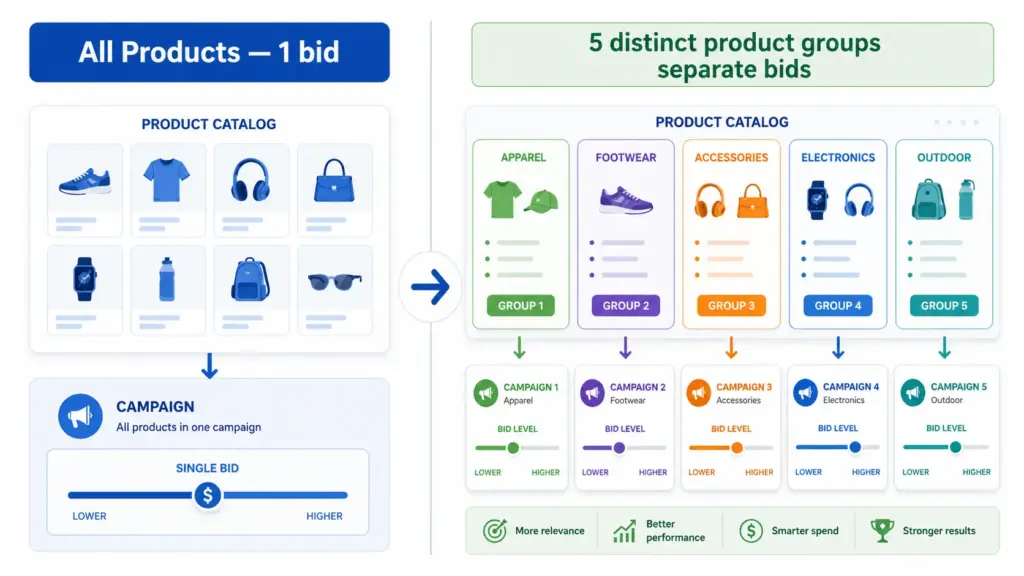
In Google Ads, create separate product groups for each margin tier
Set target ROAS or manual CPC bids proportionally — high-margin products get 2–3× the bid of low-margin ones
If you manage your feed through a PIM or feed tool, add a calculated column that assigns the label value based on a margin formula. This keeps labels current as costs change without manual intervention.
Strategy 2: Seasonality Labels
Seasonality labels let you ramp bids up on products entering peak demand and pull them back on products going off-season — without touching your campaign architecture.
evergreen — products with consistent year-round demand. Steady bids.
new-product — less than 30 days data. Moderate bid until you have enough signal.
slow-mover — impressions but no conversions after 30+ days. Investigate before committing budget.
suppress — products you want to exclude from Shopping entirely. Set bid to £0.01.
Review and update performance labels monthly. A new-product that converts well should graduate to top-performer within 30–45 days.
How to Add Custom Labels to Your Feed
Option A: Directly in your product feed file
Add columns named custom_label_0, custom_label_1 etc. to your feed spreadsheet or data source. Assign values per row. Upload the updated feed to Google Merchant Center.
Option B: Using a supplemental feed
If you cannot modify your primary feed directly, use a supplemental feed containing just the ID column and your custom label columns. Merchant Center merges supplemental data onto matching product IDs. This is useful when your primary feed is managed by a platform you do not control directly.
Option C: Rules in Merchant Center
Under Products → Feeds → Feed Rules in Google Merchant Center, you can set conditional rules that assign custom label values based on other attributes — for example, assigning "clearance" to all products with a sale_price more than 30% below regular price. No feed editing required.
For apparel catalogs with multiple variants, reviewing how apparel-specific feed attributes interact with your labels is worthwhile before setting up segmentation.
Common Custom Label Mistakes
Using custom labels for relevance signals — Google ignores label values for matching. They are campaign management tools only.
Inconsistent values — "High Margin", "high-margin", and "HIGH MARGIN" are three different values in Google Ads. Pick a format and stick to it.
Forgetting to update labels when conditions change — A clearance product that returns to full price still carries the clearance label and its low bid.
Setting up labels but not creating separate product groups — Labels do nothing if all products sit in the same "All Products" group with one bid.
What to Do Next
Start with one label. Margin is the highest-impact first label for most stores. Assign high / mid / low to every product, create three product groups, and set bids proportionally. Run for 30 days and compare ROAS by tier.
Before setting up labels, run your feed through the GTIN Validator to confirm your product identifiers are clean — label segmentation on a feed with GTIN errors will still underperform at any bid level.
For teams managing large catalogs across multiple channels, maintaining custom label logic inside a PIM means labels update automatically when product data changes rather than requiring manual feed edits every time margins or seasons shift. Try the Google Shopping Feed Generator or explore the LynkPIM free plan to manage this at scale.
Frequently Asked Questions
What are custom labels in Google Shopping?
Custom labels (custom_label_0 through custom_label_4) are five optional feed attributes you define yourself. Google uses them purely for campaign segmentation in Google Ads — not for product matching or relevance. Each accepts a free-text value up to 100 characters.
How many custom labels can you use in Google Shopping?
You can use up to five custom labels per product. You do not need to use all five — start with one, typically margin tier (custom_label_0), and expand once that segmentation is delivering clear ROAS differences between groups.
Do custom labels affect Google Shopping relevance or matching?
No. Custom labels are invisible to Google's matching algorithm. Relevance is determined by your title, description, and google_product_category. Labels exist solely for you to create separate bid groups — they have zero influence on which queries your products appear for.
What is the best first custom label to set up?
Margin tier (custom_label_0) produces the fastest ROI impact for most stores. Assign high, mid, and low values to every product, create three product groups in Google Ads, and set bids proportionally. Run for 30 days and compare ROAS by tier before adding further labels.
Can I add custom labels without editing my main product feed?
Yes. Use a supplemental feed containing just the product ID and custom label columns, or set up Feed Rules in Google Merchant Center to assign label values conditionally based on existing attributes — for example, assigning "clearance" to all products where sale price is more than 30% below regular price. No primary feed editing required.
How to Create a Google Shopping Product Feed: The Complete 2026 Guide
Google Shopping is not keyword-driven. You do not write ads and bid on search terms the way you do in Google Search. Instead, Google reads your product feed — a structured file containing your product data — and decides when, where, and how to show your products based on what is in it. Which means the quality of your product feed is not a technical detail. It is your campaign strategy.
A well-built Google Shopping product feed gets your products into the right auctions with the right information. A poorly built one gets you suppressed listings, low impression share, wasted ad spend, and a Merchant Center full of warnings you are not sure how to fix.
This guide covers everything: what a Google Shopping feed is, every required and high-impact optional attribute for 2026, how to structure your feed, the most common errors and how to fix them, and how to generate a feed without doing it manually. If you want to skip straight to generating one, the Google Shopping Feed Generator builds a properly structured feed from your product data without any technical setup.
Your product feed is what Google reads to decide how to show your products. The quality of that data directly determines your Shopping performance.
What is a Google Shopping product feed?
A Google Shopping product feed is a structured file — typically XML or a Google Sheets spreadsheet — that contains all the product information Google needs to display your products in Shopping results, Shopping ads, and free product listings. You submit this file to Google Merchant Center, which processes it, validates each product against Google’s product data specification, and makes approved products eligible to appear across Google Shopping surfaces.
The feed is essentially a translation layer between your internal product catalog and Google’s product knowledge system. Google uses the attributes in your feed — title, description, price, GTIN, category, images — to understand what you are selling, match it to relevant search queries, and place it in the right Shopping auctions at the right price points.
This is why product feed quality has such a direct and measurable impact on Shopping performance. Google cannot guess what is missing from your feed. If your title is vague, your category is too broad, or your GTIN is invalid, Google works with less information — and less information means worse matching, lower impression share, and higher cost per click.
Google Shopping feed: required attributes for 2026
Google’s product data specification defines which attributes are required for every product, which are required for specific categories, and which are optional but recommended. Here is the complete picture for 2026.
Getting every required field right is the baseline. High-impact optional fields are where you gain competitive advantage over feeds that only meet the minimum.
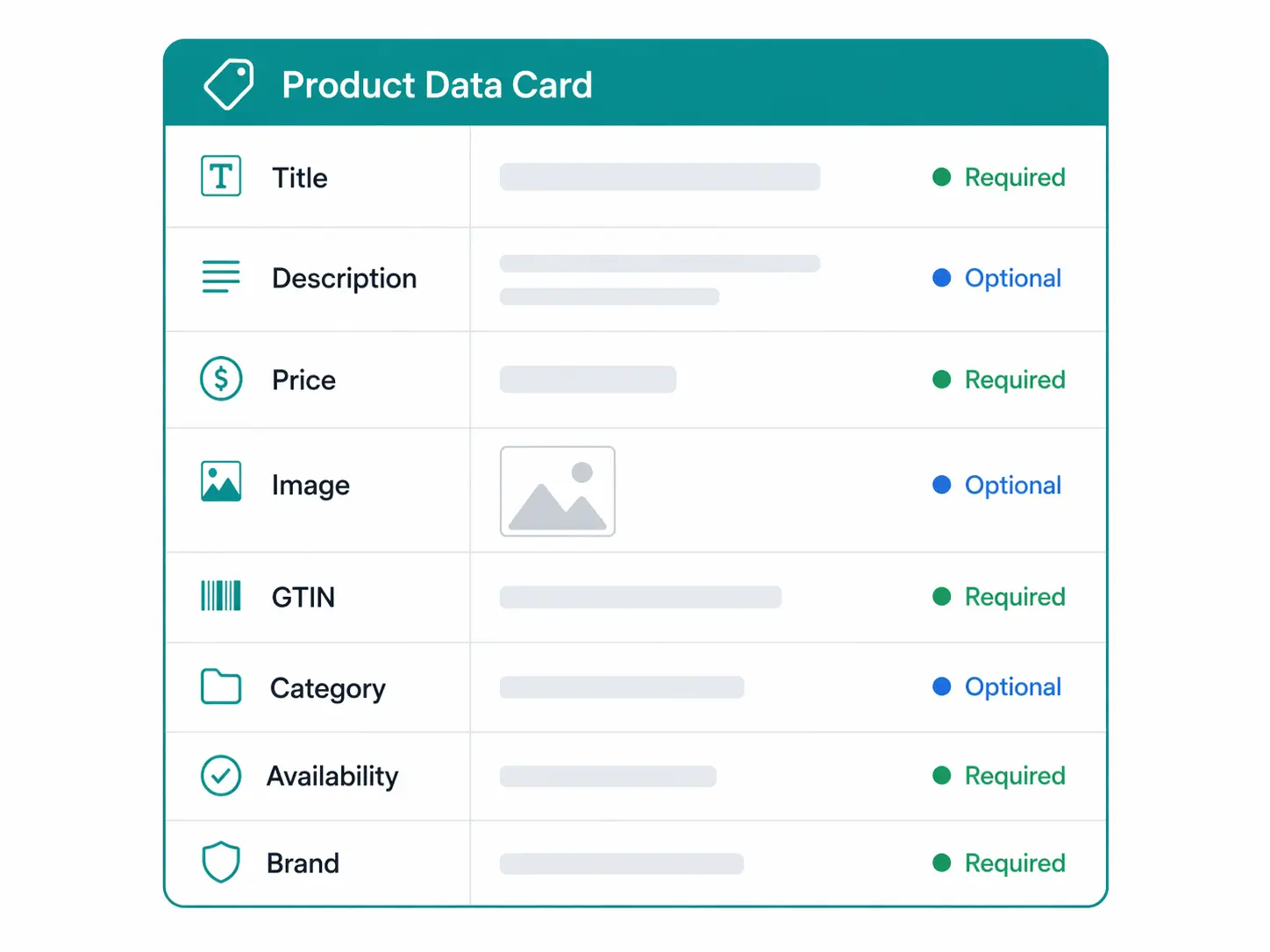
Required for all products
Attribute
Feed name
What Google needs
ID
id
Your unique internal product identifier. Must be consistent across feed updates — changing IDs causes products to be treated as new listings.
Title
title
The product name as it will appear in Shopping results. Max 150 characters. Most important single attribute for matching to search queries.
Description
description
Product description. Max 5,000 characters. Used for query matching but not displayed in Shopping ads — still critical for relevance scoring.
Link
link
The full URL of the product page. Must match the domain verified in Merchant Center.
Image link
image_link
URL of the main product image. Minimum 100×100px, recommended 800×800px or larger. No watermarks, no promotional text overlaid.
Availability
availability
One of: in_stock, out_of_stock, preorder, backorder. Must match the availability shown on your product page.
Price
price
The price in your local currency including currency code. Must match the price on the landing page. Format: 24.99 GBP
Brand
brand
The product brand or manufacturer name. Required for most product types. Do not use your store name as the brand unless you are the manufacturer.
Condition
condition
One of: new, refurbished, used.
Required for most products (strongly recommended for all)
Attribute
Feed name
Notes
GTIN
gtin
Required for all products with a manufacturer-assigned GTIN. Without it, products receive “Limited performance” warnings. See the GTIN compliance guide for validation.
MPN
mpn
Manufacturer Part Number. Required if no GTIN exists. Helps Google identify the product through alternative matching.
Google product category
google_product_category
Google’s own taxonomy category ID. Not strictly required but strongly recommended — without it Google auto-assigns a category which is often too broad.
Identifier exists
identifier_exists
Set to false only for products that genuinely have no GTIN or MPN. Never use as a workaround for products that do have identifiers.
Required for specific categories
Attribute
Required for
size
Apparel & Accessories
color
Apparel & Accessories
gender
Apparel & Accessories
age_group
Apparel & Accessories
item_group_id
Any product with variants — links all variants of a product together
energy_efficiency_class
Applicable appliances sold in EU markets
High-impact optional attributes (worth adding for every product)
These are not required but consistently improve Shopping performance when included. Treat them as required for any product where they apply:
additional_image_link — Up to 10 additional product images. Listings with multiple images consistently outperform single-image listings in Shopping.
sale_price — If you run promotions, the sale price field shows a strikethrough price in Shopping results which significantly improves click-through rate.
shipping — Declared shipping costs are shown directly in Shopping results. Missing shipping information can cause your listing to appear with an estimated shipping cost that may be higher than your actual rate.
product_type — Your own internal category path for the product. Useful for campaign segmentation in Google Ads — lets you structure bids by your own category structure rather than Google’s taxonomy alone.
custom_label_0 through custom_label_4 — Five free-form fields you define. Commonly used to flag margin tier, season, bestseller status, or clearance — information you can then use to adjust bids in Google Ads.
material, pattern, size_type, size_system — All improve matching accuracy for apparel and help Google serve your product to more relevant queries.
How to write high-performing feed titles
Your product title is the most important single field in your feed for Shopping performance. Google uses it as the primary signal for query matching, and it is what shoppers read when deciding whether to click your listing. A weak title is the most common reason a well-stocked feed underperforms.
The formula that consistently works for Shopping feed titles is: Brand + Key attribute(s) + Product type + Differentiating detail
Key rules: put the most important attributes first — Google truncates titles in display so the first 70 characters matter most. Include the specific product type that matches how people search (“Waterproof Rain Jacket” not just “Jacket”). Include variant-specific details (colour, size, material) in the title for variant products — this is what differentiates your listing from competing variants of the same product in the same auction.
What to avoid: promotional language (“Best Price,” “Free Shipping,” “Sale”), all-caps, excessive punctuation, and keyword stuffing. Google’s title quality filters actively penalise these patterns and may suppress listings that use them.
Google product category: how to get it right in 2026
The google_product_category attribute maps your product to Google’s own taxonomy — a hierarchical classification system with over 6,000 categories. Google updated this taxonomy significantly in January 2026, adding four new top-level categories (Smart Home & IoT, Electric Vehicles & Accessories, Sustainable Products, and AI & Robotics) and expanding Electronics and Health substantially. The compliance deadline for affected products is July 31, 2026.
You can submit either the category ID number or the full text path — both are accepted. The text path is easier to read and audit:
The key principle: always map to the most specific applicable category, not the nearest parent. A product mapped to “Apparel & Accessories” is vastly less useful to Google than one mapped to “Apparel & Accessories > Clothing > Activewear > Running Jackets.” Specificity improves relevance matching, reduces the cost of impressions that go nowhere, and is one of the factors Google’s Shopping algorithm uses to determine bid eligibility in competitive categories.
For the full picture on category mapping — including how to build your internal category structure and map it to Google’s taxonomy — the category mapping guide covers the complete approach.
Feed structure: XML vs Google Sheets vs API
Google Merchant Center accepts product feeds in three formats. Which one is right for you depends on your catalog size, how often your data changes, and your technical setup.
XML feed (recommended for most)
An XML feed is a structured file that follows the RSS 2.0 format with Google’s custom namespace. It is the most flexible format, works for any catalog size, and supports all attributes. You host the file at a URL that Merchant Center fetches on a schedule — daily is recommended for most catalogs, more frequently if your prices or availability change regularly.
A minimal valid XML feed entry looks like this:
<?xml version="1.0" encoding="UTF-8"?>
<rss version="2.0" xmlns:g="http://base.google.com/ns/1.0">
<channel>
<title>Your Store Name</title>
<link>https://yourstore.com</link>
<description>Product feed for Google Shopping</description>
<item>
<g:id>SKU-1234</g:id>
<g:title>Columbia Men's Watertight II Waterproof Rain Jacket — Navy, L</g:title>
<g:description>Lightweight packable rain jacket with seam-sealed construction...</g:description>
<g:link>https://yourstore.com/products/columbia-watertight-navy-l</g:link>
<g:image_link>https://yourstore.com/images/columbia-watertight-navy-l.jpg</g:image_link>
<g:availability>in_stock</g:availability>
<g:price>89.99 GBP</g:price>
<g:brand>Columbia</g:brand>
<g:gtin>0123456789012</g:gtin>
<g:condition>new</g:condition>
<g:google_product_category>Apparel & Accessories > Clothing > Outerwear > Coats & Jackets</g:google_product_category>
<g:color>Navy</g:color>
<g:size>L</g:size>
<g:gender>male</g:gender>
<g:age_group>adult</g:age_group>
<g:item_group_id>columbia-watertight-ii</g:item_group_id>
</item>
</channel>
</rss>
Google Sheets feed
A Google Sheets feed is a spreadsheet with one column per attribute and one row per product. It is the quickest format to get started with and requires no technical setup. Google fetches the sheet directly from your Google Drive on a schedule. The main limitation is scale — Sheets feeds become slow and difficult to maintain beyond a few thousand products. They are a good starting point for small catalogs or for testing a new feed structure before moving to XML.
Content API (for developers)
The Google Content API for Shopping allows you to push individual product updates programmatically rather than uploading a full feed file. This is the right approach if you have a large catalog with frequent price or availability changes, or if you are building a PIM-to-Merchant Center integration. API updates are near-real-time, which matters for any product where price or availability changes frequently throughout the day.
Feed generators — the practical middle ground
For most ecommerce teams, writing and maintaining an XML feed manually is not realistic. The practical approach is a feed generator — a tool that takes your product data and outputs a properly structured, compliant feed automatically. The Google Shopping Feed Generator does this without requiring any coding — you provide your product data and it builds the feed in the correct format, validates the required attributes, and outputs a file ready for Merchant Center submission.
How to submit your feed to Google Merchant Center
Once your feed is built, submitting it to Merchant Center is a straightforward process:
Create a Merchant Center account at merchants.google.com if you do not have one. Verify and claim your website domain during setup.
Add your feed — go to Products → Feeds → Add feed. Choose your country of sale and language, then select your feed type (scheduled fetch for XML, Google Sheets, or manual upload).
Configure fetch schedule — for XML feeds, enter the URL where your feed is hosted and set a daily fetch schedule. Google will check for updates at this URL automatically.
Wait for processing — new feeds typically take 24–72 hours to process. During this time products show a “Pending” status. Data quality checks run during processing and may flag errors.
Review Diagnostics — once processing is complete, go to Products → Diagnostics to see any errors, warnings, or item-level issues. Errors prevent products from being shown. Warnings do not block products but hurt performance. Address both.
Link to Google Ads — to run Shopping campaigns, link your Merchant Center account to your Google Ads account via the account linking section. Without this link, your products appear only in free Shopping listings, not in paid Shopping ads.
The most common Google Shopping feed errors — and how to fix them
Google Merchant Center’s Diagnostics tab shows you exactly which products are affected and why. Errors block products from appearing. Warnings reduce performance without blocking.
Missing or invalid GTIN
The single most commercially damaging feed error. Products with missing or invalid GTINs receive “Limited performance” warnings and are at a disadvantage in Shopping auctions. Fix: validate all GTINs before feed submission using the GTIN Validator, set identifier_exists = false for products that genuinely have no GTIN, and never submit placeholder or fabricated GTINs. The full guide to GTIN compliance for ecommerce covers every error type and fix.
Price mismatch between feed and landing page
Google crawls your product pages and compares the price in your feed against the price shown to customers. If they do not match — even temporarily during a sale that has not been updated in the feed — Google disapproves the product. Fix: update your feed whenever prices change, use the sale_price and sale_price_effective_date attributes for promotions rather than changing the base price field, and increase your feed fetch frequency if your prices change regularly.
Image quality issues
Images that are too small (under 100×100px for non-apparel, under 250×250px for apparel), contain promotional overlays, have watermarks, use placeholder images, or are not accessible from the URL in the feed will be rejected. Fix: use images of at least 800×800px, ensure they are hosted at a publicly accessible URL, and never use images with text, badges, or promotional overlays as your primary image.
Availability mismatch
Your feed says “in_stock” but your landing page shows the product as out of stock, or vice versa. Google crawls pages and flags mismatches. Fix: ensure your feed reflects real-time availability. For most platforms this means connecting your feed to your live inventory system rather than generating a static file. If you are managing feed updates manually, increase update frequency and build an out-of-stock alert into your process.
Promotional text in titles or descriptions
Phrases like “Free Shipping,” “Best Price,” “On Sale,” “Limited Time,” or “Buy Now” in product titles or descriptions violate Google’s editorial policy and will cause products to be disapproved. Fix: remove all promotional language from titles and descriptions. Use the promotion_id attribute and Google Merchant Promotions to communicate promotional offers — this is the correct channel for that information.
Missing required attributes for category
Apparel products without colour, size, gender, and age group. Products with variants missing item_group_id. These are category-specific requirements that products fail silently if the attributes are not included. Fix: audit which Google product categories your products map to and ensure all category-specific required attributes are populated. The Completeness Checker shows you where required fields are missing across your catalog.
Feed optimisation: what moves performance after you fix errors
Once your feed is error-free and all required attributes are populated, these are the optimisations that consistently move Shopping performance:
Title optimisation
Test different title structures for your top product categories. The Brand + Attribute + Type + Detail formula is a starting point, not a fixed rule. Some categories perform better with the product type first. Use Search Terms reports in Google Ads to find which queries are actually triggering your Shopping ads, then ensure those terms appear in your titles.
Custom labels for bid segmentation
Use the five custom label fields to classify products by margin, seasonality, or performance tier. Then in Google Ads, create separate ad groups for each label and set different bids based on the commercial value of each segment. This is one of the most impactful feed-level optimisations available — it lets you bid more aggressively on high-margin products and more conservatively on low-margin ones, using the same campaign structure.
Additional images
Products with multiple images — lifestyle shots, multiple angles, detail close-ups — consistently outperform single-image listings in Shopping. Use the additional_image_link attribute to add up to 10 images per product. Google uses these in different Shopping surfaces and in the product knowledge panel.
Feed freshness
Google favours feeds that are updated regularly. Daily fetch schedules are the minimum for most catalogs. If your inventory turns over quickly or you run frequent price promotions, twice-daily or real-time API updates will prevent the price and availability mismatches that suppress products at the worst possible moments — like when a competitor goes out of stock and you should be capturing that traffic.
For the underlying data quality that makes all of this possible — clean attributes, consistent values, valid GTINs, complete required fields — the PIM data quality guide covers the full framework. And if you want to understand whether your product data infrastructure is set up to maintain feed quality at scale, the PIM Readiness Assessment takes five minutes and shows you exactly where the gaps are.
☐ GTINs validated — no missing, invalid, or placeholder values
☐ identifier_exists = false set for products without GTINs
☐ google_product_category mapped to the most specific applicable category
☐ Google product categories updated for January 2026 taxonomy changes (deadline July 31, 2026)
☐ Apparel products include color, size, gender, age_group
☐ All variant products include item_group_id
☐ Product titles follow Brand + Attribute + Type + Detail format, no promotional text
☐ Images are minimum 800×800px, no watermarks, no overlay text
☐ Feed prices match prices on landing pages
☐ Feed availability matches real-time inventory
☐ Feed fetch schedule is set to daily minimum
☐ Google Merchant Center Diagnostics shows zero errors
☐ Custom labels configured for bid segmentation by margin or category
☐ Merchant Center linked to Google Ads account
Frequently asked questions
What is a Google Shopping product feed?
A Google Shopping product feed is a structured file — typically XML or a spreadsheet — that contains your product data in the format Google Merchant Center requires. It includes attributes like title, price, availability, images, GTIN, and product category. Google reads this file to understand what you sell and determines when to show your products in Shopping results and Shopping ads.
What format does a Google Shopping feed need to be in?
Google Merchant Center accepts XML (the recommended format for most catalogs), Google Sheets, plain text with tab-delimited values, and programmatic submission via the Content API for Shopping. XML is the most widely used format and supports all attributes. Google Sheets is the simplest option for small catalogs. The Content API is for high-frequency updates or large-scale integrations.
How often should I update my Google Shopping feed?
Daily is the minimum recommended update frequency for most catalogs. If your prices or availability change intraday — during flash sales, for example, or if you have a high-volume catalog where items sell out frequently — you should update more frequently or use the Content API for near-real-time updates. Google products expire after 30 days if not refreshed, and price or availability mismatches between your feed and landing pages will cause products to be disapproved.
Why are my Google Shopping products disapproved?
The most common reasons for product disapproval in Merchant Center are: price mismatch between feed and landing page, missing or invalid GTIN, image quality issues (too small, watermarked, or inaccessible URL), promotional text in titles or descriptions, and missing required attributes for the product’s category (such as color and size for apparel). Check the Diagnostics tab in Merchant Center for the specific reason — it lists the failing attribute and the affected products for each error type.
Do I need a GTIN for every product in my Google Shopping feed?
Yes, for any product that has a manufacturer-assigned GTIN. Products without a valid GTIN receive a “Limited performance due to missing value [GTIN]” warning and are at a disadvantage in Shopping auctions. For products that genuinely do not have a GTIN — custom goods, handmade items, private label products without GS1 registration — set identifier_exists = false. Never submit a fabricated GTIN. The GTIN Validator checks your existing GTINs against GS1 standards before you submit.
What is the item_group_id attribute and when do I need it?
The item_group_id attribute groups product variants — different sizes, colours, or other defining attributes of the same base product — together in Google’s system. All variants of the same product should share the same item_group_id. Without it, Google treats each variant as an entirely separate product and cannot display them as a single listing with variant options. This is required for any product that has multiple variants.
How do I create a Google Shopping feed without coding?
The simplest approach for most ecommerce teams is a feed generator tool. The Google Shopping Feed Generator builds a properly structured, compliant feed from your product data without any technical setup — you provide your product information and it outputs a file ready for Merchant Center submission. For teams managing product data in a PIM, feed generation is typically handled automatically as part of the channel syndication workflow.