Author: Binu Mathew

  • PIM Implementation Guide: Timeline, Steps & What to Prepare (2026)

    PIM Implementation Guide: Timeline, Steps & What to Prepare (2026)

    PIM Implementation Guide: Timeline, Steps, and What to Prepare in 2026

    Most PIM implementations that go wrong do not fail because of the software. They fail because the team started the project without cleaning the data first, without defining the taxonomy before importing products, or without a clear picture of which channels needed to be live by which date. The software then gets blamed for problems that were already in the catalog before go-live.

    This guide gives you the honest version of what a PIM implementation actually involves — the preparation work that most vendors underemphasise, a realistic timeline for different catalog sizes, the six steps in the right order, and the most common mistakes that turn a four-week project into a four-month one. If you are not yet sure whether you need a PIM at all, the guide to PIM for small and mid-size stores covers that question first.
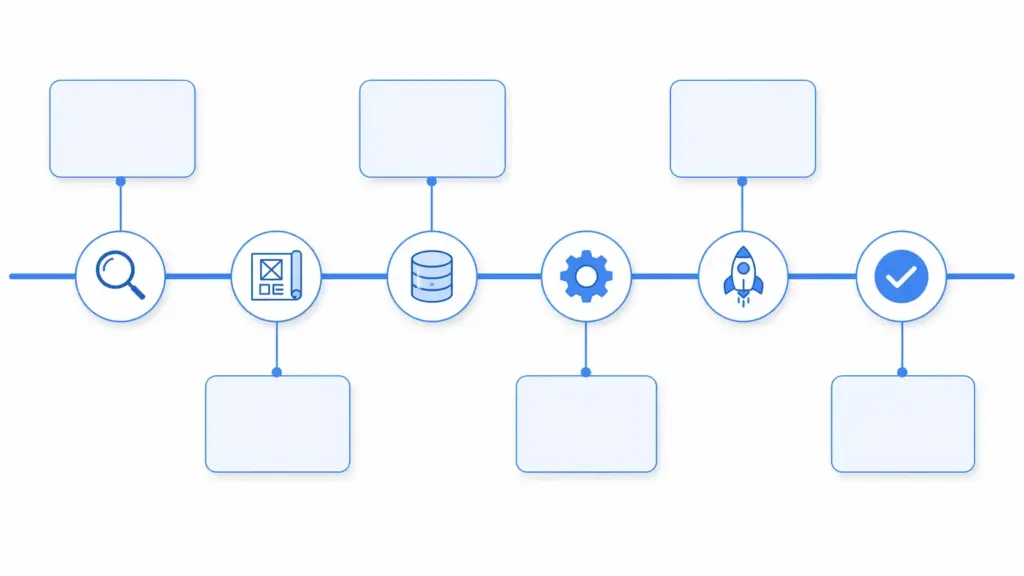
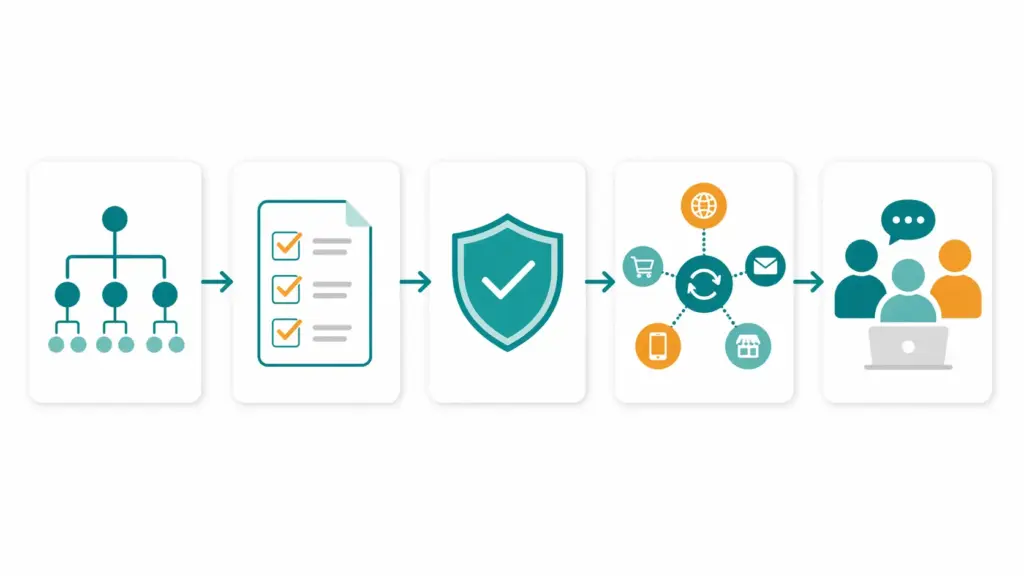
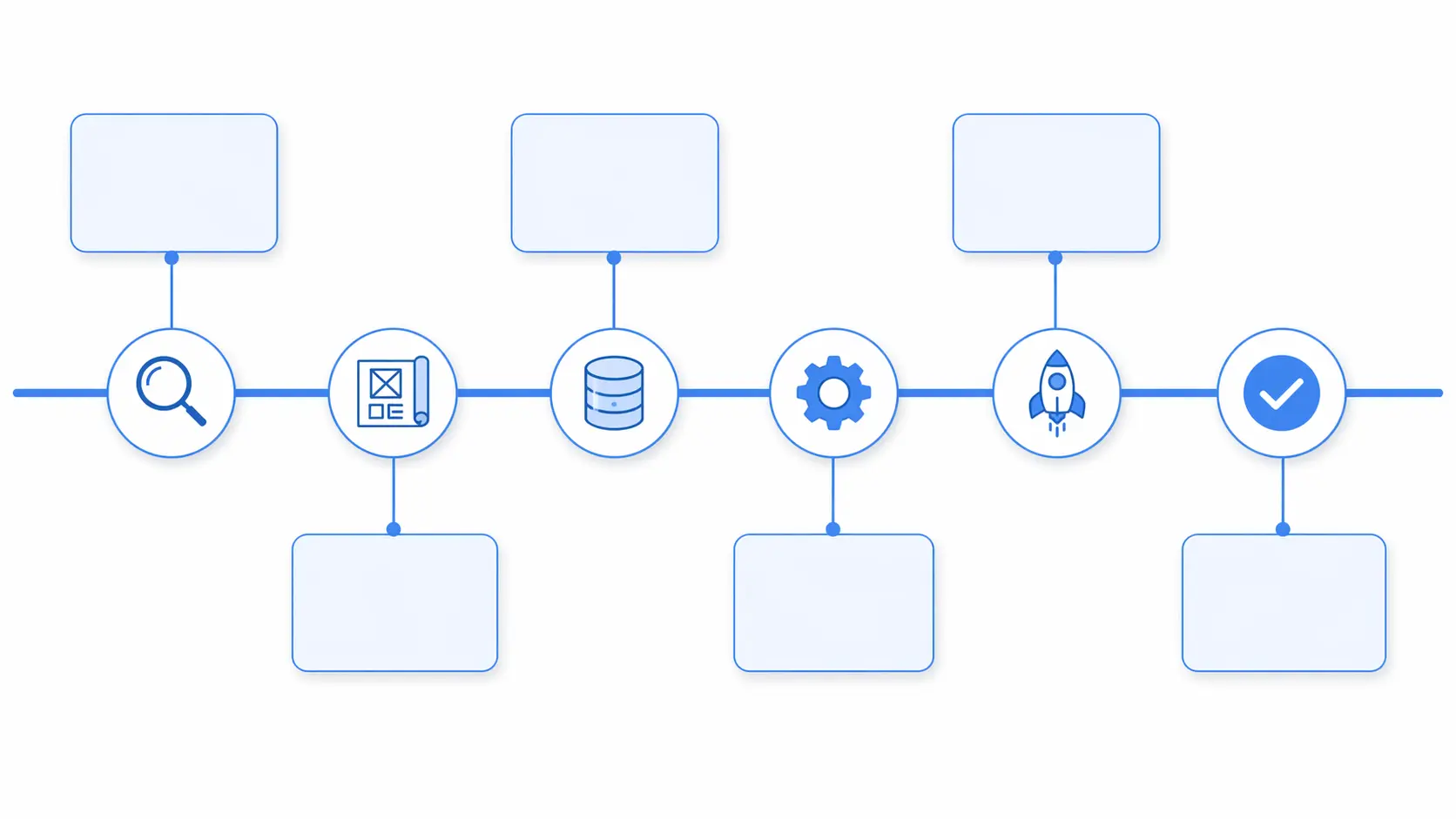
    A PIM implementation has six phases. The first two — audit and taxonomy design — are where most of the real work happens, and where most teams underinvest.

    What PIM implementation actually involves

    A PIM implementation is the process of taking your product data from wherever it currently lives — spreadsheets, your ecommerce platform, supplier files, an ERP, a mix of all of the above — and establishing a single, governed product information system that your team manages and that feeds every sales channel you operate.

    It involves three distinct types of work that often get conflated:

    • Data work — auditing what you have, cleaning what is wrong, defining what is required, migrating it into the new system
    • Configuration work — building your taxonomy, defining attribute templates, setting up validation rules, configuring channel export mappings
    • Integration work — connecting the PIM to your ecommerce platform, your supplier import process, and any channel feeds you want to automate

    Most teams underestimate the data work, overestimate the complexity of the integration work, and skip the configuration work entirely — which is why the product data in the new system ends up in the same state as the product data in the old spreadsheets. The structure has to come before the data, not after.

    Realistic PIM implementation timelines

    Implementation timelines depend primarily on three things: catalog size, data quality at the start, and how many channels you need to connect at go-live. Here are realistic ranges based on these factors:

    Catalog sizeData qualityChannels at go-liveRealistic timeline
    Under 500 SKUsReasonably clean1–2 channels1–3 weeks
    500–2,000 SKUsMixed — some cleanup needed2–3 channels3–6 weeks
    2,000–10,000 SKUsSignificant cleanup required3–5 channels6–12 weeks
    10,000+ SKUsComplex, multi-source data5+ channels3–6 months

    The single biggest variable in these timelines is data quality at the start. A catalog with 2,000 SKUs where 60% have missing required fields, inconsistent attribute values, and no GTINs will take three times as long to implement as a catalog with 2,000 clean, well-structured products. The cleanup work does not disappear — it just moves from “before go-live” to “after go-live and blocking your channel performance.”

    Before starting any implementation, run your current catalog through the Completeness Checker to get a baseline picture of where your data quality stands. It shows you exactly which categories have the highest gap rates and which fields are consistently missing — information that directly determines how long your implementation will take.

    The six steps of a PIM implementation — in the right order

    Step 1: Catalog audit

    Before touching any system, document what you have. Export every product from every source — your current ecommerce platform, any supplier files you have on file, any spreadsheets being maintained by different team members — and create a complete inventory of your current product data state.

    What you are looking for in the audit:

    • Total SKU count and how many active vs inactive products you have
    • How many distinct product types exist and what attributes each needs
    • What percentage of products have complete required fields
    • Where inconsistencies exist — multiple naming conventions, uncontrolled value lists, mixed formats
    • Whether GTINs are present and valid for products that have them
    • How many duplicate records exist
    • Which data sources exist and in what formats

    This audit is the foundation of everything that follows. Without it you are configuring a system for a catalog you do not fully understand, and the gaps will surface at the worst possible time — during channel feed setup or after go-live when products start getting suppressed.

    Step 2: Taxonomy and attribute design

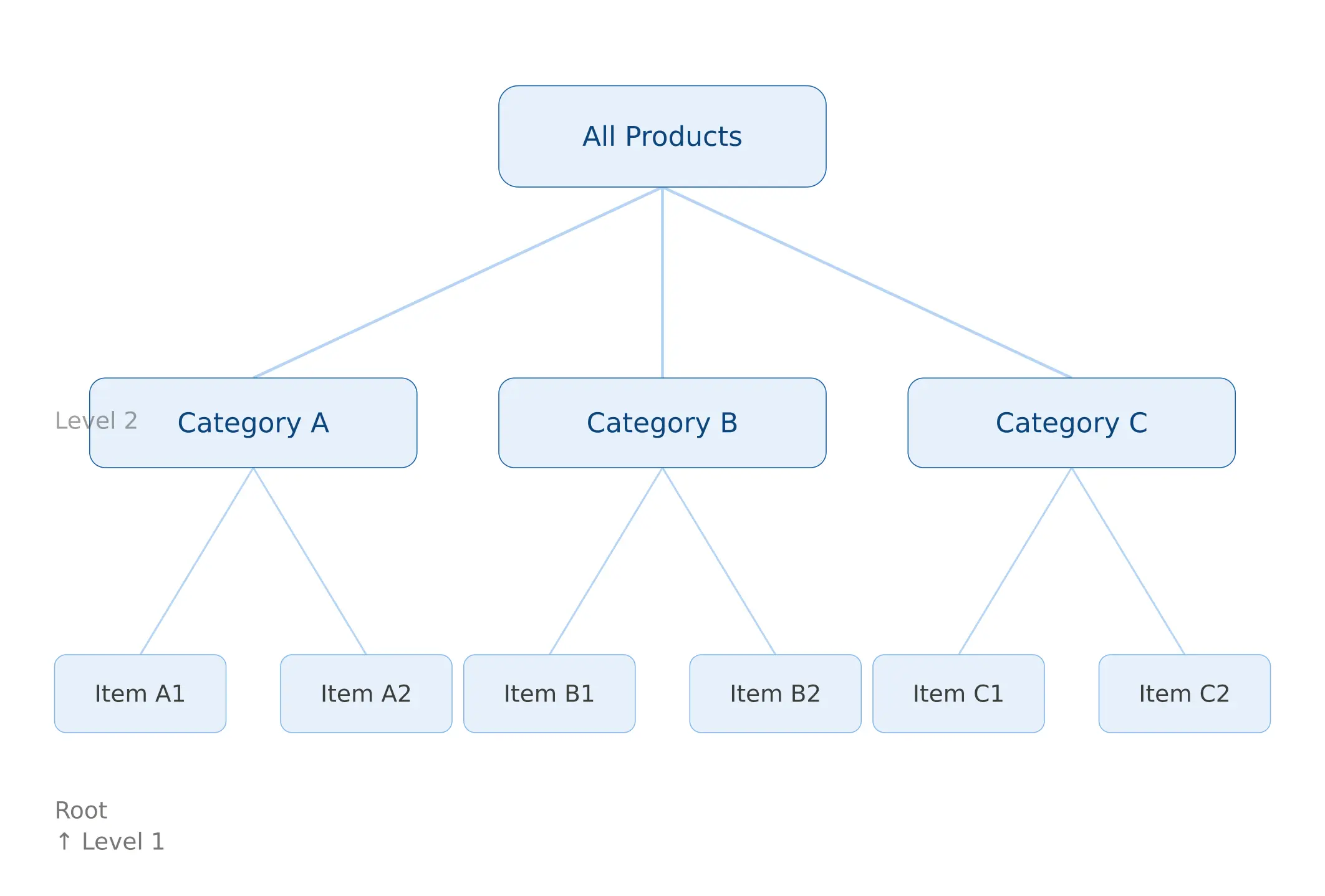
    This is the most critical and most skipped step. Your taxonomy is the structural skeleton of the PIM — the category hierarchy and attribute templates that define what data is required for each product type. You must design this before you import a single product.

    The deliverables from this step:

    • A complete category tree with 3–5 hierarchy levels and defined leaf categories
    • An attribute template for each leaf category — required fields, optional fields, and controlled value lists for key attributes
    • A naming convention guide — singular vs plural, capitalisation rules, no abbreviations
    • A channel mapping table — how each internal leaf category maps to Google Shopping, Amazon, and any other channels you sell on

    The category mapping guide covers exactly how to build each of these in detail. Budget two to five days for this step depending on how many distinct product types you have. It is the highest-leverage time you will spend in the entire implementation.

    Step 3: Data preparation and cleaning
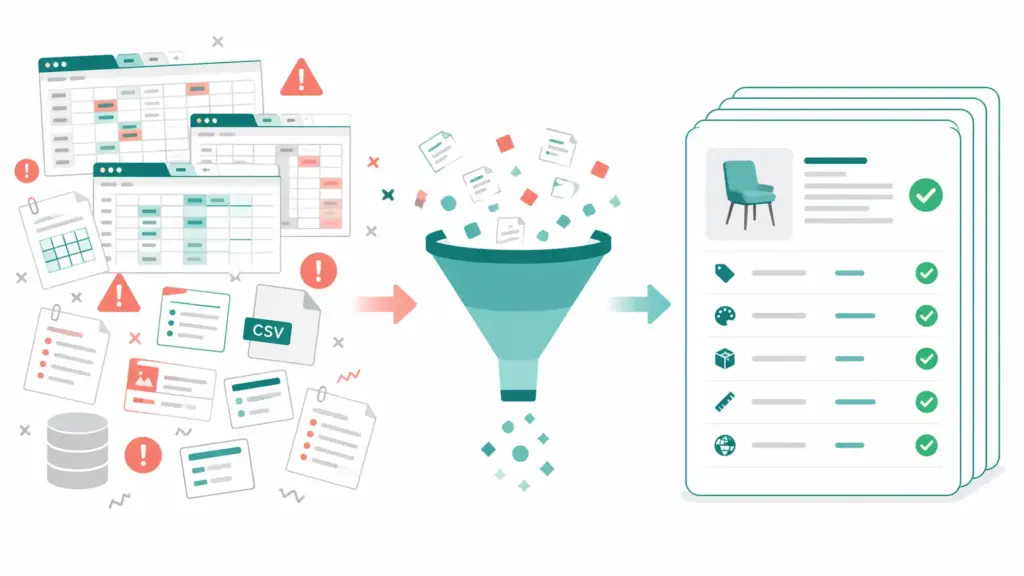
    Data preparation is the unglamorous middle of every implementation. How much work it requires depends almost entirely on the state of your data going in.

    Armed with your audit findings and your new taxonomy, prepare your data for migration. This means cleaning what you have in your current system before importing it — not importing it and cleaning it afterwards.

    Key data preparation tasks:

    • Standardise attribute values — map all variant values to your controlled lists (all the “Cotton / Ctn / 100% Cotton” variants become “Cotton”)
    • Validate GTINs — check format, digit count, and check digit for every product that has a GTIN. Fix or flag everything that fails. For the full GTIN validation process, the GTIN compliance guide covers each error type and its fix.
    • Remove duplicates — merge duplicate product records, preserving the best data from each
    • Map to new taxonomy — assign each product to its correct leaf category in your new structure
    • Flag incomplete records — identify which products will not meet the completeness threshold for your first channel at go-live and prioritise those for enrichment

    For supplier data specifically — which often arrives in the worst state — the guide on cleaning supplier product data covers the full process for onboarding external data sources cleanly.

    Step 4: System configuration

    Now you build the structure in the PIM itself. This step translates your taxonomy design and attribute templates into the actual system configuration:

    • Create your category hierarchy in the PIM
    • Define attribute templates for each leaf category with required and optional fields
    • Set up controlled value lists for key attributes
    • Configure validation rules — required field checks, format validation, GTIN checks
    • Set up user roles and permissions — who can create, edit, approve, and publish
    • Configure channel export mappings — how your internal attributes map to Google Shopping fields, Amazon attributes, and any other channel formats

    For most small and mid-size implementations this step takes two to five days. For larger implementations with many product types and multiple channels, plan for one to three weeks. Do not rush this step — every shortcut taken here shows up as a data quality problem after go-live.

    Step 5: Data migration

    With the system configured and your data prepared, migrate your products into the PIM. The approach that works consistently for any catalog size:

    1. Migrate by category, highest revenue first. Start with the category that drives the most revenue. Import it, validate it against your attribute templates, fix anything the validation catches, and confirm the data looks correct before moving to the next category.
    2. Use your validation layer from day one. Every product should pass through your validation rules during import. Products that fail required field checks go to a review queue, not directly into the live catalog.
    3. Do not migrate inactive products first. Start with your active, live catalog. Inactive, discontinued, or archived products can be migrated in a second phase once the live catalog is running cleanly.
    4. Verify before connecting channels. Before connecting the PIM to any live channel feed, manually spot-check 20–30 products across different categories. Check that titles, descriptions, images, GTINs, and category mappings all look correct. Fix issues at this stage — they are much easier to fix before channel syndication starts than after.

    Step 6: Channel connection and go-live

    Connect your first channel — usually your ecommerce website or Google Shopping — and verify that the feed is publishing correctly and passing channel validation. For Google Shopping specifically, check Google Merchant Center Diagnostics within 48 hours of your first feed submission for any errors or warnings. For the full picture on what Google requires and how to diagnose feed issues, the Google Shopping feed guide covers every error type and fix.

    Add channels one at a time — not all simultaneously. A phased channel rollout means that if something goes wrong with a channel connection, it is isolated and fixable without affecting the others. Going live on five channels simultaneously and having a feed issue means five channels with a problem instead of one.

    Your first 90 days: the realistic roadmap

    The 90-day roadmap is a practical target for most small to mid-size implementations. Enterprise implementations with large catalogs and complex integrations run longer, but the phase structure is the same.

    Weeks 1–2: Foundation

    • Complete catalog audit — total SKU count, data quality baseline, source inventory
    • Design taxonomy — category hierarchy, attribute templates, naming conventions
    • Define channel mapping table — internal categories to Google, Amazon, and priority channels
    • Start data preparation — standardise attribute values, validate GTINs, remove duplicates
    • Define completeness thresholds — what score is required for a product to be publishable

    Weeks 3–6: Build

    • Configure PIM — build category hierarchy, attribute templates, validation rules, user roles
    • Complete data preparation for highest-revenue categories
    • Migrate first category batch — import, validate, fix, verify
    • Connect first channel — ecommerce website or Google Shopping
    • Verify channel feed — check Merchant Center Diagnostics, fix any errors
    • Migrate second and third category batches

    Weeks 7–12: Full rollout

    • Migrate remaining categories
    • Connect remaining channels one at a time
    • Set up supplier import workflows with category mapping rules
    • Retire old spreadsheets — single source of truth is now the PIM
    • First data quality review — completeness scores by category, any new channel warnings
    • Establish ongoing governance — weekly completeness monitoring, quarterly taxonomy reviews

    The most common PIM implementation mistakes

    Mistake 1: Building the taxonomy inside the PIM before designing it on paper

    The most expensive mistake in PIM implementations. Teams open the new system and start creating categories directly in the interface, making structural decisions on the fly without thinking through the full hierarchy. Three weeks later they realise the taxonomy does not scale to their full product range, and reworking it with products already imported means remapping hundreds or thousands of records.

    The fix is simple: design the full taxonomy in a spreadsheet before touching the system. Every category, every level, every attribute template. Review it against your actual product range. Only then build it in the PIM.

    Mistake 2: Migrating dirty data and planning to clean it later

    “We will clean it up after go-live” is the sentence that turns a six-week implementation into a six-month one. Dirty data that enters the PIM still needs cleaning — it just now lives in a new system instead of a spreadsheet, and is being published to live channels in the meantime. Channel feed warnings accumulate, customer-facing product pages have missing information, and the team spends post-launch scrambling to fix data problems that were known before migration started.

    The correct approach: clean before you migrate, not after. Prepare the data in your existing system first. It is genuinely faster to clean a spreadsheet than to clean the same data inside a PIM with live channel connections attached.

    Mistake 3: Going live on all channels simultaneously

    The instinct at the end of an implementation is to connect everything at once and turn it all on. This means that if anything goes wrong — a misconfigured channel mapping, an unexpected feed error, a GTIN problem that was not caught in validation — it affects every channel simultaneously. Debugging multiple channel failures at once while the live catalog is affected is a stressful and slow process.

    Connect one channel, verify it is working cleanly for 48–72 hours, then add the next. This takes slightly longer but means each new channel connection is isolated and verifiable before the next one goes in.

    Mistake 4: Not defining who owns the taxonomy

    Within weeks of go-live, team members start creating new categories because they cannot find where a new product type belongs, adding free-text values to controlled lists because the right value was not available, or importing supplier data without applying mapping rules because the rules were not documented. The taxonomy drifts back toward chaos gradually and then suddenly.

    Before go-live, assign one person or team as the taxonomy owner — the single point of accountability for all structural changes. Document who they are, how change requests should be submitted, and what the criteria are for creating a new category. This is governance, and it is the difference between a PIM that maintains its quality over time and one that degrades back to the state of the spreadsheets it replaced.

    Mistake 5: Treating implementation as a one-time project

    A PIM implementation is not finished at go-live. It is the start of an ongoing process. Channel requirements change — Google updated its taxonomy significantly in January 2026. New product types emerge that your original taxonomy did not anticipate. Supplier data formats evolve. New channels need to be added.

    Build quarterly review cycles into your PIM operations from day one: completeness scores by category, channel feed health, taxonomy gaps, supplier mapping rule accuracy. Treat the PIM like the operational infrastructure it is — maintained continuously, not set up once and forgotten. The data quality framework covers exactly what to monitor and how often.

    What to prepare before you start: pre-implementation checklist

    Before you start your PIM implementation — before signing a contract, before any configuration work — make sure you have these things in place:

    • ☐ A complete export of your current product catalog from all sources
    • ☐ A baseline data quality assessment (completeness, GTIN validity, duplicate count)
    • ☐ A draft category hierarchy reviewed against your actual product range
    • ☐ A list of every channel you need to publish to at go-live
    • ☐ The specific attribute requirements for each target channel
    • ☐ A named taxonomy owner who will be responsible for structural decisions
    • ☐ A documented go-live date and the channels that must be live by that date
    • ☐ An agreed completeness threshold — what percentage of required fields must be populated before a product can be published
    • ☐ A plan for how supplier data will be onboarded and mapped going forward

    Teams that start their implementation with all of these in place consistently complete on time. Teams that start without them consistently do not. If you are not yet sure whether your organisation is ready for a PIM implementation, the PIM Readiness Assessment scores your current state across five dimensions — taxonomy, data quality, supplier management, channel readiness, and governance — and tells you exactly where to focus preparation before you start.


    Frequently asked questions

    How long does a PIM implementation take?

    Timeline depends on catalog size and data quality. A small store with under 500 clean SKUs can go live in one to three weeks. A mid-size store with 2,000–10,000 SKUs and mixed data quality typically takes six to twelve weeks. Large catalogs with complex data, many channels, and significant cleanup required can take three to six months. The single biggest variable is the state of your data going in — clean data migrates fast, dirty data does not.

    What should I do before starting a PIM implementation?

    The most important pre-implementation steps are: audit your current product data to understand its quality and completeness, design your taxonomy and attribute templates before touching any system, validate your GTINs and standardise key attribute values, and identify which channels need to be live at go-live and what their specific data requirements are. Teams that invest two to three weeks in preparation before starting configuration consistently complete implementations faster and with fewer post-launch problems.

    What is the hardest part of implementing a PIM?

    The hardest part is the data preparation — not the software configuration. Most teams underestimate how much inconsistency, incompleteness, and structural disorder exists in their current product data until they try to migrate it into a system that enforces rules and structure. The taxonomy design step — deciding on category hierarchy and attribute templates before importing anything — is the most important and most frequently skipped, and the one that causes the most post-launch problems when done incorrectly or not at all.

    Do I need a consultant to implement a PIM?

    For small and mid-size implementations — under 5,000 SKUs, two to four channels, reasonably clean data — most teams can implement a well-designed PIM without external consultants if they invest time in the preparation steps described above. A consultant adds value when the catalog is very large, the data is extremely complex, there are many integrations required, or the team has no prior experience with taxonomy design and data modeling. The preparation checklist above covers what you need to have in place to implement independently.

    How do I migrate product data from spreadsheets to a PIM?

    The recommended approach: clean and standardise your data in the spreadsheet first, design your target taxonomy and attribute templates, then import category by category starting with your highest-revenue products. Validate each batch against your attribute templates before importing the next. Run the new system in parallel with your spreadsheet for two weeks after go-live, then retire the spreadsheet once you have confirmed the PIM is operating cleanly. Never migrate and clean simultaneously — it takes longer and creates more confusion than doing them sequentially.

    What data should I clean before migrating to a PIM?

    Focus on the four highest-impact areas first: standardise attribute values for key fields like color, size, and material so they match your controlled value lists; validate GTINs against GS1 standards and fix or remove invalid ones; remove duplicate product records; and ensure your category assignments are consistent with your new taxonomy structure. Secondary cleanup — improving descriptions, adding missing images, completing optional fields — can happen inside the PIM after go-live without blocking your channel connections.
  • PIM for Ecommerce: What Small & Mid-Size Stores Actually Need (2026)

    PIM for Ecommerce: What Small & Mid-Size Stores Actually Need (2026)

    PIM for Ecommerce: What Small and Mid-Size Stores Actually Need in 2026

    Most PIM content online is written for enterprise teams — large catalogs, complex integrations, multi-million pound implementations. If you run a store with a few hundred to a few thousand SKUs, you read that content and think either “we’re not ready for this” or “we definitely don’t need this.” Both reactions are often wrong.

    The truth is that PIM for ecommerce at the small and mid-size level looks completely different from enterprise PIM — different problems, different capabilities required, different price points, different implementation complexity. This guide cuts through the noise and tells you exactly what a growing ecommerce store actually needs from a product information management system, when you genuinely need it, and what you can get away with until then.

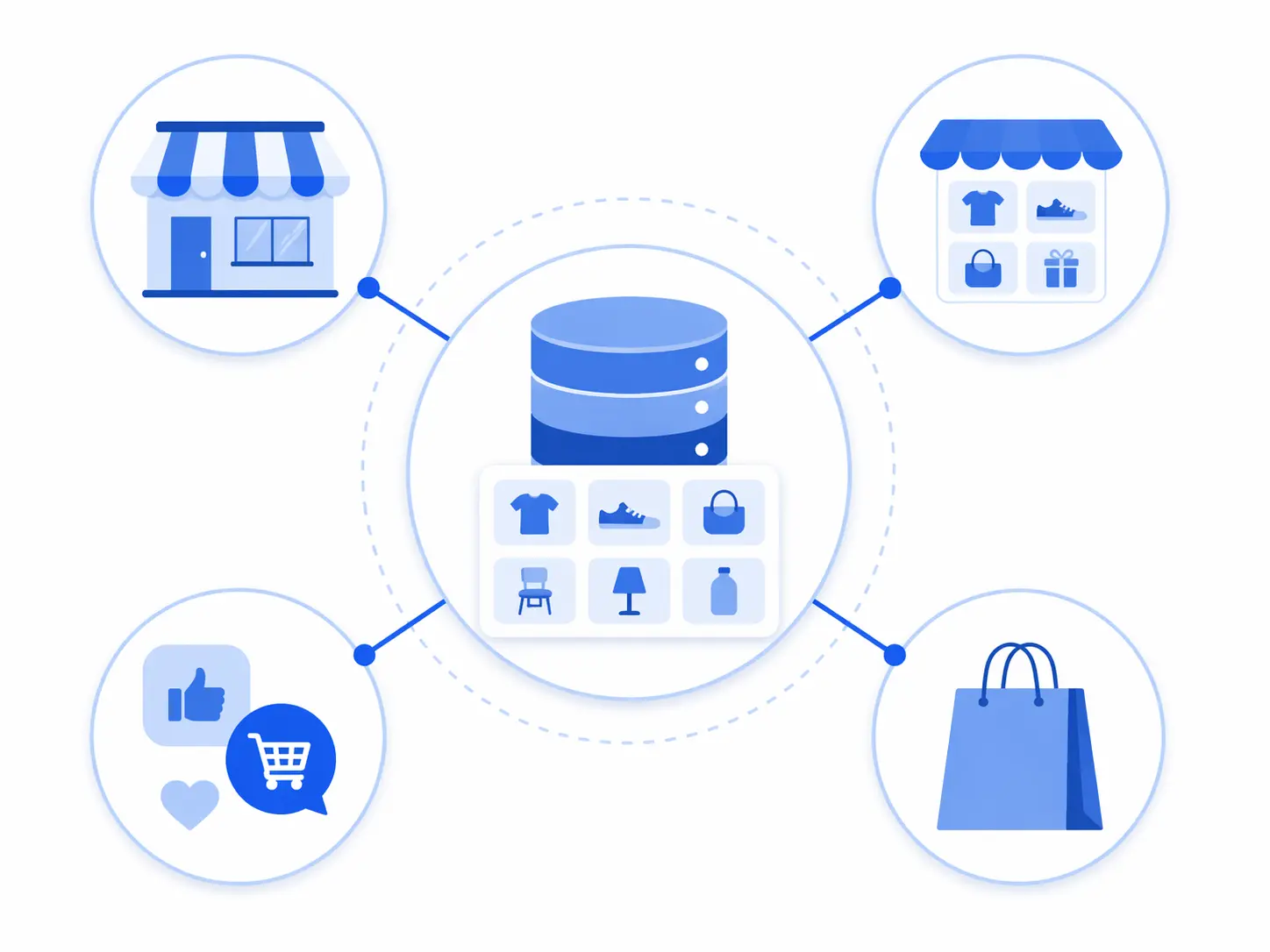
    At its core, PIM for small ecommerce stores solves one problem: one place for all your product data, feeding every channel consistently without manual effort every time something changes.

    What PIM actually does — in plain language

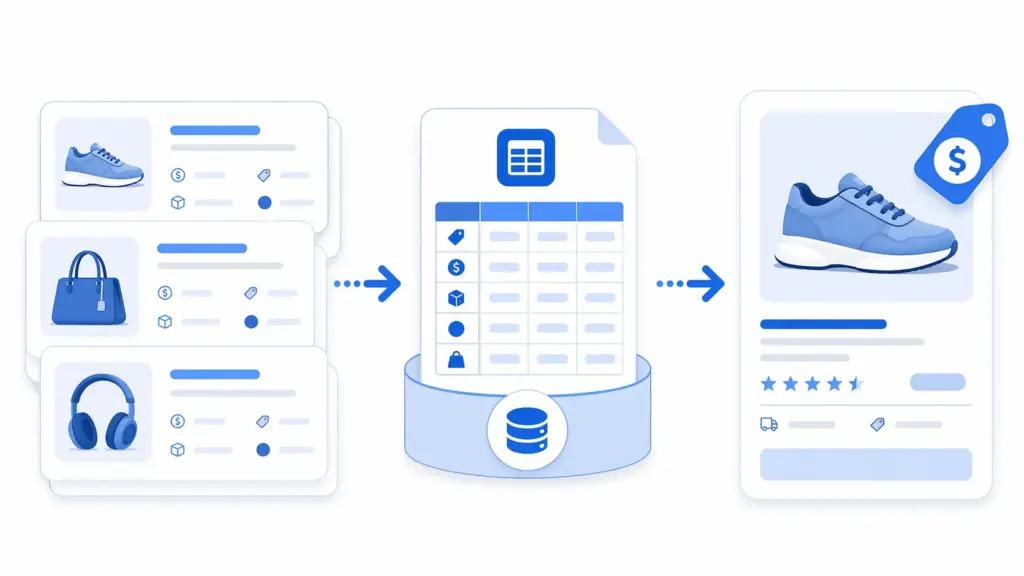
    A Product Information Management system is the single place where all your product data lives, gets enriched, gets validated, and gets published to wherever you sell. That is the whole job description.

    It handles four things that every ecommerce store eventually needs to do consistently:

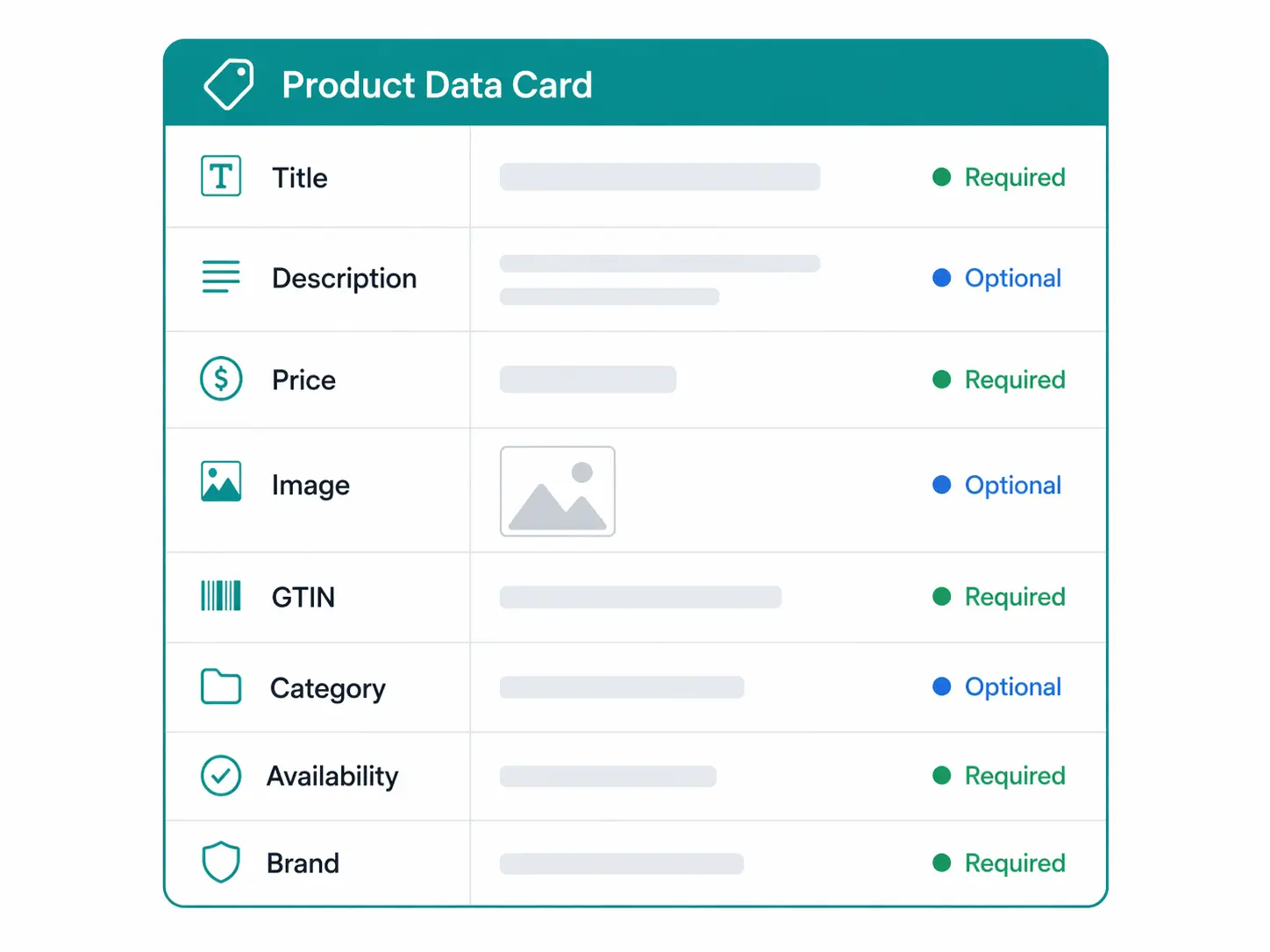
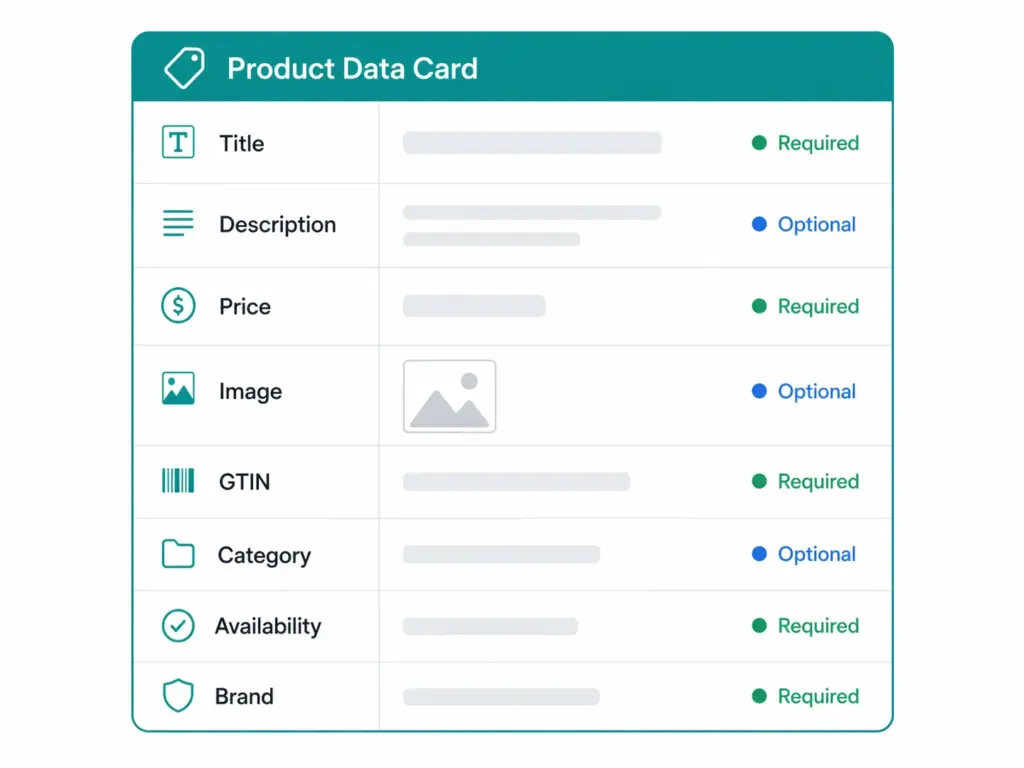
    • Store — one central record for each product with all its attributes: title, description, images, dimensions, materials, sizing, care instructions, pricing, inventory status, and every other field that applies to that product type
    • Enrich — fill in missing fields, improve descriptions, add images, complete the data so every product is publishable and persuasive
    • Validate — check that required fields are populated, that values match controlled lists (no rogue “Ctn” in the Cotton field), that GTINs are valid, that nothing goes live incomplete
    • Publish — push clean, channel-specific product data to your website, Google Shopping, Amazon, marketplaces, and anywhere else you sell — without manually reformatting for each one

    That is it. If you want a deeper look at the full capability picture, the 2026 PIM guide covers everything from data modeling to channel syndication. But for a small or mid-size store, those four functions are what actually matters day-to-day.

    The honest answer to “do I need a PIM?”

    You do not need a PIM when you are small. A store with 50 SKUs, one channel, and one person managing product data does not need dedicated product information management software. A well-maintained spreadsheet genuinely works at that scale.

    You start needing one when the spreadsheet approach creates more problems than it solves. That tipping point is different for every store, but it tends to happen around the same set of triggers:

    • You are selling on more than one channel and manually reformatting product data for each one
    • More than one person is editing product data and you keep overwriting each other’s work
    • Supplier data arrives in different formats and someone has to reconcile it manually every time
    • Products go live with missing information because there is no validation step before publishing
    • You cannot quickly answer “which products are missing a size guide?” or “which SKUs have no Google category mapped?”
    • A price change or product update requires editing the same information in three or four different places

    If three or more of those apply to your store right now, you are past the spreadsheet stage. The PIM vs spreadsheets guide covers the specific failure modes in detail — where exactly Excel breaks and what it costs when it does.

    The small store breaking point: 200–500 SKUs

    Spreadsheets work beautifully until they do not. The breaking point for most ecommerce stores is somewhere between 200 and 500 SKUs — the point where the maintenance overhead starts to compound.

    The 200–500 SKU range is where most stores hit the wall. It is not that the spreadsheet cannot technically hold 500 rows — it can. It is that maintaining accuracy, completeness, and consistency across 500 product records across multiple channels, with a team of more than one person, without a validation layer, becomes a full-time job that no one actually has.

    Here is what the compounding cost of spreadsheet-based product management actually looks like at that scale:

    • A new supplier sends 80 products in their own format. Someone spends two days mapping, cleaning, and importing. Next season they send an updated file in a slightly different format. Two days again.
    • You launch on Amazon. The Amazon listing requirements for your product category are different from your website. Someone reformats 200 products manually. You update a price. Now there are two prices — one in the website sheet, one in the Amazon sheet. They get out of sync within a week.
    • A product gets a new image. Someone updates the website. Forgets the Google Shopping feed. The feed keeps serving the old image. Google flags it.
    • You hire a second person to help with catalog management. They create slightly different title formats. Now you have two naming conventions across 500 products and no easy way to standardise them.

    None of these are catastrophic individually. Together, compounding over months, they represent a significant drag on every commercial activity that depends on product data — which is all of them.

    What a PIM specifically solves for small ecommerce stores

    For small stores, these five capabilities are what PIM actually delivers in practice — not the enterprise feature list, but the specific problems it solves at 200–2,000 SKUs.

    1. One version of every product

    Every product has one record. When a price changes, you change it once and it updates everywhere. When an image is replaced, it is replaced in every channel simultaneously. This sounds basic because the problem it solves is basic — but the time saved and errors prevented compound significantly at even 300 SKUs.

    2. Category-level attribute templates

    Every product category has a defined set of fields that apply to it. A T-shirt needs color, size, fabric, and sleeve length. A laptop needs processor, RAM, storage, and screen size. A PIM enforces these templates automatically — when a new T-shirt is added to the catalog, the system knows exactly which fields need to be filled and which values are acceptable. Products cannot be published until required fields are complete.

    This is the single capability that does the most to improve product data quality for growing stores. For a full explanation of how attribute templates work with taxonomy, the category mapping guide covers it in depth.

    3. Channel publishing without manual reformatting

    Your website, Google Shopping, Amazon, and any marketplace you sell on all have different data requirements. Your website description can be 500 words. Google Shopping wants a concise title with specific attributes in a specific order. Amazon requires a structured bullet point format and specific category fields. A PIM maintains these channel-specific output formats as templates — you maintain one product record, and the PIM generates the correct format for each channel automatically.

    For the specifics of what Google Shopping requires in 2026, the Google Shopping feed guide covers every required and high-impact optional attribute.

    4. Supplier import with mapping rules

    When a supplier sends you a product file, a PIM applies your category mapping rules automatically — translating their category names to yours, applying the correct attribute template, flagging anything that does not map cleanly for review. After the first import from a given supplier, subsequent imports are largely automated. The manual work stays constant regardless of how many products the supplier sends.

    5. Data completeness visibility

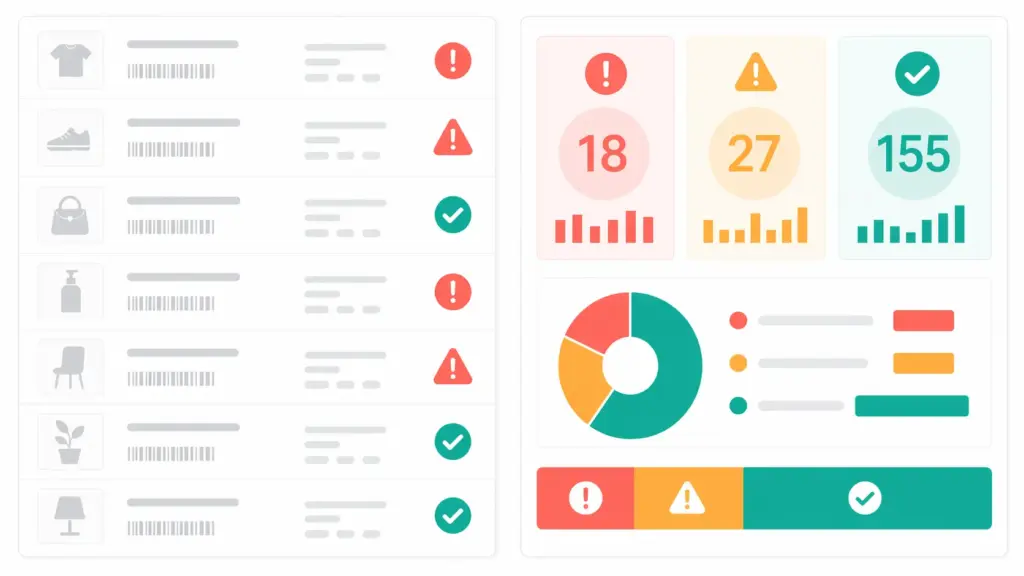
    At any time, you can see exactly which products are incomplete, which fields are missing, and which categories have the lowest data quality scores. This turns data quality from a vague concern (“our catalog probably has some gaps”) into a managed metric with clear actions. The Completeness Checker shows you this picture for your current catalog without needing a full PIM in place first.

    What small stores do not need from a PIM

    This matters as much as what you do need — because most PIM vendors lead with enterprise capabilities that small stores will never use and should not be paying for.

    • Complex workflow approval chains — enterprise PIMs have multi-stage approval workflows designed for teams of 50+ people across multiple territories. A small team does not need a four-step approval chain to update a product description.
    • Localisation at scale — managing 40 language versions of a catalog is a genuine enterprise problem. If you sell in one or two markets, you need basic translation support, not a full localisation management platform.
    • ERP integration complexity — deep, real-time bidirectional integration with SAP or Oracle is an enterprise implementation project measured in months. Small stores typically need simpler, one-directional data flows that take days not months to configure.
    • Custom data modeling — enterprise PIMs are often sold as blank-canvas platforms where you design the entire data model from scratch. This flexibility is genuinely powerful — and genuinely expensive to implement properly. Small stores benefit more from a system with sensible defaults that can be extended, not one that requires a full data architecture project before you can add a product.

    The right PIM for a small or mid-size ecommerce store is one that solves the five core problems above, gets you up and running in days not months, and has a pricing model that makes sense at your catalog size. Enterprise PIM pricing — which can run to tens of thousands per month — is not the only option, and for most small stores it is the wrong option entirely.

    The right time to implement PIM: a practical checklist

    Use this to assess whether now is the right time for your store:

    • ☐ You have more than 200 SKUs and the number is growing
    • ☐ You sell on more than one channel
    • ☐ More than one person manages product data
    • ☐ You receive product data from suppliers in varying formats
    • ☐ Products regularly go live with missing or incorrect information
    • ☐ A price or product update requires editing in multiple places
    • ☐ You cannot quickly identify which products are incomplete
    • ☐ Channel feed errors (Google Shopping suppressed listings, Amazon disapprovals) are a recurring problem
    • ☐ You spend more than a few hours per week on manual product data maintenance

    If you checked five or more, the time and error costs of your current approach almost certainly exceed the cost of a PIM. If you checked three or four, you are approaching the threshold and it is worth assessing properly before the problem compounds further.

    The PIM Readiness Assessment takes five minutes and gives you a scored breakdown across five dimensions — taxonomy, data quality, supplier management, channel readiness, and team governance — so you can see exactly where your current setup is strong and where it is costing you.

    What to look for in a PIM as a small ecommerce store

    When you are ready to evaluate PIM options, these are the capabilities that matter most at small and mid-market scale — not the enterprise feature checklist:

    Fast time to value

    You should be able to import your existing product catalog, define basic category templates, and start publishing to at least one channel within a week of starting. If the implementation timeline is measured in months, the system is built for an enterprise that needs custom data architecture — not for a growing store that needs its catalog under control now.

    Pricing that scales with your catalog

    PIM pricing models vary significantly. Some charge by SKU count, some by user seats, some by channel connections, some flat monthly. For small stores, SKU-based or flat monthly pricing is usually most predictable. Avoid systems with per-channel pricing that makes each new marketplace you connect prohibitively expensive — channel expansion is exactly the growth scenario where PIM should become more valuable, not more costly.

    Google Shopping and key marketplace connectors built in

    For most small ecommerce stores, the channels that matter are your own website, Google Shopping, and one or two marketplaces. The PIM should have native or near-native connectors for these — not a generic export that you have to manually map every time. The Google Shopping feed specifically needs to stay current with Google’s taxonomy updates (the most recent significant update was January 2026 with a July 31 compliance deadline).

    Validation and completeness scoring

    The system should tell you, clearly and automatically, which products are not ready to publish and why. Not after they fail in a channel feed — before they get there. Required field validation, GTIN format checking, controlled value list enforcement — these should be built in, not add-ons.

    For a broader picture of what good data quality infrastructure looks like and the six dimensions it needs to cover, the PIM data quality guide covers the full framework.

    Usable by non-technical team members

    In a small store, the person managing product data is usually not a developer. The PIM needs to be manageable by a merchandiser, an ecommerce coordinator, or a founder — not just by someone comfortable with APIs and data pipelines. This rules out a significant portion of enterprise PIM options that require technical implementation for basic tasks.

    The migration question: how to move from spreadsheets to PIM without chaos

    The most common reason small stores delay implementing PIM is fear of the migration — getting hundreds or thousands of product records out of spreadsheets and into a new system without breaking the live catalog.

    The migration is rarely as complex as it looks, but it does require some preparation:

    1. Audit before you migrate. Run your current catalog through the Completeness Checker before migrating anything. Fix the most obvious gaps — missing required fields, duplicate SKUs, invalid GTINs — in your spreadsheet first. Migrating clean data is dramatically easier than migrating and cleaning simultaneously.
    2. Define your category structure first. Before importing a single product, map out your category hierarchy and the attribute templates for each leaf category. This is the skeleton that the PIM will use to validate everything you import. Skipping this step and importing products into a blank structure is what causes migrations to take months instead of weeks.
    3. Import in batches by category. Start with your highest-revenue category. Import it, validate it, connect it to one channel, and confirm everything works before moving to the next category. A phased migration means problems are contained and fixable, not spread across your entire catalog.
    4. Run parallel for two weeks. Keep your spreadsheet updated alongside the PIM for the first two weeks after go-live. If something breaks, you have a fallback. After two weeks of clean operation, retire the spreadsheet completely — having both running in parallel beyond that point creates the same data consistency problems you were trying to solve.

    Frequently asked questions

    Do small ecommerce stores need a PIM?

    Not immediately. A store with under 200 SKUs selling on one or two channels can typically manage product data in a well-maintained spreadsheet. The need for PIM becomes clear when you are selling across multiple channels, receiving supplier data in varying formats, managing product data with more than one person, or spending significant time each week on manual data maintenance and fixing errors. Most growing ecommerce stores hit this threshold somewhere between 200 and 500 SKUs.

    What is PIM for ecommerce in simple terms?

    PIM — Product Information Management — is the system that holds all your product data in one place, enforces data quality, and publishes it to every sales channel in the correct format. Instead of maintaining separate spreadsheets for your website, Amazon, and Google Shopping, you maintain one product record in the PIM and it handles the channel-specific formatting automatically. It is the infrastructure layer between your product catalog and everywhere you sell.

    How many SKUs do you need before PIM makes sense?

    SKU count alone is not the right threshold — the more relevant signals are whether you sell on multiple channels, whether more than one person manages product data, and whether you receive supplier data that needs to be mapped and cleaned on import. That said, most ecommerce teams find the maintenance overhead of spreadsheet-based catalog management becomes unsustainable somewhere between 200 and 500 SKUs, particularly once they are selling on more than one channel.

    Is PIM software expensive for small businesses?

    Enterprise PIM pricing — tens of thousands per month — is not what small ecommerce stores need or should be paying. The PIM market has matured significantly and there are now purpose-built options for growing ecommerce teams with pricing that scales from small catalogs upward. The right question is not whether PIM is affordable but whether the time and error costs of your current approach exceed the cost of the system. For most stores past the 300 SKU mark selling on multiple channels, the answer is yes.

    What is the difference between a PIM and an ecommerce platform like Shopify?

    Shopify (and similar platforms) is where your store lives and where customers browse and purchase. PIM is where your product data is managed before it goes to Shopify. Your ecommerce platform handles the storefront, checkout, payments, and orders. PIM handles the product information that populates that storefront — and every other channel you sell on. Most growing stores use both: PIM as the single source of truth for product data, and their ecommerce platform as one of the channels PIM publishes to.

    How long does it take to implement a PIM for a small store?

    For a small store with a reasonably clean existing catalog, a straightforward PIM implementation — importing products, defining category templates, configuring one or two channel connections — should take one to three weeks. More complex scenarios (messy data, many supplier sources, multiple channels to configure simultaneously) add time but should still be measured in weeks not months for stores under 5,000 SKUs. If a vendor is quoting you a six-month implementation for a small catalog, the system is built for enterprise scale and is probably the wrong fit.


  • Job Title Category Mapping: How to Classify CEO, Founder & Director Roles

    Job Title Category Mapping: How to Classify CEO, Founder & Director Roles

    Job Title Category Mapping: How to Classify CEO, Founder, Director and Every Other Role in Your Taxonomy

    You are building a CRM, a B2B contact database, a startup classification system, or an internal org taxonomy — and you keep hitting the same wall. Where does a Founder go? Is a Co-Founder the same category as a CEO? Does “Head of Sales” map to Director or VP? Is a “Chief of Staff” an executive or an operations function?

    Job title category mapping is one of those problems that looks simple until you try to make it consistent across thousands of records. This guide gives you a complete, practical framework: how to classify every major role type across seniority levels and job functions, with specific answers for the titles that cause the most confusion.

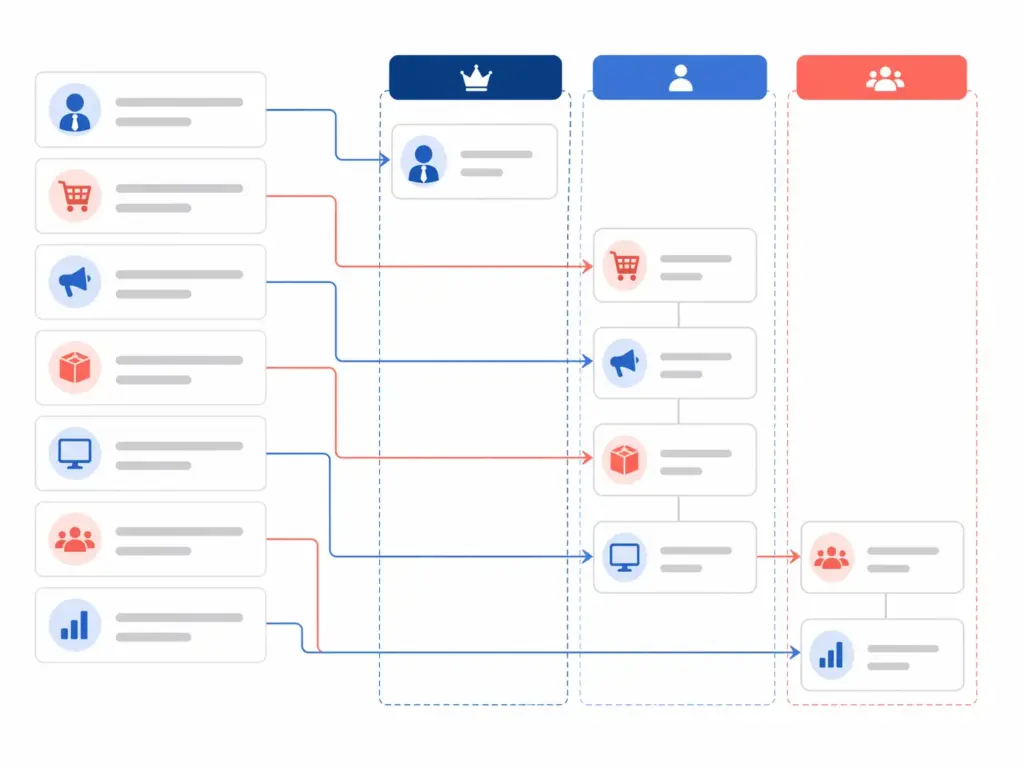
    A well-designed job title taxonomy maps every role to two dimensions: seniority level (vertical) and job function (horizontal). Getting both right is what makes the classification useful.

    Why job title category mapping is harder than it looks

    Job titles are not standardised. Two people with identical responsibilities at different companies might be called “Director of Marketing” at one and “Head of Growth” at another. A “VP of Engineering” at a 20-person startup has a completely different scope than the same title at a 5,000-person enterprise. A “Founder” might be actively running the business as CEO, or might have stepped back to an advisory role years ago.

    This inconsistency is the core challenge of job title taxonomy. The solution is a two-dimensional classification model: every role gets mapped to a seniority level and a job function. These two dimensions together give you a consistent, queryable classification regardless of how many ways people describe the same role.

    This same two-dimensional principle applies in product taxonomy too — every product maps to a category (what it is) and carries attributes (what it is like). The logic is structurally identical. If you are building taxonomy systems more broadly, the ecommerce category mapping guide covers the same principles applied to product data.

    The two dimensions of job title classification

    Dimension 1: Seniority level

    Seniority level describes where a role sits in the organisational hierarchy — the vertical dimension of your taxonomy. Most organisations and classification systems use five to seven levels:

    LevelCommon titles at this levelTypical scope
    C-Suite / OwnerCEO, CFO, CTO, COO, CMO, CPO, CISO, Founder, Co-Founder, Owner, Managing Director, PresidentCompany-wide strategy, ultimate accountability for a function or the whole business
    VP / SVP / EVPVice President, Senior VP, Executive VP, Group VPCross-team leadership, owns a large function or business unit, usually reports to C-suite
    DirectorDirector, Senior Director, Head of [function]Owns a department or team, sets strategy for their area, manages managers
    ManagerManager, Senior Manager, Team Lead, PrincipalManages a team directly, executes departmental strategy
    Senior Individual ContributorSenior [role], Lead [role], Staff [role], SpecialistDeep expertise, no direct reports or minimal mentorship role
    Individual Contributor[Role] without prefix, Associate, Analyst, Coordinator, Executive (in UK usage)Executes tasks within a team, reports to a manager
    Entry LevelJunior, Assistant, Intern, Graduate, TraineeLearning the role, supervised closely

    Dimension 2: Job function

    Job function describes what area of the business a role belongs to — the horizontal dimension. LinkedIn’s professional taxonomy, which covers over 900 million profiles and is the most widely used professional classification system, uses these top-level functions:

    Job function is the horizontal dimension of your taxonomy. Seniority is the vertical. Every title maps to exactly one cell in this grid.
    • Commercial / Sales — sales, business development, account management, revenue
    • Marketing — brand, growth, content, performance marketing, product marketing
    • Technology / Engineering — software development, infrastructure, data, security, IT
    • Operations — supply chain, logistics, fulfilment, customer service, project management
    • Finance / Legal — accounting, FP&A, legal, compliance, risk
    • People / HR — talent acquisition, HR business partners, learning & development, culture
    • Product — product management, UX, design, research
    • General Management / Executive — cross-functional leadership, strategy, board-level roles

    Every job title maps to one seniority level and one function. A “Director of Marketing” is Director × Marketing. A “VP of Engineering” is VP × Technology. A “Sales Analyst” is Individual Contributor × Commercial. The classification is unambiguous once you have defined the two dimensions clearly.

    How to classify the titles that cause the most confusion

    Founder and Co-Founder

    Seniority level: C-Suite / Owner
    Function: General Management

    Founder and Co-Founder are ownership titles, not role titles. They describe how someone came to be at the company, not what they do now. For classification purposes, always map Founder and Co-Founder to C-Suite level — they have founder-level authority regardless of their current day-to-day role.

    For function, use General Management as the default unless the founder has a specific functional title alongside it (Founder & CTO maps to Technology; Founder & CMO maps to Marketing). A plain “Founder” with no other qualifier goes to General Management.

    Co-Founder follows exactly the same logic. Map them identically to Founder unless they have a functional title that tells you otherwise.

    President

    Seniority level: C-Suite
    Function: General Management

    President is a C-Suite title that typically sits alongside or just below CEO, with responsibility for operations, revenue, or a specific business unit. In some organisations President is used interchangeably with CEO, particularly in family businesses and smaller companies. Always classify as C-Suite, General Management.

    Managing Director

    Seniority level: C-Suite
    Function: General Management

    Managing Director (MD) is the UK and European equivalent of CEO in most contexts. In investment banking and consulting it is a senior individual contributor level below Partner — but for most ecommerce and retail organisations, MD is C-Suite. When in doubt, context matters: if the MD runs a company or a business unit, classify as C-Suite. If they are in a professional services firm, check whether the title follows the IC-track convention.

    Head of [function]

    Seniority level: Director
    Function: whatever follows “Head of”

    “Head of” is the most common Director-equivalent title in modern tech and ecommerce companies. “Head of Sales” = Director × Commercial. “Head of Product” = Director × Product. “Head of People” = Director × HR. The function is always in the title — just map accordingly.

    The exception: “Head of” at a very small company (under 20 people) sometimes means the only person doing that function, which is more Individual Contributor than Director. If context is available, use it. If not, default to Director — it is better to over-rank than under-rank when segmenting for outreach or analysis.

    VP vs Director — where is the line?

    This is the most frequently contested boundary in job title taxonomy, and it varies significantly by company size and industry. The general rule:

    • VP owns a large function, manages multiple directors or teams, typically reports to C-suite directly, and has cross-functional influence
    • Director owns a specific department or team within a function, typically reports to a VP, and manages managers or senior ICs

    In practice, at companies under 100 people these lines blur significantly. A “VP of Marketing” at a 15-person startup may have zero direct reports and be doing IC-level work. For taxonomy purposes, honour the title as given unless you have strong contextual evidence to reclassify. Titles are how people self-identify, and reclassifying them based on company size alone creates inconsistency that is hard to maintain.

    Chief of Staff

    Seniority level: Director or VP depending on scope
    Function: General Management / Operations

    Chief of Staff is a cross-functional role that supports a C-suite executive. It does not fit cleanly into any single function — it typically spans strategy, operations, communication, and project management. For seniority, classify at Director level for most organisations; VP level if the role has been explicitly positioned as VP equivalent or if the Chief of Staff manages other people. Function: General Management is the safest default.

    Owner

    Seniority level: C-Suite / Owner
    Function: General Management

    “Owner” is most common in small businesses where the person is both the business owner and the operator. Treat identically to Founder — C-Suite, General Management. In a product context, “Product Owner” is a specific Agile role that maps to Individual Contributor or Senior IC × Product, not C-Suite.

    Partner

    Seniority level: C-Suite or VP depending on industry
    Function: depends on firm type

    Partner means very different things by industry. In professional services (law, consulting, accounting), Partner is the top ownership/equity level — C-Suite equivalent. In technology companies, “Partner” often refers to a business development or channel role at Director or VP level. In venture capital, General Partner is C-Suite; Principal or Associate are lower levels. Always use industry context when classifying Partner titles.

    C-suite titles: the full reference

    TitleLevelFunction
    CEO — Chief Executive OfficerC-SuiteGeneral Management
    CFO — Chief Financial OfficerC-SuiteFinance / Legal
    CTO — Chief Technology OfficerC-SuiteTechnology
    COO — Chief Operating OfficerC-SuiteOperations
    CMO — Chief Marketing OfficerC-SuiteMarketing
    CPO — Chief Product OfficerC-SuiteProduct
    CHRO — Chief Human Resources OfficerC-SuitePeople / HR
    CRO — Chief Revenue OfficerC-SuiteCommercial
    CISO — Chief Information Security OfficerC-SuiteTechnology
    CCO — Chief Customer OfficerC-SuiteOperations / Commercial
    CDO — Chief Data OfficerC-SuiteTechnology
    CSO — Chief Strategy OfficerC-SuiteGeneral Management

    Ecommerce-specific job title taxonomy

    Ecommerce organisations have a set of role titles that do not exist in general corporate taxonomies and that cause classification confusion when you try to map them to standard systems. Here is how to handle the most common ones.

    Ecommerce-specific titles often straddle traditional function boundaries — a good taxonomy defines them explicitly rather than forcing them into ill-fitting standard categories.
    Ecommerce TitleSeniority LevelFunctionNotes
    Director of EcommerceDirectorCommercial / OperationsOwns online channel strategy and P&L
    VP of EcommerceVPCommercial / OperationsTypically manages multiple ecommerce directors
    Head of DigitalDirectorMarketing / TechnologyFunction varies — check if reporting to CMO or CTO
    Ecommerce ManagerManagerCommercial / OperationsDay-to-day platform and campaign management
    Merchandising DirectorDirectorCommercialOwns product assortment and pricing strategy
    Category ManagerManagerCommercialManages a product category’s performance
    Product Manager (ecommerce)IC to Senior ICProductDistinct from Category Manager — owns platform features
    CX Director / Head of CXDirectorOperationsCustomer experience across channels
    Marketplace ManagerManagerCommercialManages Amazon, eBay, marketplace channel
    Performance Marketing ManagerManagerMarketingPaid search, shopping ads, paid social
    Head of GrowthDirectorMarketing / CommercialAcquisition-focused; classify as Marketing unless revenue-owning
    Trading ManagerManagerCommercialUK/EU term for ecommerce trading and promotions management

    Building your job title taxonomy: practical rules

    Rule 1: Always map to two dimensions

    Every title in your taxonomy needs a seniority level AND a function. A flat list of titles with no structure is a lookup table, not a taxonomy. The value of a taxonomy is the ability to query across dimensions — show me all Director-level contacts in Marketing, or all C-suite contacts in companies under 50 people. That querying only works if both dimensions are populated consistently.

    Rule 2: Standardise synonyms into canonical forms

    Build a synonym mapping table that normalises variant titles to a canonical form before classification. “Head of Sales,” “Sales Director,” “Director of Sales,” and “Commercial Director” should all map to the same canonical classification: Director × Commercial. Without this normalisation step, your taxonomy produces inconsistent results every time a new title variant enters your data.

    This is the same principle that applies in product data taxonomy — where “Cotton,” “100% Cotton,” and “Ctn” need to map to the same canonical value before they can be classified consistently. The taxonomy design guide covers this in depth for product catalogs, but the logic applies equally to any classification system.

    Rule 3: Use a fallback category for ambiguous titles

    Not every title will map cleanly. “Evangelist,” “Fellow,” “Advisor,” “Consultant,” “Board Member” — these do not fit neatly into standard seniority or function categories. Build an explicit fallback: an “Unclassified” or “Needs Review” category that catches ambiguous titles rather than forcing them into a wrong category. A wrong classification is worse than no classification — it silently corrupts your downstream analysis.

    Rule 4: Separate the title from the classification

    Store the original title as-given in one field, and your canonical classification in separate seniority level and function fields. Never overwrite the original title. This preserves the source data for future re-classification if your taxonomy rules change, and it means you can always audit your mapping logic against real examples.

    Rule 5: Review your mapping rules when your data changes

    Job title conventions evolve. “Growth Hacker” was an IC role in 2015 and is now closer to Director or VP in established organisations. “Chief of Staff” barely existed as a title in tech before 2018. Review your synonym mapping and classification rules at least annually, and any time you onboard a significant new data source with different title conventions.

    Standard classification systems: LinkedIn, O*NET and Schema.org

    If you are building a classification system that needs to interoperate with external platforms or standards, it is worth knowing the three most widely used reference systems:

    LinkedIn Job Functions

    LinkedIn uses 26 top-level job functions and a seniority level system with eight levels (Internship, Entry Level, Associate, Mid-Senior Level, Director, Executive, Owner, Partner). These are the de facto standard for B2B contact classification because LinkedIn is where most professionals self-identify their role. For any system that sources data from LinkedIn or needs to match against LinkedIn audiences, aligning your taxonomy to LinkedIn’s function and seniority structure is strongly recommended.

    O*NET SOC Taxonomy

    The US Bureau of Labor Statistics Standard Occupational Classification (SOC) system is the official US government classification for occupations, maintained through O*NET. It covers over 1,000 occupational categories across 23 major groups. It is the reference system for labour market research and workforce analytics. For most commercial CRM or contact classification purposes it is more granular than needed, but it is the right reference if you need to map your taxonomy to government or research datasets.

    Schema.org JobPosting

    If you are publishing job listings or building a system that needs to be understood by search engines, the Schema.org JobPosting structured data format defines how to mark up job titles, employment types, and organisational roles in a way that Google and other search engines can parse. The occupationalCategory field accepts O*NET-SOC codes, making it the bridge between your taxonomy and SEO-visible structured data.

    Job title taxonomy in product data contexts

    If you arrived at this article through a product data or PIM context — specifically mapping role-based access, defining who in an organisation manages which product categories, or building a classification system for B2B product catalog permissions — the principles are identical but the application is slightly different.

    In a PIM or product data context, job title taxonomy typically comes up in two scenarios:

    • Role-based access control: which team members (by role) can create, edit, approve, or publish product data. A Category Manager can edit products in their category. A Merchandising Director can approve. A VP of Ecommerce can publish to all channels.
    • B2B catalog permissions: which customer roles (by job title) see which products, pricing tiers, or catalog sections. A purchasing manager at a wholesale customer sees trade pricing. A finance director sees contract terms. An end user sees retail pricing.

    Both scenarios require a clean job title taxonomy as the input. If you are building this for a PIM implementation, the PIM guide covers how role-based governance works within product data management systems, and the PIM Readiness Assessment will tell you whether your current infrastructure can support role-based catalog governance.


    Frequently asked questions

    What category does Founder belong to?

    Founder maps to C-Suite level, General Management function. Founder is an ownership title that indicates the highest level of authority in a company, regardless of the founder’s current day-to-day role. If the founder has a specific functional title alongside it (Founder & CTO, Founder & CMO), use that function instead. A plain “Founder” with no qualifier always goes to General Management at C-Suite level.

    Is Co-Founder the same category as CEO?

    For classification purposes, yes — both map to C-Suite level. The distinction is that CEO is a functional role (runs the company operationally) while Co-Founder is an ownership title (helped start the company). In many startups the Co-Founder is also the CEO, but not always. If someone is listed as both Co-Founder and CEO, classify as CEO × General Management. If listed as Co-Founder only, classify as C-Suite × General Management.

    What category does “Head of Sales” map to?

    “Head of Sales” maps to Director level × Commercial function. “Head of” is the standard Director-equivalent title in modern technology and ecommerce companies — it indicates ownership of a function without the traditional corporate “Director” label. The function is always derived from what follows “Head of”: Head of Sales = Commercial, Head of Product = Product, Head of People = HR.

    What is the difference between VP and Director in a job title taxonomy?

    VP (Vice President) sits above Director in the standard seniority hierarchy. A VP typically owns a large function, manages multiple directors or teams, and reports directly to C-suite. A Director owns a specific department or team within a function, typically reports to a VP, and manages managers or senior individual contributors. At smaller companies these lines blur — a “VP” at a 15-person startup may be doing Director-level work — but for taxonomy purposes, honour the title as given.

    Where does Managing Director sit in a job title taxonomy?

    Managing Director (MD) maps to C-Suite level for most organisations — it is the standard UK and European equivalent of CEO. The exception is investment banking and consulting, where MD is a senior individual contributor level below Partner. For ecommerce and retail organisations, always classify Managing Director as C-Suite × General Management.

    How do I handle job titles that don’t fit standard categories?

    Build an explicit “Unclassified” or “Needs Review” fallback category for titles that do not map cleanly — Evangelist, Fellow, Advisor, Board Member, Consultant, and similar. Never force an ambiguous title into a wrong category to avoid leaving a field blank. A wrong classification corrupts downstream analysis silently, while an unclassified record is clearly flagged for human review. Log all unclassified titles and review them periodically — patterns in what gets flagged often reveal gaps in your taxonomy rules that are worth closing.


  • GTIN and UPC Compliance for Ecommerce: The Complete 2026 Guide

    GTIN and UPC Compliance for Ecommerce: The Complete 2026 Guide

    A product with an invalid GTIN does not throw an obvious error. It does not flash a warning on your product page. It just quietly underperforms — suppressed in Google Shopping, flagged in Amazon Seller Central, ignored by channel matching algorithms — while you spend weeks trying to figure out why that category is not converting.

    GTIN compliance is one of the least visible and most commercially damaging data quality problems in ecommerce. This guide covers everything you need to know: what GTINs are, the difference between UPC, EAN, and other formats, what Google and Amazon actually require in 2026, how to validate your barcodes, and how to fix the most common errors before they cost you further.

    If you want to check your GTINs right now before reading further, the GTIN Validator checks format, digit count, and GS1 check digit compliance in seconds — no account needed.

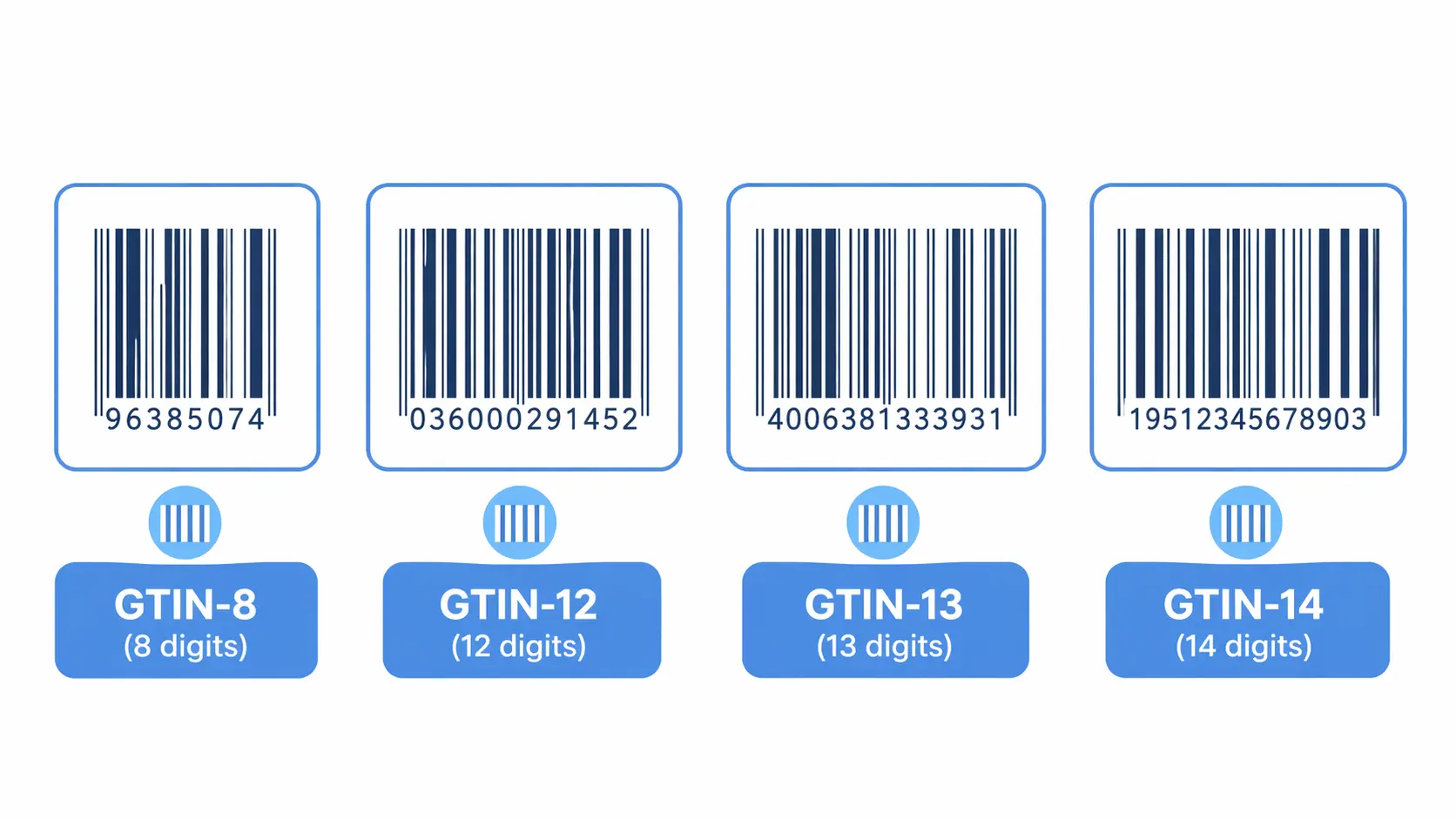
    GTINs come in four formats. Knowing which format applies to your products and markets is the first step to compliance.

    What is a GTIN?

    A GTIN — Global Trade Item Number — is the unique numerical identifier assigned to a product for use across global supply chains, retail systems, and digital commerce platforms. It is the number encoded inside a barcode, printed underneath the bars, and submitted to channels like Google Shopping and Amazon to tell their systems exactly what product you are selling.

    GTINs are governed by GS1, the global standards organisation responsible for product identification across more than 150 countries. Every legitimate GTIN traces back to a GS1 Company Prefix — a unique identifier assigned to the brand or manufacturer that owns the product.

    The key thing to understand about GTINs is that they are not optional for serious ecommerce operations. Google, Amazon, and most major marketplaces use GTINs to match your product listing against their product knowledge graphs. Without a valid GTIN, your product is effectively unverified — and channels treat unverified products with reduced visibility, lower ad performance, and in some cases outright rejection.

    GTIN formats: UPC, EAN, GTIN-8 and GTIN-14 explained

    The word “GTIN” is an umbrella term. Under it sit four distinct formats, each used in different contexts and markets. Knowing which format applies to your products is the first step to compliance.

    FormatDigitsAlso known asWhere usedTypical use case
    GTIN-88EAN-8Global, mostly outside North AmericaSmall packaging where a full barcode won’t fit
    GTIN-1212UPC, UPC-AUS and Canada primarilyStandard retail products in North American markets
    GTIN-1313EAN-13, ISBN-13Global standard outside North AmericaMost retail products sold in Europe, Asia, and globally
    GTIN-1414ITF-14GlobalCases, multipacks, and logistics units — not for point-of-sale

    For most ecommerce brands selling in North America, GTIN-12 (UPC) is the standard. For brands selling in Europe or globally, GTIN-13 (EAN-13) is the norm. For any product sold in both markets, GTIN-13 is the safer choice because it is universally accepted — a GTIN-13 works everywhere a GTIN-12 works, but not vice versa.

    UPC vs EAN — what is actually the difference?

    This is the most common source of confusion. A UPC (Universal Product Code) is a GTIN-12 — a 12-digit identifier primarily used in the US and Canada. An EAN (European Article Number) is a GTIN-13 — a 13-digit identifier used globally outside North America. Both are GTINs. Both are issued by GS1. Both encode the same kind of product identity information.

    The practical difference: if you sell exclusively in North America, UPC (GTIN-12) works fine. If you sell internationally or plan to, get a GTIN-13. Most modern channel systems accept both, but some older retail systems in the US were originally built for 12-digit UPCs and may have issues with 13-digit EANs. When in doubt, check the specific channel requirements — Google, Amazon, and Shopify all accept both.

    What is the check digit and why does it matter?

    Every GTIN ends with a check digit — a single number calculated from the preceding digits using a standard GS1 algorithm. Its sole purpose is to validate that the rest of the GTIN has been entered or transmitted correctly. If the check digit does not match the calculation, the GTIN is invalid — regardless of how legitimate the product or brand is.

    Check digit errors are one of the most common GTIN validation failures. They usually happen when GTINs are typed manually rather than imported from source, when digits are transposed, or when a GTIN from a supplier file has been accidentally truncated. A product with a check digit error will fail validation in Google Merchant Center and Amazon, often silently.

    GTIN-13 check digit calculation example:
     
    GTIN without check digit: 501234567890?
     
    Step 1 — multiply alternating digits by 1 and 3:
    5×1, 0×3, 1×1, 2×3, 3×1, 4×3, 5×1, 6×3, 7×1, 8×3, 9×1, 0×3
    = 5 + 0 + 1 + 6 + 3 + 12 + 5 + 18 + 7 + 24 + 9 + 0 = 90
     
    Step 2 — subtract from next multiple of 10:
    100 - 90 = 10 → check digit = 0
     
    Valid GTIN-13: 5012345678900

    You do not need to calculate this manually. The GTIN Validator runs this calculation automatically against every GTIN you submit and flags any that fail.

    Why GTINs matter for ecommerce channel performance

    A valid GTIN is the handshake between your product data and every channel’s product knowledge system. Without it, channels cannot confidently place your products.

    Google Shopping — 2026 requirements

    Google uses GTINs to match your product listings against its product knowledge graph — a database of verified product information that Google uses to understand what you are selling, how to price it contextually, and where to show it. Products with valid GTINs get matched to Google’s knowledge graph and benefit from that context. Products without valid GTINs are treated as unverified and ranked accordingly.

    The practical impact is significant. According to Google’s own Merchant Center guidance, advertisers who correctly provide GTINs for their products see up to 40% higher click-through rates in Shopping campaigns compared to those without. Products with missing or invalid GTINs receive a “Limited performance due to missing value [GTIN]” warning in Merchant Center — a warning that directly reduces Shopping visibility.

    For 2026, Google’s requirements remain: GTIN is mandatory for all products that have one assigned by the manufacturer. The only legitimate exception is products where no GTIN exists — custom-made items, handmade products, vintage items, or products manufactured before GTINs were assigned. For these, set the identifier_exists attribute to false in your feed. Do not leave the GTIN field blank, and never submit a fabricated or placeholder GTIN — both trigger warnings and can lead to account-level penalties.

    Amazon — GTIN requirements and exemptions

    Amazon requires GTINs (UPC, EAN, ISBN, or JAN) for most product listings and uses them to match new listings to existing product detail pages in its catalog. This matching is what determines whether your listing joins an existing product page — inheriting reviews, rankings, and buy box history — or creates a new one.

    Submitting an invalid GTIN on Amazon typically results in one of two outcomes: your listing is rejected outright, or it creates a duplicate product page that competes with the correct listing and inherits none of its history. Both are expensive outcomes.

    Amazon does offer GTIN exemptions for certain categories and for brands that manufacture products not sold by others. To apply, you submit an exemption request through Seller Central with brand documentation. Exemptions are category-specific and must be applied for separately for each category you sell in. For most branded products with manufacturer-assigned GTINs, exemption is not the right path — finding and using the correct GTIN is.

    Shopify

    Shopify does not enforce GTIN at the platform level — you can publish a product to your Shopify store without one. However, when you connect Shopify to Google Shopping, Facebook Catalog, or any other channel via Shopify’s feed integrations, the GTIN field flows through to those channels and is validated there. A missing or invalid GTIN in Shopify becomes a missing or invalid GTIN in your Google feed, with all the consequences that follow.

    Shopify’s taxonomy (v2026-02) also uses GTINs as part of its product matching and recommendation logic. Keeping your GTIN field accurate in Shopify is good hygiene regardless of which channels you use downstream.

    The most common GTIN compliance errors — and how to fix them

    Most GTIN errors are systematic — they come from the same root cause across dozens or hundreds of products, which means fixing the process fixes the whole catalog.

    Error 1: Wrong digit count

    What it looks like: A GTIN field contains 10, 11, or 15 digits instead of 8, 12, 13, or 14. Sometimes a leading zero has been dropped — a GTIN-13 stored as a GTIN-12 because the system stripped the leading zero on import.

    Root cause: Supplier data files exported from systems that did not zero-pad the GTIN field. Excel is a particular culprit — it treats GTIN columns as numbers and drops leading zeros automatically unless the column is formatted as text.

    Fix: Validate all GTINs for digit count before import. For GTINs that have had leading zeros dropped, restore them: a 12-digit EAN that should be 13 digits gets a leading zero prepended. For GTINs with legitimately wrong lengths that do not match any valid format, request the correct value from your supplier. Never pad with random digits to reach the right length — that creates a new invalid GTIN.

    Error 2: Check digit failure

    What it looks like: The GTIN has the right number of digits but fails the GS1 check digit calculation. Google Merchant Center flags it as invalid. The product gets a “Limited performance” warning.

    Root cause: Manual data entry with a transposed digit. Corruption during file transfer or format conversion. A supplier who assigned their own internal identifier in the GTIN field rather than the actual GS1-issued GTIN.

    Fix: Run your GTIN field through a check digit validator — the GTIN Validator does this for your full product list instantly. For products where the check digit fails and you cannot find the correct GTIN from the supplier, contact the manufacturer directly. The correct GTIN is registered with GS1 and traceable through the Verified by GS1 lookup service.

    Error 3: Duplicate GTINs across different products

    What it looks like: Two different products in your catalog have the same GTIN. Or the same GTIN appears on multiple variants — different sizes of the same shoe assigned the same GTIN, for example.

    Root cause: GTINs copied from one product record to another during catalog setup. Supplier files where variants were listed with the parent GTIN rather than variant-specific GTINs. Internally generated GTINs that were not assigned uniquely.

    Fix: Each unique product variant — each distinct combination of size, colour, and other defining attributes — needs its own unique GTIN. This is a GS1 requirement and a channel requirement. Run a uniqueness check on your GTIN field and flag any value that appears more than once. For products that genuinely share a GTIN in your catalog due to supplier data issues, request variant-level GTINs from the supplier or manufacturer.

    Error 4: Fabricated or placeholder GTINs

    What it looks like: GTINs like “000000000000,” “123456789012,” or any sequential or obviously fake number in the GTIN field. Sometimes these are inserted by teams trying to pass feed validation with a value in the field rather than a blank.

    Root cause: Misunderstanding of channel requirements — teams assume any value is better than no value. It is not. Google and Amazon validate GTINs against GS1’s database of registered company prefixes. A fabricated GTIN will fail this check.

    Fix: Remove fabricated GTINs entirely. For products that genuinely do not have GTINs, set identifier_exists = false in your Google feed and use the Amazon GTIN exemption process. A blank GTIN field handled correctly through these channels is far better than a fake one — fake GTINs can trigger account-level policy violations.

    Error 5: GTINs missing for products that have them

    What it looks like: Your catalog shows the identifier_exists field as false, or the GTIN field is blank, for branded products that do have manufacturer-assigned GTINs.

    Root cause: Supplier data not collected at onboarding. Products imported from a source that did not include GTINs. The GTIN field was not included in the import template.

    Fix: Add GTIN as a required field in your supplier onboarding process and in your import attribute template. For existing products with missing GTINs, request them from suppliers — any legitimate manufacturer or brand owner has their GTINs registered with GS1 and can provide them. As a last resort for branded products, the GS1 Verified by GS1 lookup service can confirm the correct GTIN for many registered products. For the broader picture on how missing GTINs relate to overall catalog data quality, the PIM data quality guide covers validity as one of the six quality dimensions.

    How to validate GTINs across your catalog

    Manual GTIN validation is not realistic beyond a handful of products. For any catalog of meaningful size, you need a systematic validation process. Here is how to approach it:

    Step 1: Export your full GTIN field

    Export every product in your catalog with its GTIN field. If you are working from a PIM or ecommerce platform, this is usually a standard export. If you are working from spreadsheets, export the GTIN column with the column formatted as text — not as a number — to prevent Excel from stripping leading zeros.

    Step 2: Run format and check digit validation

    For each GTIN, check: is it 8, 12, 13, or 14 digits? Does the check digit match the GS1 algorithm? Is it unique across the catalog? The GTIN Validator handles all three checks automatically. It accepts bulk input and returns a flagged list of every GTIN that fails, with the specific reason for each failure.

    Step 3: Cross-reference with channel warnings

    Log into Google Merchant Center and check the Diagnostics tab for any “Missing value [GTIN]” or “Invalid value [GTIN]” warnings. These are the GTINs that are actively hurting your Shopping performance right now. Prioritise these for immediate correction — every product with a GTIN warning is underperforming in Shopping ads today.

    In Amazon Seller Central, check the Inventory Health report and any listing quality warnings for GTIN-related issues. These are usually under “Listing Enhancements” or flagged as “Suppressed Listings.”

    Step 4: Build validation into import workflows

    The most effective GTIN compliance strategy is not a periodic audit — it is a quality gate at import. Every product entering your catalog, whether from a supplier feed or manual entry, should pass a GTIN format and check digit check before it is added to the live catalog. Products that fail go to a review queue, not directly to channel feeds.

    This is one of the core capabilities of a properly configured PIM. If you are not sure whether your current setup can enforce GTIN validation at import, the PIM Readiness Assessment covers data validation as one of its assessment dimensions.

    GTIN compliance by product type: what to do in edge cases

    Custom and handmade products

    Products made to order, custom-printed items, and handmade goods typically do not have manufacturer-assigned GTINs. For these: set identifier_exists = false in Google feeds. On Amazon, apply for a GTIN exemption through Seller Central. Do not fabricate a GTIN. Channels understand that some products are genuinely unidentified — they just need to be told explicitly rather than left blank or given a fake value.

    Bundles and multipacks

    A bundle of two or more products sold together as a single unit needs its own unique GTIN — you cannot reuse the GTIN of one of the component products. If you are assembling your own bundles, you need to obtain new GTINs from GS1 for each bundle configuration. For multipacks that were packaged by the original manufacturer, the multipack GTIN is typically provided with the product data and encoded as a GTIN-14.

    Private label products

    If you manufacture or private-label products under your own brand, you are responsible for obtaining and assigning GTINs. You do this by purchasing a GS1 Company Prefix from your local GS1 organisation, which gives you the right to create a defined number of GTINs under your prefix. These GTINs are then yours to assign to your products and register in the GS1 system. Do not purchase GTINs from resellers who sell individual numbers without a company prefix — these are often recycled GTINs from other brands and will fail GS1 verification.

    Vintage and pre-GTIN products

    Products manufactured before GTINs were widely adopted — antiques, vintage items, certain collectibles — may genuinely have no GTIN. Treat these the same as custom products: identifier_exists = false on Google, GTIN exemption on Amazon. Provide as much other identifying information as possible (brand, MPN, condition) to help channels understand and place the product accurately.

    GTIN compliance checklist

    Use this as a quick audit of your current GTIN health:

    • ☐ All GTINs in your catalog are 8, 12, 13, or 14 digits
    • ☐ No GTINs have had leading zeros stripped (common in Excel exports)
    • ☐ All GTINs pass GS1 check digit validation
    • ☐ No duplicate GTINs across different product variants
    • ☐ No fabricated or placeholder GTINs (000000000000, 123456789012 etc.)
    • ☐ Products without GTINs have identifier_exists = false set in Google feeds
    • ☐ Amazon GTIN exemptions are in place for products that need them
    • ☐ Google Merchant Center Diagnostics shows no GTIN warnings
    • ☐ GTIN is a required field in your supplier onboarding checklist
    • ☐ GTIN validation runs at import before products enter the live catalog

    If you have unchecked items, start with the GTIN Validator to identify exactly which products in your catalog are failing and why. For the broader data quality picture beyond GTINs, the Completeness Checker shows you where other required fields are missing across your catalog. And if you want to understand how GTIN validation fits into your overall product data infrastructure, the category mapping guide covers how the full data model connects.


    Frequently asked questions

    What is the difference between GTIN and UPC?

    A UPC (Universal Product Code) is a specific type of GTIN — specifically, a GTIN-12, the 12-digit format used primarily in the US and Canada. GTIN is the umbrella term covering all four formats: GTIN-8, GTIN-12 (UPC), GTIN-13 (EAN), and GTIN-14. All UPCs are GTINs, but not all GTINs are UPCs. For ecommerce purposes, the terms are often used interchangeably in channel documentation, but technically they refer to different things.

    Does every product need a GTIN?

    Every product that has been assigned a GTIN by its manufacturer needs that GTIN submitted to channels like Google and Amazon. Products that genuinely do not have a GTIN — custom goods, handmade items, vintage products, private label items you manufacture yourself without GS1 registration — can set identifier_exists = false on Google or apply for GTIN exemption on Amazon. You should never fabricate a GTIN for a product that does not have one.

    How do I get a GTIN for my product?

    GTINs are issued through GS1. You purchase a GS1 Company Prefix from your local GS1 organisation — this is a unique prefix that identifies your company in the global GS1 system. You then assign GTINs to your products using that prefix. Do not purchase GTINs from third-party resellers who sell individual barcodes without a company prefix — these are often recycled identifiers from other brands and will fail GS1 verification checks on Google and Amazon.

    Why is my GTIN being rejected by Google Merchant Center?

    Google validates GTINs against GS1’s database. The most common reasons for rejection are: wrong digit count (GTIN should be 8, 12, 13, or 14 digits), check digit failure (the last digit does not match the GS1 algorithm), a fabricated or placeholder GTIN, or a GTIN that cannot be verified as registered to any known company prefix. Run your GTINs through the GTIN Validator to identify the specific reason for failure, then either correct the GTIN or set identifier_exists = false if the product genuinely has no GTIN.

    Does each product variant need its own GTIN?

    Yes. Each unique product variant — each distinct combination of defining attributes like size and colour — needs its own unique GTIN. A blue t-shirt in size M and the same t-shirt in size L are different products from a channel perspective and require different GTINs. Reusing the same GTIN across variants is a GS1 standard violation and causes listing conflicts on Amazon and Google Shopping.

    What is the GTIN exemption on Amazon?

    Amazon’s GTIN exemption allows sellers to list products that genuinely do not have manufacturer-assigned GTINs — typically private label brands, custom products, or certain categories where GTINs are not standard. The exemption is category-specific and must be applied for through Seller Central with brand documentation. It is not a general workaround for products that have GTINs but where you do not have them — for those, you need to obtain the correct GTIN from the manufacturer.


  • PIM Data Quality: How to Measure, Score & Fix Your Product Data (2026)

    PIM Data Quality: How to Measure, Score & Fix Your Product Data (2026)

    PIM Data Quality: How to Measure, Score, and Improve Your Product Data in 2026

    Here is a scenario most ecommerce teams recognise. A product goes live with the right title and a price. Three weeks later, a customer emails asking why the size guide is missing. Someone checks the PIM. The size attribute is blank for that entire category. It has been blank since import. Nobody noticed because nobody was measuring.

    That is what poor PIM data quality actually looks like in practice. Not dramatic failures. Quiet gaps that compound over time — missing fields, inconsistent values, invalid GTINs — until they start costing you in channel rejections, poor search rankings, higher returns, and customers who abandon product pages because the information they need is not there.

    This guide covers the full picture: what PIM data quality actually means, how to measure it across the six dimensions that matter, how to build a scoring system for your catalog, and how to fix the most common problems before they hit your channels. If you want to know where your data stands right now, the Completeness Checker will show you in under two minutes.

    Data quality is not one number — it is six distinct dimensions, each of which can fail independently and each of which affects your catalog differently.

    Why product data quality problems are more expensive than they look

    The cost of bad product data is easy to underestimate because most of it is invisible. It does not show up as a single line item on a P&L. It shows up as a thousand small frictions that nobody traces back to their source.

    Gartner research puts the average annual cost of poor data quality at $12.9 million per organisation. For ecommerce teams specifically, that number is made up of things like:

    • Channel rejections. Google Merchant Center and Amazon reject or suppress products with missing required fields, invalid GTINs, or non-compliant attribute values. Every suppressed listing is revenue you are not generating.
    • Higher return rates. Products with incomplete or inaccurate descriptions — missing size guides, wrong dimensions, vague material information — get returned at significantly higher rates. The customer received something different from what the product page implied.
    • SEO underperformance. Product pages with thin or incomplete data have less content for search engines to index, fewer relevant terms to rank for, and lower engagement signals from the users who do land on them.
    • Team time lost to firefighting. In organisations without a systematic data quality process, a meaningful portion of every product manager’s week goes to finding and fixing data problems that a structured quality framework would have caught automatically at input.
    • Customer abandonment. Research from the Baymard Institute consistently shows that incomplete product information is one of the top reasons customers abandon product pages without purchasing. You cannot sell a product someone cannot fully evaluate.

    The good news is that data quality problems are fixable — systematically, not just case by case. But you have to be able to measure them first.

    The six dimensions of PIM data quality

    Data quality is not a single score. It is a profile across six distinct dimensions, each of which can fail independently and each of which affects your catalog in different ways. Understanding which dimension is failing in your catalog tells you exactly what kind of fix is needed.

    Each dimension fails differently and requires a different fix — which is why treating “data quality” as a single problem leads to unfocused, ineffective cleanup campaigns.

    1. Completeness

    Completeness is the most visible dimension: are all the required fields populated for a given product? It is also the easiest to measure — you can express it as a percentage. A product with 18 out of 24 required fields filled is 75% complete.

    But completeness is category-specific. A 100% complete record for a T-shirt is missing essential information for a laptop. Your completeness measurement has to be applied against the attribute template for the product’s category, not against a universal field list. A T-shirt with no processor specification is not “incomplete” — a laptop with no processor specification is a serious problem.

    This is why taxonomy design and data quality are inseparable. Without a well-defined taxonomy with category-specific attribute templates, you cannot accurately measure completeness at scale.

    2. Accuracy

    Accuracy means the data correctly reflects reality. A product listed as weighing 500g that actually weighs 750g is inaccurate. A jacket described as 100% cotton that is actually a cotton-polyester blend is inaccurate. A product listed as available in blue, black, and red when red has been discontinued for six months is inaccurate.

    Accuracy is the hardest dimension to measure at scale because it often requires comparison against a source of truth outside the PIM — supplier specs, physical samples, or manufacturer documentation. The most effective approach is to build accuracy checks into supplier onboarding and product creation workflows, rather than trying to audit accuracy retroactively across a live catalog of thousands of SKUs.

    3. Consistency

    Consistency means the same information is represented the same way across all products where it applies. “Cotton,” “100% Cotton,” “cotton,” and “Ctn” are four representations of the same value that will all be treated as different values by any system that processes them — including Google Shopping’s feed parser, Amazon’s attribute matcher, and your own faceted search filters.

    Consistency problems almost always originate from the absence of controlled value lists. If your Color attribute can accept any free-text input, “Black,” “black,” “Jet Black,” “Noir,” and “BLK” will all end up in your catalog representing the same colour. The fix is not cleanup — it is enforcing a controlled vocabulary at input so the problem cannot enter the system in the first place.

    4. Timeliness

    Timeliness means your data reflects the current state of the product. Prices that have not been updated since a supplier price increase, stock status fields that say “In Stock” for products that were discontinued two months ago, descriptions that reference a promotion that ended in January — these are timeliness failures.

    Timeliness is particularly critical for anything that feeds into advertising. A Google Shopping ad that drives someone to a product page for an out-of-stock or discontinued item burns ad budget, damages trust, and inflates your bounce rate simultaneously.

    5. Uniqueness

    Uniqueness means each real-world product has exactly one record in your system. Duplicate product records — the same SKU appearing twice, or the same product entered under two different names by two different team members — create inventory reporting errors, inconsistent channel exports, and confusion during enrichment when both records get updated but in different ways.

    Duplicates are most commonly introduced at supplier import when a product arrives that already exists in the catalog under a slightly different SKU or title. A deduplication check at import — comparing incoming GTINs, MPNs, or titles against existing records — catches most of them before they enter the live catalog.

    6. Validity

    Validity means the data conforms to the rules and formats that govern it. A GTIN field containing a 10-digit value is invalid — GTINs are 8, 12, 13, or 14 digits. A Size field containing “extra large” when the controlled list specifies “XL” is invalid. An EAN that fails its check digit calculation is invalid and will cause feed rejections in every channel that validates it.

    Validity failures are particularly dangerous because they look fine to human reviewers but fail automated processing silently. A product with an invalid GTIN will not throw an obvious error on your product page — it will quietly underperform in Google Shopping while your team spends weeks trying to understand why that category is not converting.

    If GTIN validity is a concern in your catalog, run your product identifiers through the GTIN Validator — it checks format, check digit, and compliance against GS1 standards instantly.

    How to build a data quality score for your product catalog

    A data quality score gives you a single number that represents the overall health of your catalog — and more usefully, a breakdown by dimension and by category that tells you exactly where to focus. Here is a straightforward scoring model that works for most ecommerce catalogs.

    A scoring model turns “our data has issues” into “these 340 products in the Footwear category are failing completeness, and here are the specific fields missing.”

    Step 1: Define your required fields per category

    Scoring completeness only makes sense against a defined standard. For each leaf-level category in your taxonomy, document which fields are required for a product to be considered publishable. These become your completeness benchmark for that category.

    Separate required fields from recommended fields. Required fields are those without which the product should not be published to any channel — things like title, description, primary image, category, and any channel-mandatory attributes. Recommended fields are those that significantly improve conversion or channel performance but are not technically blocking — things like secondary images, detailed care instructions, or enhanced marketing copy.

    Step 2: Apply dimension weights

    Not all six dimensions are equally important for every catalog. A simple weighting model for most ecommerce operations:

    DimensionWeightWhy
    Completeness30%Missing fields block publishing and harm SEO
    Accuracy25%Wrong information drives returns and complaints
    Validity20%Invalid values cause silent channel failures
    Consistency15%Inconsistent values break filters and feed matching
    Timeliness7%Stale data creates customer trust issues
    Uniqueness3%Duplicates cause reporting and enrichment problems

    Adjust these weights based on your business. If you sell exclusively through Google Shopping and Amazon, validity should carry more weight because feed rejections from invalid GTINs are your most immediate revenue risk. If you have a large supplier-fed catalog with known duplicate problems, bump up uniqueness.

    Step 3: Score at product level, aggregate at category level

    Calculate a quality score for each individual product, then aggregate those scores by category. Aggregating by category is what makes the scores actionable — it tells you whether you have a system-wide problem or a category-specific one, and it lets you prioritise cleanup work by the categories that drive the most revenue.

    A product-level completeness score is straightforward:

    Completeness score = (fields populated / required fields for category) × 100
     
    Example:
    Running Shoes — required fields: 12
    Fields populated on product ID 4821: 9
    Completeness score: 9/12 × 100 = 75%

    A product with a completeness score below your publishability threshold (typically 80–90% depending on your standards) should not go live. A category with an average completeness score below that threshold needs a systematic fix at the import or enrichment layer, not individual product-by-product patching.

    Step 4: Set thresholds and automate alerts

    Define three quality tiers for your catalog and configure your system to flag products accordingly:

    • Publishable (green): Meets all required field minimums and passes validity checks. Can be published to all channels.
    • Needs enrichment (amber): Meets required fields but missing recommended fields, or has consistency warnings. Can be published to primary channels but should not be considered complete.
    • Blocked (red): Missing required fields, invalid values, or failing validity checks. Should not be published until fixed.

    The blocked tier is the one that causes the most immediate revenue impact. Products in the blocked tier are either not live at all, or live but suppressed in channel feeds — both bad outcomes. Clearing the blocked tier should always be the first priority when improving data quality scores.

    The most common PIM data quality problems — and exactly how to fix them

    Problem: Missing required fields at category level

    What it looks like: You run a completeness report and find that 40% of products in your Footwear category are missing the “Upper Material” field. The field exists in the system — it just never got populated.

    Root cause: Usually one of three things. The attribute template for that category was not defined when the products were imported. The supplier’s data file did not contain that field. Or the field was added to the template after the products were already in the system and nobody went back to populate it retroactively.

    Fix: Bulk enrichment against your supplier’s source data where the field exists there. For fields your supplier did not provide, this becomes a manual enrichment task — prioritise the highest-revenue products first. Going forward, enforce the attribute template at import so new products cannot enter the catalog with required fields missing. The guide on cleaning supplier product data covers the import hygiene side of this in detail.

    Problem: Inconsistent values in key attributes

    What it looks like: Your Color filter on the storefront returns 47 distinct values for what should be about 12 colours. “Navy,” “Navy Blue,” “Dark Blue,” “Midnight Blue,” and “NAVY” are all in there. Customers filtering by “Blue” miss half the relevant products.

    Root cause: Free-text input on attributes that should use a controlled value list. Different suppliers use different colour terminology. Different team members entered values without a standard. The attribute was never standardised.

    Fix: Create a controlled value list for the Color attribute with your approved values. Run a one-time bulk remap of all existing non-standard values to the correct standard ones (a find-and-replace operation in most PIM systems). Then enforce the controlled list going forward so new values can only be selected from the approved list. This is a one-time migration cost that pays back on every single feed export you run for the rest of the catalog’s life.

    Problem: Invalid or missing GTINs

    What it looks like: Your Google Merchant Center account shows “Limited performance due to missing value [GTIN]” warnings across a significant portion of your catalog. Some products have GTINs entered but they are failing validation — check digit errors, wrong digit count, or duplicate GTINs assigned to different products.

    Root cause: GTINs were not collected from suppliers at import, were entered manually with errors, or were assigned internally without following GS1 GTIN standards. This is one of the most commercially damaging data quality problems in ecommerce because it directly affects Google Shopping performance — Google prioritises products with valid GTINs in Shopping auctions, and advertisers with correct GTINs see up to 40% higher click-through rates according to Google’s own data.

    Fix: Validate your entire GTIN field against GS1 standards. The GTIN Validator checks format, digit count, and check digit compliance in seconds. For products with missing GTINs, request them from your suppliers — most legitimate branded products have assigned GTINs that suppliers are required to provide. For products genuinely without GTINs (custom products, handmade items), set the identifier_exists field to false in your Google feed rather than leaving the GTIN field blank or entering an invalid value.

    Problem: Stale product descriptions after seasonal or specification changes

    What it looks like: A product description still references a bundle component that was removed six months ago. A care instruction says “machine washable at 40°C” but the fabric changed to a wool blend in the latest version that requires hand wash only. A technical specification references last year’s component that has since been upgraded.

    Root cause: Product updates happened in a sourcing or product development system but did not flow through to the PIM. Or product data was managed in spreadsheets and only part of it was updated when the change happened.

    Fix: Establish a change notification process: when a product’s specification changes at source — in your ERP, in supplier documentation, in your product development workflow — there should be a trigger that flags the corresponding PIM record for review. This does not need to be fully automated (though automation is ideal). A simple process where spec changes are communicated to whoever owns the PIM record, with a 48-hour SLA for updates, prevents most timeliness failures.

    Problem: Duplicate product records from supplier imports

    What it looks like: You have two records for the same product — one created manually six months ago, one imported from a supplier feed last month. They have different titles, different image sets, and different completeness scores. Some channels are serving one, some are serving the other. Inventory reporting is wrong because both records are showing separate stock counts.

    Root cause: No deduplication check at import. The import process does not compare incoming products against existing records before creating new ones.

    Fix: Add a GTIN or MPN matching step to your import workflow. Before creating a new product record, check whether a product with the same GTIN or MPN already exists. If it does, update the existing record rather than creating a new one. For existing duplicates, merge records manually — preserving the richer data from each — then audit your channel mappings to ensure all channels are pointing to the consolidated record.

    Building a data quality process that runs continuously — not as a one-time fix

    The single biggest mistake teams make with product data quality is treating it as a cleanup project. They spend two weeks fixing everything, declare victory, and watch the problems come back within three months because nothing changed about how data enters or moves through the system.

    Data quality is a process, not a state. Here is what a continuous quality process looks like in practice:

    Quality gates at import

    Every product entering the catalog — whether from a supplier feed, a manual entry, or a migration — should pass through a set of quality gates before it is added to the live catalog. At minimum: required field check, GTIN validation, controlled value list compliance, and duplicate check. Products that fail any gate go to a holding queue for review, not directly into the live catalog.

    Weekly completeness monitoring

    Run a completeness report by category every week. Look for categories where the average completeness score dropped — this usually means new products were added without full enrichment. Set a rule: no new products are considered “launched” until they hit your completeness threshold. Time-to-market pressure is the most common reason completeness scores degrade, because teams push products live before enrichment is complete. Embedding the quality threshold into the launch definition prevents this.

    Monthly validity audits

    Run your GTIN fields through a validator monthly. Check your channel feeds for any new suppression or rejection warnings in Google Merchant Center and Amazon Seller Central. Channel platforms update their requirements — what was a valid submission last quarter may fail a new validation rule this quarter. Monthly audits catch these changes before they compound into significant traffic losses.

    Quarterly data quality reviews

    Once a quarter, look at your full quality score across all six dimensions and compare it to the previous quarter. Are scores improving, degrading, or stable? Where are the biggest gaps? Which categories need the most attention? This review should feed directly into the following quarter’s enrichment prioritisation. The goal is not perfection — it is measurable, consistent improvement that you can point to as evidence of operational progress.

    If you are not sure where to start with assessing your current data infrastructure, the PIM Readiness Assessment covers data quality governance as one of its five dimensions and gives you a concrete starting point. And if you want to understand what a PIM needs to provide to support the processes described in this guide, the 2026 PIM guide covers the full capability picture.

    PIM data quality checklist

    Use this as a starting-point audit for your catalog:

    • ☐ Every leaf-level category has a defined required attribute template
    • ☐ Controlled value lists are enforced for Color, Size, Material, and other key attributes
    • ☐ All GTINs have been validated against GS1 standards
    • ☐ Products without GTINs are marked identifier_exists = false in channel feeds
    • ☐ A completeness score is calculated per product against its category template
    • ☐ Products below your publishability threshold are blocked from channel export
    • ☐ Import workflows include duplicate detection (GTIN/MPN matching)
    • ☐ Import workflows include required field validation before products enter the live catalog
    • ☐ A process exists for propagating product specification changes from source into the PIM
    • ☐ Completeness is monitored weekly, validity is audited monthly
    • ☐ A quarterly data quality review compares scores across periods

    If you checked fewer than seven of these, your catalog has quality gaps that are currently costing you in channel performance, team time, or both. The Completeness Checker is the fastest way to see exactly where the gaps are concentrated.


    Frequently asked questions

    What is PIM data quality?

    PIM data quality refers to how well the product information stored in your Product Information Management system meets the standards required for it to be useful — for internal operations, for channel publishing, and for customer decision-making. It is measured across six dimensions: completeness, accuracy, consistency, timeliness, uniqueness, and validity. Poor PIM data quality results in channel rejections, higher return rates, lower search rankings, and customers who cannot find or evaluate your products effectively.

    How do you measure product data quality?

    The most practical approach for ecommerce teams is to start with completeness — the percentage of required fields populated for a given product against its category’s attribute template. From there, add validity checks (particularly GTIN validation), consistency monitoring (checking for non-standard values in controlled-list attributes), and periodic accuracy audits against supplier source documents. Aggregate scores by category rather than at the overall catalog level to make the results actionable.

    What causes product data quality problems?

    The most common causes are: supplier data arriving without required fields or in inconsistent formats; attribute templates that were not defined before import; free-text input on fields that should use controlled value lists; no duplicate detection at import; product specification changes that are not propagated into the PIM; and teams prioritising speed-to-market over completeness so products go live before enrichment is finished. Most data quality problems are process failures, not data failures — they are preventable with the right governance at input.

    How do invalid GTINs affect Google Shopping performance?

    Google uses GTINs to match your product listings against its product knowledge graph. Products with valid GTINs are matched to the right product in Google’s system, which improves ad relevance, Shopping feed placement, and eligibility for Google’s performance features. Products with missing or invalid GTINs receive a “Limited performance due to missing value [GTIN]” warning and are at a disadvantage in Shopping auctions. Google’s own data shows that advertisers with correct GTINs see up to 40% higher click-through rates. Invalid GTINs — those with wrong digit counts or failing check digit validation — can also cause product disapprovals in Merchant Center.

    What is a good product data completeness score?

    For products to be considered publishable to primary channels, a completeness score of 85–90% against the required attribute template is a reasonable threshold for most ecommerce catalogs. For high-consideration or high-value products — electronics, fashion, home furnishings — where the customer research process is more intensive, 95%+ completeness on required and recommended fields is a better target. For marketplace channels with strict data requirements (Amazon in particular), completeness requirements are effectively set by the channel’s mandatory fields, which vary by category and should be checked in the relevant Browse Tree Guide.


  • Ecommerce Product Taxonomy: Category Mapping Rules & Guide (2026)

    Ecommerce Product Taxonomy: Category Mapping Rules & Guide (2026)

    Most ecommerce teams know their taxonomy is a mess. Products miscategorised at import, filters returning garbage results, Google Shopping feeds rejected for category mismatches — these are symptoms of the same underlying problem. The category mapping layer was never properly designed.

    This guide fixes that. It covers what an ecommerce product taxonomy actually is, how to build category mapping rules that hold up at scale, what Google’s January 2026 taxonomy changes mean for your feed strategy, and how to handle the hardest part — incoming supplier data that arrives in fifteen different formats and calls the same product by six different names.

    If you already have a taxonomy and want to understand why your hierarchy keeps drifting, start at the taxonomy structure guide. If you’re starting from scratch or rebuilding your mapping layer specifically, you’re in the right place.

    A well-designed ecommerce product taxonomy is the structural layer behind every clean catalog, accurate feed, and consistent customer experience.

    What is an ecommerce product taxonomy — and what it isn’t

    An ecommerce product taxonomy is the hierarchical classification system that defines how every product in your catalog is organised, enriched, and mapped to sales channels. It’s the skeleton that everything else sits on top of.

    Here’s what that looks like in practice:

    Clothing (Level 1)
      └── Women's Clothing (Level 2)
            └── Tops (Level 3)
                  └── Blouses (Level 4 — leaf category)
                        ├── Required: Color, Size, Fabric, Sleeve Length
                        └── Optional: Neckline, Pattern, Occasion

    The leaf category — Blouses — is where products actually live. Every leaf category should have a defined attribute template attached to it: the specific fields that apply, the values those fields can take, and which ones are required versus optional. That template is what drives data completeness, and data completeness is what drives channel eligibility.

    Here’s the distinction that trips up most teams: a taxonomy is not the same as navigation. Your internal classification taxonomy answers the question “what is this product and how should it be enriched?” Your customer-facing navigation answers “how does a shopper find this product?” These two things are related but should not be the same structure. A product might live in Clothing > Women’s > Tops > Blouses in your taxonomy, while appearing under New In, Work Wardrobe, and Under £50 in navigation. Conflating the two is how taxonomies become impossible to maintain.

    Research from the Baymard Institute‘s large-scale ecommerce UX studies found that poor category taxonomy is one of the top five causes of site abandonment. Customers who can’t find a product within a few clicks leave — and they rarely come back.

    Why category mapping specifically is where most taxonomies fall apart

    Taxonomy design and category mapping are related but different problems. Taxonomy design is about building the right structure. Category mapping is about consistently and accurately placing products into that structure — especially when those products are coming from external sources that don’t know or care what your structure looks like.

    Three scenarios where mapping breaks consistently:

    Supplier data arrives with its own category logic

    A supplier sends a product feed. Their file calls the category “M-SHIRTS-CASUAL.” Another supplier sends the same type of product under “Men Tops.” A third has it as “Casualwear > Male.” All three should land in your Clothing > Men’s > T-Shirts category. Without mapping rules, someone maps this manually every time. With mapping rules, it’s automated on import.

    This is the single biggest source of catalog quality problems in multi-supplier operations. The fix isn’t cleaning up the mess downstream — it’s building mapping rules that prevent the mess from entering the catalog in the first place. The guide on cleaning supplier product data covers the broader data quality side of this.

    Products get mapped to the wrong level of specificity

    Products mapped too broadly — a pair of trail running shoes classified as just “Footwear” — miss the attribute template that would enforce the right data fields. They arrive in the catalog missing drop height, terrain type, upper material, and pronation guidance. They then get flagged as incomplete. No one knows why because the category assignment looks fine at a glance.

    Products mapped too specifically — an “Organic Cotton Relaxed-Fit French-Tuck Blouse” classified into a category that only exists for that one product type — create a taxonomy with hundreds of single-item categories that’s impossible to govern.

    The right level is almost always the leaf category that applies a meaningful, shared attribute template to a coherent group of products — specific enough to enforce relevant data, broad enough that multiple products belong in it.

    Internal teams use category names inconsistently

    Without a style guide and an enforced taxonomy, different team members create their own category interpretations. “Men’s Shoes” and “Mens Shoes” and “Shoe – Men” are three different category IDs in a system and three identical-looking things to a human reviewing a spreadsheet. Over 18 months with a growing team and no governance, this compounds into a catalog where the same product type exists in eight different places under eight slightly different names.

    The answer isn’t cleanup campaigns. The answer is building the mapping rules and governance that prevent the problem from recurring. We’ll cover both.

    How to build ecommerce category mapping rules that actually hold

    Category mapping rules are the translation layer between how the outside world classifies products and how your taxonomy does.

    A category mapping rule is a conditional statement: if an incoming product matches this pattern, it goes into this internal category and inherits this attribute template. Rules can be based on the supplier’s category label, keywords in the product title, specific field values in the data, or a combination.

    The logic of a mapping rule looks like this:

    IF supplier_category CONTAINS "T-Shirt" OR "Tee" OR "M-SHIRTS"
      OR product_title CONTAINS "t-shirt" OR "tshirt" OR "tee"
    THEN internal_category = "Clothing > Men's Clothing > T-Shirts"
    AND apply_attribute_template = "T-Shirts_Men"
    AND flag_for_review = FALSE

    And critically, you need a fallback for everything that doesn’t match:

    IF no_rule_matches
    THEN internal_category = "Unmapped — Needs Review"
    AND flag_for_review = TRUE
    AND notify = [taxonomy-owner@yourcompany.com]

    The unmapped holding category is non-negotiable. Products that don’t match any rule should never be silently placed into a default category — they end up miscategorised, inherit the wrong attribute template, and produce bad data downstream with no visible error.

    Building your mapping rules document

    Before you encode rules into any system, document them in a mapping spreadsheet. Columns you need:

    Supplier Category InputMatch LogicInternal Category TargetAttribute TemplateLast Reviewed
    M-SHIRTS-CASUAL, Men Tops, Casualwear > MaleCONTAINS any ofClothing > Men’s > T-ShirtsT-Shirts_Men2026-01-15
    WOMENS-BLOUSE, Women’s Tops > FormalCONTAINS any ofClothing > Women’s > Tops > BlousesBlouses_Women2026-01-15
    [No match]FallbackUnmapped — Needs ReviewNone

    This document becomes your taxonomy’s source of truth for supplier onboarding. Every new supplier gets mapped here first, before their data touches the catalog. The effort at onboarding is twenty minutes of mapping work. The cost of skipping it is months of catalog cleanup.

    Rules for building good mapping rules

    A few principles that separate mapping rules that hold from ones that drift:

    • Never let supplier categories become your internal categories. Suppliers optimise for their own operations, not yours. Their category names reflect how they organise their warehouse, not how your customers browse or how your data model is structured.
    • Build rules at the supplier level, not just the category level. Supplier A’s “Tops” and Supplier B’s “Tops” may not mean the same thing. Prefix your rules with supplier ID where the same label appears across multiple sources with different product types behind it.
    • Log every manual override. If someone manually reassigns a product that the mapping rules should have caught, that’s a signal the rule is wrong or incomplete. Log it. If the same pattern appears three times, create a new rule.
    • Review rules quarterly. Suppliers change their data formats. Seasonal categories come and go. New product types emerge that your original rules didn’t anticipate. A mapping rule set that was accurate in January may have meaningful gaps by April.

    Hierarchy design: how deep is too deep, how broad is too broad

    The most common taxonomy design question is about hierarchy depth. Teams building their first proper taxonomy usually either go too shallow (everything in five categories with no subcategory structure) or too deep (seven levels of subcategories that collapse under their own maintenance weight).

    The practical guideline for most ecommerce catalogs is 3 to 5 levels maximum. Here’s why that number makes sense and what it looks like in practice:

    • Level 1 — Department: Clothing, Electronics, Home & Garden, Sports
    • Level 2 — Category: Women’s Clothing, Laptops, Garden Tools
    • Level 3 — Subcategory: Tops, Gaming Laptops, Hand Tools
    • Level 4 — Leaf category (where products live): Blouses, RTX Gaming Laptops, Pruning Shears

    When you feel the urge to go to Level 5 or deeper, the right question to ask is: does this product type genuinely need a different attribute set, or am I just trying to describe a variation? If it’s a variation — color, size, material, fit, terrain type — that’s an attribute. Attributes are cheap and infinitely flexible. Categories are expensive because every category you add needs naming, governance, a mapping rule, and a channel mapping. Use them only when they’re genuinely warranted.

    The test that makes this concrete: if you removed this subcategory and merged its products into the parent, would those products need different fields? If yes — the subcategory earns its place. If no — it’s just label-making.

    For a deeper guide on hierarchy architecture, attribute design, and governance models, the scalable taxonomy structure guide covers the structural layer in detail.

    Mapping your taxonomy to channel requirements in 2026

    Your internal taxonomy and your channel taxonomies are different things that need to stay in sync. Your internal taxonomy is designed around your data model. Channel taxonomies — Google, Amazon, Shopify — are designed around their own requirements, which change independently of you and don’t care about your internal structure.

    The right model is a channel mapping layer: a separate table that maps each of your internal leaf categories to the correct category ID in each channel. One internal category might map to different targets across channels, and that’s expected and fine — as long as the mapping is explicit and maintained.

    Your internal taxonomy is the hub. Channel category mappings are the spokes — maintained separately so changes in any channel don’t break your internal structure.

    Google Product Taxonomy — January 2026 changes (deadline: July 31, 2026)

    Google made its most significant product taxonomy update in several years in January 2026. Four new top-level categories were introduced: Smart Home & IoT, Electric Vehicles & Accessories, Sustainable Products, and AI & Robotics. The Electronics and Health & Beauty categories were substantially expanded and reorganised.

    Google has set a compliance deadline of July 31, 2026. Products that remain mapped to deprecated or renamed categories after this date may see reduced Shopping visibility or feed rejection. If you sell in any of these affected verticals, audit your Google category mappings now.

    The full Google product taxonomy is publicly available and updated with each version. Always reference the official source — there are outdated versions circulating in third-party tools that will cause feed rejections.

    Key principle for Google taxonomy mapping: always map to the most specific applicable category, not the nearest parent. Google’s algorithm rewards specificity. A pair of trail running shoes mapped to Apparel & Accessories > Shoes will underperform against a competitor who correctly mapped to Apparel & Accessories > Shoes > Athletic Shoes > Running Shoes.

    Shopify Standard Product Taxonomy (v2026-02)

    Shopify’s standard taxonomy is newer and actively evolving — the current release is v2026-02. It uses machine learning to suggest categories based on product titles and descriptions, which reduces manual mapping work for simple catalogs. However, the suggestions are not always accurate and should always be verified, particularly for products with ambiguous titles or dual-use cases.

    Shopify’s taxonomy is increasingly being adopted as a reference standard beyond the Shopify ecosystem, particularly among mid-market brands building channel-agnostic product data models. It’s worth mapping to even if it’s not your primary channel.

    Amazon Browse Tree Guide

    Amazon has over 10,000 categories and splits them between open listing categories (anyone can list) and gated categories requiring prior approval. Your internal categories will rarely map 1:1 to Amazon’s Browse Tree — the structures are built with different goals in mind.

    The most common Amazon mapping mistake is categorising at too high a level because it’s easier. “Electronics” is valid but useless. “Electronics > Camera & Photo > Digital Cameras > Mirrorless Cameras” is what Amazon’s algorithm expects and what drives relevant placement. Deep, specific mapping consistently outperforms broad mapping in Amazon search visibility.

    GS1 as a classification baseline

    If you sell B2B, wholesale, or through retail trading partners who require standardised product data exchange, the GS1 Global Product Classification (GPC) standard is worth understanding. GS1 provides a universal language for product classification used by major retailers and distributors globally. It won’t replace your internal taxonomy, but knowing how your categories map to GS1 bricks and segments makes retailer onboarding significantly faster.

    Category mapping by role: who maps what, and when

    One of the most overlooked dimensions of category mapping is the human side: different roles in an ecommerce organisation interact with the taxonomy at different points and with different goals. When the mapping process isn’t designed with roles in mind, it breaks down at handoff points.

    Founder or category manager — strategic mapping

    At the strategic level, category decisions are about which product types belong in the catalog, how they relate to each other commercially, and how the top-level taxonomy structure reflects the brand’s positioning. A founder building a DTC brand in a specific vertical needs to make deliberate decisions about category structure early, because those decisions affect everything from navigation UX to attribute standardisation to how Google indexes the site. Getting this right early is dramatically cheaper than restructuring a live catalog later.

    Product manager or merchandiser — operational mapping

    Product managers and merchandisers are typically the people doing the day-to-day mapping work — classifying new products, reviewing unmapped items, deciding whether a new product type needs a new leaf category or can fit into an existing one. This is where the mapping rules document and the style guide are most critical. Without them, these decisions get made inconsistently across team members and shifts, and the taxonomy drifts.

    Supplier onboarding team — import mapping

    The supplier onboarding team is the first line of defense against bad category data entering the catalog. Their job is to map each new supplier’s category structure to your internal taxonomy before any product data is imported. This mapping is almost always manual for the first supplier from a given source. Once documented, it becomes a rule set that future imports use automatically. Teams that treat supplier mapping as a one-time setup task rather than a governed process end up re-doing it every time a supplier updates their feed format.

    If your supplier data quality is a consistent bottleneck, it’s worth assessing the broader picture with the PIM Readiness Assessment — it surfaces exactly where in the data flow the problems are concentrated.

    Taxonomy naming conventions: the part everyone skips

    Naming inconsistency is the silent killer of otherwise well-designed taxonomies. “Men’s Running Shoes,” “Mens Running Shoes,” “Running Shoes – Men,” and “Men > Running > Shoes” are four different category IDs in any system and four identical-looking things to a human skimming a spreadsheet. At twenty categories, this is manageable. At two thousand, it’s catastrophic.

    Write down these decisions before you build, and enforce them without exceptions:

    • Singular vs. plural: Pick one and use it at every level. (“Shoe” or “Shoes” — not both.) Most operational taxonomies use singular. Most navigation taxonomies use plural. Decide which model you’re building.
    • Possessives: “Women’s” or “Women” or “Female”? One form, every time.
    • Ampersands vs. “and”: “Home & Garden” or “Home and Garden”? One form.
    • Capitalisation: Title Case or Sentence case? Either works. Inconsistency doesn’t.
    • Special characters: Avoid them in category names used as system identifiers. Use them only in display labels if needed.
    • Abbreviations: None in category names. “TV & AV” is opaque. “Televisions & Audio-Visual Equipment” is self-explanatory.

    This should live in a one-page taxonomy style guide that every person who touches the catalog has read. It doesn’t need to be complex. It needs to exist and be the single reference point that ends “well I didn’t know we did it that way” conversations.

    The attribute template layer: where taxonomy connects to data quality

    Category mapping without attribute templates is half a solution. The point of placing a product in the right category isn’t just organisational — it’s so that the correct attribute template applies, which defines what fields are required, what values are acceptable, and what gets validated before the product can be published.

    A simple attribute template table for a leaf category looks like this:

    CategoryRequired AttributesOptional AttributesControlled Value Lists
    Running ShoesBrand, Gender, Size, Color, Upper MaterialTerrain Type, Drop Height, PronationGender: [Men, Women, Unisex, Kids]
    BlousesBrand, Size, Color, Sleeve Length, FabricOccasion, Pattern, NecklineSleeve: [Short, Long, 3/4, Sleeveless]
    Gaming LaptopsBrand, Processor, RAM, Storage, GPU, Screen SizeRefresh Rate, Weight, Battery LifeRAM: [8GB, 16GB, 32GB, 64GB]

    The controlled value lists in the right column are what prevent the “Cotton / 100% Cotton / Ctn / cotton” problem from ever entering the system. When the acceptable values for a field are pre-defined and enforced at input, downstream exports to Google, Amazon, and any other channel become dramatically cleaner.

    If you want to see how complete your current product data actually is across categories, the Completeness Checker will show you exactly where the gaps are by category and by field.

    For the full picture on what PIM infrastructure you need to enforce this properly at scale, the 2026 PIM guide covers the system requirements end-to-end.

    Taxonomy governance: the process that keeps everything from breaking again

    You can design a perfect taxonomy today and have it in disarray within twelve months without governance. Governance is the set of rules and processes that control how the taxonomy changes over time — not to prevent change, but to make sure changes are deliberate, documented, and communicated to every system that depends on them.

    The minimum governance model for a growing ecommerce operation:

    • Single owner: One person (or team) is accountable for the taxonomy. Change requests go through them. This doesn’t mean they do all the work — it means there’s no ambiguity about who decides.
    • Creation criteria: A new category is only created when products in it need a different attribute template OR when customers browse for them distinctly. Everything else becomes an attribute or a tag.
    • Change log: Every category creation, rename, merge, or deletion is recorded with a date, the requester, and the reason. This is what prevents “I don’t know why we have three categories called Tops” six months from now.
    • Review cadence: Quarterly taxonomy health checks. Check for orphaned products (not assigned to any category), empty categories, near-duplicate categories, and channel mapping gaps.
    • Deprecation process: Categories are never hard-deleted. They’re deprecated — products migrated, mapping rules updated, channel maps updated — then archived. Hard deletes break feed exports silently and cause the kind of sudden Google Shopping drop that takes days to diagnose.

    If you’re managing product data across multiple team members and want to understand where your data governance currently stands, the free PIM Readiness Score covers taxonomy governance as one of its five assessment dimensions.

    Common category mapping mistakes — and what to do instead

    Mapping to parent categories instead of leaf categories

    Mapping a product to “Electronics” instead of “Electronics > Computers > Laptops > Gaming Laptops” means the product inherits no meaningful attribute template, gets incomplete data, and underperforms in every channel that cares about specificity — which is all of them. Always map to the deepest applicable category.

    Treating brand as a category

    Brand is an attribute. A Nike running shoe belongs in “Footwear > Athletic > Running Shoes” with Brand = Nike — not in a “Nike” category. The only exception is marketplaces where brand pages function as independent browse destinations, and even then the brand taxonomy is a navigation overlay, not the core classification structure.

    Letting channel taxonomies drive internal structure

    Google’s taxonomy has 6,000+ categories and is designed for standardisation across millions of merchants. Amazon’s has even more. Neither was designed for managing your catalog, enriching your product data, or serving your customer navigation experience. Use them as mapping targets, not as your internal model. The relationship is one-way: your internal taxonomy maps to channel taxonomies, not the other way around.

    Not updating mappings when channels update their taxonomies

    Channel taxonomies change, and they don’t notify you personally when they do. Google’s January 2026 update is a good example — brands that set their Google category mappings years ago and never revisited them may now be mapping to deprecated categories with a July 2026 deadline to fix it. Build taxonomy health checks into your quarterly calendar and specifically include “are all channel mappings current?” as a standing agenda item.

    Quick-start taxonomy mapping template

    If you’re building or rebuilding your category mapping layer, this is the minimum structure to have documented before you start building in any system:

    1. Category tree document — every category, parent, and leaf level with IDs
    2. Naming convention guide — singular/plural, capitalisation, punctuation rules
    3. Attribute template table — required and optional fields per leaf category with controlled value lists
    4. Supplier mapping rules document — incoming labels mapped to internal categories, with fallback rule
    5. Channel mapping table — internal leaf category to Google, Amazon, Shopify, and any other relevant channel
    6. Governance record — owner, change log, review cadence, deprecation process

    These six documents are the complete picture of a functional taxonomy mapping layer. Some teams keep them in a wiki. Some in a shared spreadsheet. The format doesn’t matter as much as the discipline of keeping them current. A PIM handles the enforcement — but the logic has to be designed and documented first, before it’s encoded into any system. If you’re not sure whether your current setup can actually enforce these rules at scale, this comparison of PIM vs spreadsheets covers exactly where spreadsheet-based taxonomy management breaks down.


    Frequently asked questions

    What is the difference between a product taxonomy and product categories?

    A product taxonomy is the complete hierarchical system — all the levels, rules, attributes, and relationships that define how products are classified. Product categories are individual nodes within that taxonomy. Think of the taxonomy as the filing system and categories as the individual folders. You can have categories without a taxonomy (just a flat list of folders), but a taxonomy requires a structured, governed set of categories with defined relationships between them.

    How many levels should an ecommerce product taxonomy have?

    Three to five levels is the practical range for most ecommerce catalogs. Level 1 is a broad department (Clothing, Electronics). Level 2 is a category (Women’s Clothing, Laptops). Level 3 is a subcategory (Tops, Gaming Laptops). Level 4 is usually the leaf category where products actually live. Going to Level 5 is occasionally justified for very large catalogs with genuinely distinct product types at that depth — but most teams who go that deep would be better served by using attributes instead of adding another level.

    Do I need a separate internal taxonomy and a Google Shopping taxonomy?

    Yes. Your internal taxonomy should be designed around your data model and your customers’ browsing behaviour. Google’s taxonomy is designed for standardisation across all Google Merchant Center merchants. They rarely align perfectly, and they shouldn’t be forced to. The right approach is to maintain your internal taxonomy and a separate mapping table that maps each of your internal leaf categories to the appropriate Google category ID. When Google updates its taxonomy — as it did in January 2026 — you update the mapping table, not your internal structure.

    How do I handle products that fit in multiple categories?

    Every product should have one primary category — the one that determines its attribute template and its place in your core data model. Secondary placement (showing the product in multiple navigation locations) is handled through tags, collections, or navigation overlays — not by duplicating the product into multiple categories. Duplicate category assignment creates reporting confusion, inconsistent data, and SEO issues with canonicalisation.

    What is the Google product taxonomy deadline for 2026?

    Google introduced four new top-level categories in January 2026 (Smart Home & IoT, Electric Vehicles & Accessories, Sustainable Products, AI & Robotics) and expanded the Electronics and Health categories significantly. The compliance deadline for products affected by these changes is July 31, 2026. Products mapped to deprecated or reorganised categories after this date may experience reduced Shopping visibility or feed rejection. Check the official Google taxonomy documentation for the current version.


  • What is product data enrichment — and why your catalog can’t convert without it

    What is product data enrichment — and why your catalog can’t convert without it

    TL;DR: The supplier sent you a spreadsheet. It has SKUs, a product name, a few dimensions, maybe a weight.

    There’s a moment every growing e-commerce team hits where they realise the problem isn’t that they don’t have product data — it’s that the data they have isn’t doing any work for them.

    The supplier sent you a spreadsheet. It has SKUs, a product name, a few dimensions, maybe a weight. You imported it, published the products, and moved on. And then the questions started coming in. “What material is this made from?” “Does this fit a standard UK plug?” “Is this suitable for outdoor use?” Questions that should have been answered by the product page itself.

    That gap — between the raw data you received and the complete, accurate, channel-ready content your customers actually need — is exactly what product data enrichment is designed to close. This article explains what it is, why it matters more than most teams realise, and how to approach it as a repeatable process rather than a one-off cleanup job.

    What product data enrichment actually means

    Product data enrichment is the process of taking raw or incomplete product information and building it into something structured, accurate, and genuinely useful — for both shoppers and the platforms you’re selling on.

    That definition sounds simple, but it covers a lot of ground in practice. Enrichment might mean adding missing technical attributes that a supplier forgot to include. It might mean rewriting a generic title into something that actually describes what the product is and who it’s for. It might mean categorising products correctly so filters work, extracting measurements from a block of description text and putting them into structured fields, or adding high-quality images to products that only had a single low-resolution shot.

    What it’s not is data cleansing, though the two often happen together. Cleansing fixes what’s wrong — removing duplicates, correcting inconsistent formatting, standardising units. Enrichment builds out what’s missing or thin. In practice you almost always need to cleanse first, then enrich — because adding detailed content on top of a dirty dataset just spreads bad data further and faster. This is why teams working on supplier data onboarding tend to find enrichment and cleansing tightly coupled steps in the same workflow.

    The three layers of product data enrichment

    It helps to think about enrichment in three distinct layers, because each one requires different skills, different inputs, and often different people on your team.

    Layer 1: Technical enrichment

    This is the structural foundation — the attributes and specifications that describe what a product physically is. Dimensions, weight, materials, compatibility, power requirements, certifications, colour codes, size ranges, country of origin. These fields feed your filters, your faceted search, your marketplace feed validations, and your product schema markup.

    Technical enrichment often requires going back to source — pulling a manufacturer spec sheet, cross-referencing a supplier datasheet, or physically measuring a sample unit. It’s not glamorous work, but it’s foundational. You cannot build a reliable attribute taxonomy if the underlying attribute values aren’t accurate and consistently formatted in the first place.

    Layer 2: Commercial enrichment

    This is the content layer — the titles, descriptions, bullet points, and marketing copy that sit on top of your technical data and do the actual selling. Commercial enrichment is where you write a product title that a real person would search for rather than a part number only a warehouse manager would recognise. It’s where you turn a list of raw specifications into a description that answers the questions a shopper is going to arrive with.

    Good commercial enrichment is channel-aware. The title format that works on Shopify isn’t the same structure that performs on Amazon. The bullet points that Amazon’s algorithm rewards are structured differently from the feature descriptions that convert on a branded storefront. This is one reason why managing product data across multiple channels without a central system gets so complicated — commercial enrichment decisions pile up differently per channel, and without a single source of truth, they diverge quickly.

    Layer 3: Asset enrichment

    This covers the visual and documentary layer — product images, lifestyle photography, videos, sizing guides, technical drawings, safety certificates, instruction manuals, and compliance documents. Asset enrichment means making sure the right assets are correctly linked to the right products, that image quality meets channel requirements, that variant images actually match their variants, and that supporting documents are findable and current.

    Asset gaps are one of the most common and most damaging forms of incomplete product data. Nearly two in five online shoppers return items because a product didn’t match its listing. A significant share of those mismatches come down not to wrong text but to images that didn’t accurately represent colour, scale, or finish. Getting asset enrichment right is as operationally important as getting the attribute data right.

    Why enrichment is a revenue problem, not just a content problem

    Teams often treat product data enrichment as a content or marketing task — something that would be nice to improve but isn’t urgent. That framing underestimates how directly product data quality connects to commercial outcomes.

    Search visibility is one of the clearest links. Search engines and marketplace algorithms rely on structured attributes to match product listings to buyer queries. When your product page for a waterproof hiking jacket is missing the “waterproof rating,” “material,” and “gender” attributes, the algorithm has fewer signals to work with. It has less confidence matching that listing to relevant searches. That’s not a content quality issue — it’s a discoverability problem with a direct revenue cost.

    Marketplace rejection is another. Amazon, Google Shopping, and most major marketplaces enforce mandatory field requirements per category. Missing GTINs, absent brand attributes, incomplete size data — these cause listings to be suppressed or rejected entirely, sometimes without a clear error message. Missing fields like GTIN, brand, or material can lead to product disapprovals on platforms like Google Shopping and Meta. When that happens to a newly launched product, the revenue impact is immediate.

    And then there’s conversion. Shoppers online can’t touch, hold, or try a product. The listing is doing the job a physical store shelf and a knowledgeable sales assistant would do in person. 46% of shoppers say better product descriptions would directly improve their shopping experience. When a product page can’t answer the question the shopper arrived with, they leave. And they usually don’t come back.

    The enrichment workflow: how to actually do it at scale

    The biggest mistake teams make with product data enrichment is treating it as a project. They do a big push before a launch, improve a few hundred products, and then move on. Within six months, new products have been added without the same rigour, supplier imports have brought in fresh thin data, and the catalog has regressed.

    Enrichment works when it’s built into the workflow rather than bolted on at the end. Here’s how a structured approach to it looks in practice.

    Step 1: Audit your catalog for enrichment gaps

    Before you can enrich anything, you need to know where the gaps are. Pull a completeness report across your catalog and look for patterns: which categories have the worst attribute coverage? Which supplier feeds are consistently thin? Which product families are missing images? Most teams discover that the gaps are concentrated rather than evenly distributed — a handful of categories or suppliers account for the majority of the problems. That’s useful because it tells you where to focus first rather than trying to boil the ocean.

    A structured product data quality checklist gives you a consistent way to score completeness across your catalog rather than relying on gut feel about which products are “done enough.”

    Step 2: Define enrichment requirements per category

    Not every product needs the same attributes. A mattress needs dimensions, firmness rating, materials, and certifications. A phone charger needs wattage, connector type, compatibility, and input/output specs. A coat needs materials, care instructions, fit guide, and size conversions for each market.

    The most efficient enrichment teams define mandatory and recommended fields per product category before they start filling gaps. This creates a clear standard — for internal teams writing content, for suppliers submitting data, and for the validation rules that catch incomplete products before they go live. Without category-level standards, enrichment becomes subjective and inconsistent between team members.

    Step 3: Separate technical enrichment from commercial enrichment

    These two layers require different skills and often different people, so mixing them in the same workflow creates bottlenecks. Technical attribute enrichment — filling in specs, standardising units, extracting dimensions from supplier descriptions — is typically an ops or data task that can be batched and partly systematised. Commercial enrichment — rewriting titles, crafting descriptions, developing channel-specific copy — is a content task that requires editorial judgment.

    Separating the two means technical enrichment can run in parallel with commercial, rather than both competing for the same person’s attention on the same product at the same time. It also means you can build different quality gates for each: a product might pass technical enrichment validation and still be in draft for commercial enrichment — and the system should be able to reflect that state accurately.

    Step 4: Build enrichment into your intake workflow

    The most durable way to keep enrichment from becoming a recurring cleanup crisis is to make it part of how products enter your catalog rather than something you do after the fact. When a new supplier feed arrives, it goes through a staging layer where enrichment gaps are flagged before anything hits your live catalog. When a new product is created internally, it must reach minimum completeness thresholds before it’s eligible for publishing. This is fundamentally what separating raw supplier data from approved catalog data achieves operationally — the intake process forces enrichment rather than letting thin data go live and dealing with it later.

    Step 5: Maintain and monitor, don’t enrich once and forget

    Product data goes stale. Suppliers update specs. Channel requirements change. New markets require translated or localised attribute values. A product that was fully enriched 18 months ago may have three attribute gaps today because the category template was updated or a new mandatory marketplace field was added.

    Building a recurring enrichment review into your catalog operations — even a lightweight monthly pass over your top-performing products — prevents the slow drift from “complete” to “out of date” that most teams only notice when a listing gets suppressed or a customer complains.

    The connection between enrichment and a PIM

    You can do product data enrichment in a spreadsheet. Many teams do, at least initially. The problem is that spreadsheets have no concept of enrichment state — there’s no way for the system to know whether a product is “being enriched,” “technically complete but awaiting commercial copy,” or “fully ready to publish.” Those states live in someone’s head, or in a colour-coded column, or in a separate tracking sheet that gets out of date.

    A Product Information Management system is built around exactly these concepts. Completeness scores tell you at a glance which products have gaps and what those gaps are. Workflow states move products through enrichment stages with clear ownership. Validation rules enforce attribute requirements before publishing is possible. And because all of this lives in one system rather than across separate tools and files, the enrichment state of your catalog is always visible and always accurate.

    If you’re currently managing enrichment in spreadsheets and finding it difficult to keep track of what’s done, what’s in progress, and what’s been missed, that’s one of the clearest signs that a more structured approach — and likely a dedicated tool — is overdue. The comparison between spreadsheets and a PIM for catalog operations makes this gap concrete.

    How LynkPIM supports product data enrichment

    LynkPIM gives e-commerce teams a structured environment to manage the full enrichment lifecycle — from identifying completeness gaps across your catalog, to managing enrichment workflows by product category, to validating that products meet channel-specific requirements before they’re published.

    Rather than tracking enrichment progress in a colour-coded spreadsheet or a separate project management tool, every product’s enrichment state is visible inside the same system where the data lives. Category-level attribute templates define what “complete” looks like for each product type. Validation rules catch gaps before they reach your channels. And when supplier data arrives thin, the staging workflow flags what needs to be enriched before it’s promoted to your live catalog.

    If your catalog has enrichment gaps you know about but haven’t had a clean way to address systematically, it’s worth seeing how a structured approach changes the scale of that problem.


    Frequently asked questions

    What is the difference between product data enrichment and data cleansing?

    Data cleansing fixes what already exists — removing duplicates, correcting inconsistent formatting, standardising units, and resolving conflicting values. Product data enrichment adds what’s missing — attributes that were never captured, descriptions that were too thin, images that weren’t provided, or commercial copy that was never written. In practice the two work together: cleansing establishes an accurate foundation, and enrichment builds complete, channel-ready content on top of it. Trying to enrich before cleansing tends to amplify existing errors rather than fix them.

    How do you prioritise which products to enrich first?

    The most practical approach is to cross-reference commercial importance with enrichment gap size. Start with your highest-revenue or highest-traffic products that have significant attribute or content gaps — those give you the fastest return. Then work through your top categories systematically, using a completeness score per product to identify what’s missing rather than checking manually. Products on channels with strict listing requirements (like Amazon) should also be prioritised because incomplete data there results in suppressed listings with a direct revenue impact.

    Can you use AI to enrich product data?

    AI can help with specific enrichment tasks, particularly generating commercial copy at scale — descriptions, bullet points, SEO titles — when given accurate technical inputs. It can also help with classification, category mapping, and extracting attributes from unstructured text like supplier descriptions. However, AI-generated enrichment still requires human review, especially for technical attributes where accuracy is non-negotiable. Using AI to generate a product description from faulty or incomplete specs just produces convincing but wrong content. The quality of AI-assisted enrichment depends entirely on the quality of the structured data it starts from.

    How often should enriched product data be reviewed and updated?

    There’s no universal answer, but a sensible baseline is to review your top-performing products quarterly and do a full catalog pass twice a year. Beyond scheduled reviews, enrichment should be triggered by specific events: a new mandatory field added by a marketplace, a category template update, a supplier spec change, or a new market requiring localised attribute values. The goal is to prevent gradual drift from “complete” to “out of date” — which tends to happen invisibly until a listing gets suppressed or a customer reports wrong information.

    Is product data enrichment only relevant for large catalogs?

    No — in fact, smaller catalogs often benefit more visibly from enrichment because there’s a higher proportion of revenue concentrated in each product. A catalog of 200 SKUs where every product has complete attributes, accurate images, and well-written descriptions will consistently outperform a catalog of 2,000 thin, incomplete listings in search rankings, conversion rates, and return rates. The scale at which enrichment becomes operationally complex is where structured tooling earns its place, but the underlying principle — that complete, accurate product data sells better — applies regardless of catalog size.

  • PIM for B2B Ecommerce: Managing Complex Product Specs, Variants, and Buyer-Specific Catalogs

    TL;DR: But B2B product catalogs are structurally different. The complexity is not just more SKUs — it is a different kind of complexity entirely.

    B2B ecommerce has a product data problem that most PIM conversations underserve.

    The standard PIM use case described in most guides is implicitly B2C:
    a brand managing product descriptions, images, and channel syndication across Shopify, Amazon, and Google Shopping. That use case is real and well-documented.

    But B2B product catalogs are structurally different. The complexity is not just more SKUs — it is a different kind of complexity entirely. Technical specifications run deeper. Variant logic is tied to engineering constraints, not just color and size. Buyers may see different prices, different product sets, and different attribute views depending on their account tier, geography, or contract terms.

    Managing this well without a PIM is possible at small scale. At any meaningful catalog size, it becomes operationally fragile very quickly.

    This guide covers how PIM functions specifically in B2B ecommerce contexts — what it handles, where it makes the biggest operational difference, and what to look for when evaluating whether a PIM is genuinely built for B2B workflows.


    How B2B product catalog complexity differs from B2C

    The most useful starting point is understanding where B2B catalog management diverges structurally from B2C, not just in scale but in kind.

    Technical attribute depth

    B2C products typically need a moderate set of commercial attributes: name, description, dimensions, material, color, size, price, images. The goal is to help a consumer understand and buy a product.

    B2B products often require a much deeper attribute layer. A single industrial component might need:

    • Material grade and alloy composition
    • Tolerance specifications and load ratings
    • Certifications and compliance standards (ISO, CE, RoHS, UL)
    • Compatibility matrices with other product families
    • Operating condition ranges (temperature, voltage, pressure)
    • Packaging configurations (unit, case, pallet)
    • Lead time and minimum order quantity by supplier or region
    • Regulatory documentation references

    These attributes are not decorative. They are decision-critical. A buyer
    specifying components for a manufacturing process needs this data to be accurate, complete, and structured — not buried in a PDF or approximated in a text description.

    When this data lives in spreadsheets, supplier emails, and legacy ERP exports, the operational cost of keeping it accurate and channel-ready is enormous.

    Variant logic tied to configuration, not presentation

    B2C variants are largely presentational: a shirt comes in blue, red, and green, in sizes S through XL. The variant logic is straightforward.

    B2B variants are often configurable or modular. A single parent product might have variants determined by:

    • Material specification choices that affect compliance certifications
    • Dimensional combinations that require different packaging
    • Voltage or frequency configurations for different geographic markets
    • Custom assembly options that alter the bill of materials
    • OEM-specific part number mappings

    This means variant relationships in B2B catalogs can be far more complex than parent-child structures built for apparel. The variant model needs to capture not just what is different between SKUs, but what those differences mean for downstream systems, documentation, and channel outputs.

    Buyer-specific catalog visibility

    In B2B ecommerce, not every buyer sees the same catalog. Depending on the business model, different buyer groups may have:

    • Access to different product sets (a distributor sees a different range
      than a direct buyer)
    • Negotiated prices that should not be visible to other buyers
    • Custom product configurations or private-label variants
    • Different required attributes based on their industry or geography
    • Localized documentation sets relevant to their regulatory environment

    This buyer-specificity is not a personalization feature layered on top of a
    standard catalog. It is a structural characteristic of how B2B commerce works.
    The product data layer needs to support it natively.

    Multi-channel distribution with very different format requirements

    B2B products reach buyers through a wider variety of channels than most B2C catalogs. Alongside a direct ecommerce storefront, B2B teams typically need to distribute product data to:

    • Distributor portals and partner catalogs
    • Procurement platforms (Ariba, Coupa, trade-specific platforms)
    • Print and digital product catalogs for sales teams
    • ERP integrations at buyer organizations
    • Industry data standards formats (ETIM, BMEcat, UNSPSC, GS1)
    • OEM and private-label partner systems

    Each of these channels has different format requirements, different mandatory fields, and different data structures. Managing separate data sets for each channel manually is where B2B product operations typically break down.


    Where PIM makes the biggest operational difference in B2B

    Given that context, the value of a PIM in B2B is not primarily about making product pages look better. It is about making complex product data operationally manageable.

    Centralized technical attribute management

    A PIM provides a single place to define, govern, and maintain the deep
    technical attribute sets that B2B products require.

    Instead of technical specs living in ERP fields that were never designed for content management, in supplier PDFs that need manual extraction, or in engineering spreadsheets that only one person can interpret, a PIM makes technical attributes:

    • Structured with defined field types (numeric with units, enumerated lists,
      boolean flags, document references)
    • Governed with validation rules that catch missing or out-of-range values
    • Searchable and filterable across the full catalog
    • Exportable in the format each downstream channel requires

    This matters most during product launches, when engineering documentation needs to become commercial product data quickly, and during product updates, when a spec change needs to propagate accurately across every channel and system simultaneously.

    Variant modeling that reflects actual product relationships

    For B2B catalog teams, a well-designed PIM variant model is one of the
    highest-value configuration investments.

    The goal is to define which attributes belong at the parent product level
    (brand, product family, core compliance certifications), which attributes
    define variant differentiation (material grade, configuration option,
    dimensional specification), and which attributes are truly SKU-level
    (barcode, specific part number, packaging unit).

    When this model is clean, the catalog scales predictably. Adding a new
    configuration option to a product family does not require duplicating every shared attribute. Updating a compliance certification at the parent level propagates correctly to all relevant variants. Channel exports pull the right data structure for each output.

    When this model is weak or missing, B2B catalogs tend to accumulate flat SKU lists where every variant carries duplicated parent-level data,
    inconsistencies are invisible until they cause channel errors, and any
    structural change requires manual intervention across dozens or hundreds of records.

    Approval workflows that reflect B2B governance requirements

    B2B product data often has higher governance stakes than B2C. A wrong specification on a consumer product description is a customer service problem.
    A wrong specification on an industrial component listing is potentially a
    liability and compliance issue.

    This means B2B catalog workflows typically need:

    • Technical review by engineering or product management before
      specifications are published
    • Legal or compliance review before certification claims are made
    • Procurement or pricing team approval before commercial terms are visible
    • Regional validation for market-specific regulatory requirements

    A PIM with configurable approval workflows allows these review steps to be built into the publishing process, rather than handled through email chains and manual checklists that are easy to skip under deadline pressure.

    Channel-specific output without maintaining separate data sets

    The multi-channel distribution reality of B2B commerce is one of the strongest arguments for a centralized PIM.

    Rather than maintaining separate spreadsheets for distributor portals, a
    different export format for procurement platforms, and a manual process for updating the print catalog, a PIM allows the team to:

    • Maintain one authoritative product record
    • Define the transformation rules for each output format
    • Validate completeness against channel-specific requirements before export
    • Trigger syndication to multiple channels from a single approved source

    This does not mean every channel receives identical data. Channel-specific fields, format requirements, and language variants are managed as output configurations on top of the core product record — not as separate data maintenance projects.


    Buyer-specific catalogs: how PIM supports account-level product visibility

    Buyer-specific catalog management is one of the most operationally complex requirements in B2B ecommerce, and it is worth addressing directly.

    The challenge is this: the same physical product may need to appear differently to different buyers. A distributor may see a different price tier. A contract customer may have access to a private-label variant. A buyer in a regulated market may need to see additional compliance documentation that is not relevant in other regions.

    There are two main ways a PIM supports this:

    Catalog segmentation at the product level

    Some PIM platforms support product visibility rules that determine which buyer groups or account segments can see which products. This is typically configured at the catalog or collection level, allowing different product sets to be assembled for different buyer tiers without duplicating product records.

    This approach works well for buyer groups with genuinely different product access — where a distributor catalog is a meaningfully different subset of the full product range.

    Attribute-level visibility and output rules

    For cases where the same product is visible to multiple buyer groups but needs to show different attribute views — different pricing fields, different documentation sets, different specification emphasis — attribute-level visibility rules allow the same product record to produce different outputs for different channel or buyer contexts.

    This is more granular than full catalog segmentation. It handles the common B2B scenario where the product is the same, but what each buyer needs to see about it is different.

    In practice, many B2B operations use a combination of both approaches:
    catalog segmentation to control product access, and attribute-level output rules to control what each buyer sees within their accessible catalog.


    Industry data standards: what B2B PIM needs to support

    One requirement that separates genuine B2B PIM capability from general-purpose product management tools is support for industry data standards.

    B2B product data exchange relies on standardized formats that allow product information to flow between trading partners, procurement systems, and industry databases in structured, interoperable ways. The most common
    include:

    ETIM (Electrotechnical Information Model) — the dominant standard for
    electrotechnical and installation products in European B2B markets. Defines product classes with standardized attributes and controlled value lists.

    BMEcat — a widely used XML standard for electronic product catalog
    exchange, common in German-speaking markets and industrial procurement.

    UNSPSC (United Nations Standard Products and Services Code) — a global hierarchical classification system used in procurement and spend analysis.

    GS1 standards — the global framework for product identification and
    data exchange, including GTIN (Global Trade Item Number) and the GS1 Data Model for product attributes.

    For B2B teams operating in industries where these standards are expected by trading partners, a PIM that cannot map to and export in these formats creates a significant integration burden.

    When evaluating a PIM for B2B use, confirming support for the specific
    standards relevant to your industry and trading partner network should be an early-stage requirement, not a late-stage discovery.


    Practical checklist: is your current B2B product data operation at risk?

    The following signals indicate that B2B product data management has scaled past what spreadsheets and manual processes can reliably handle:

    • Technical specifications for the same product are inconsistent across
      distributor portal, direct ecommerce site, and internal sales tools
    • Updating a compliance certification requires manual changes across
      multiple systems and files
    • Variant relationships are represented as flat SKU lists where every
      record carries duplicated parent-level data
    • Channel export preparation requires a dedicated person pulling data
      from multiple sources before each submission
    • Buyer-specific pricing or visibility is managed through separate
      spreadsheet versions of the product catalog
    • New product launches consistently run late because data preparation is a bottleneck
    • Industry standard format submissions (ETIM, BMEcat, GS1) require
      significant manual reformatting from internal data
    • There is no clear workflow for engineering or compliance review of
      product specifications before they are published
    • The team cannot answer confidently: which version of this product
      record is the current approved version?

    If more than three of these apply, the operational risk from unmanaged
    product data complexity is already affecting time-to-market, channel
    accuracy, and team capacity.


    What to look for in a PIM built for B2B

    Not every PIM is designed to handle B2B catalog complexity. When evaluating options specifically for B2B use cases, these capabilities matter most:

    Deep attribute modeling — support for technical field types (numeric
    with units, range values, multi-value attributes, document references),
    not just text and image fields optimized for consumer product descriptions.

    Flexible variant architecture — ability to define parent-child-variant
    relationships that reflect actual product configuration logic, not just
    presentational color-size grids.

    Configurable approval workflows — multi-step review processes with
    role-based permissions, so technical, compliance, and commercial review can be built into the publishing path.

    Buyer-specific catalog support — either through catalog segmentation,
    attribute visibility rules, or both, depending on the business model.

    Industry standard format export — native or configurable support for
    relevant B2B data standards, not just CSV and generic JSON outputs.

    API-first architecture — B2B operations typically involve more
    system-to-system integrations than B2C. A PIM that exposes a well-documented API makes it significantly easier to connect to ERP systems, procurement platforms, and distributor portals without bespoke integration projects for each connection.

    Audit logging and version history — in regulated industries, being
    able to demonstrate what version of a specification was published and when is not a nice-to-have. It is a compliance requirement.


    Summary

    B2B product catalog management is not a scaled-up version of B2C product management. The structural differences — technical attribute depth, configuration-driven variant logic, buyer-specific visibility, multi-system distribution, industry data standards — create a genuinely different operational challenge.

    A PIM built for this context makes technical attributes structured and
    governable, variant relationships accurate and scalable, approval workflows rigorous enough to meet compliance requirements, and channel outputs manageable without maintaining separate data sets for each distribution path.

    The teams that run into problems are almost always the ones who have scaled their catalog past what spreadsheets and manual coordination can handle, but have not yet put the infrastructure in place to manage product data as a governed operational system.

    The inflection point usually comes at a combination of catalog size,
    channel count, and team involvement — not any single threshold. But when it comes, the cost of continuing without structure typically exceeds the cost of fixing the data model by a significant margin.


    Frequently asked questions

    Is a PIM different for B2B versus B2C?

    The core function — centralizing, governing, and distributing product data — is the same. But B2B use cases require deeper technical attribute modeling, more complex variant architecture, configurable approval workflows, buyer-specific catalog support, and often compatibility with industry data standards that are rarely relevant in B2C contexts.

    Can a standard ecommerce PIM handle B2B requirements?

    Some can, with configuration. Others are built primarily for B2C commerce and lack the technical attribute depth, variant modeling flexibility, or industry standard export capabilities that B2B operations need. Evaluating specifically against B2B requirements — not just general feature lists — is essential.

    How does a PIM handle buyer-specific pricing in B2B?

    PIM is not a pricing engine, and pricing logic typically lives in an ERP
    or commerce platform. However, a PIM can support buyer-specific catalog visibility — controlling which products or attributes are visible to which buyer segments — and can feed structured product data into commerce systems that handle buyer-specific pricing logic downstream.

    What is the most common B2B product data failure mode?

    Flat SKU lists without governed variant relationships. When every
    configuration option is a separate record carrying all parent-level
    attributes duplicated, the catalog becomes extremely difficult to maintain accurately. A spec change at the product family level requires updating dozens or hundreds of individual records. This is the most common source of inconsistency in B2B catalogs that have grown past spreadsheet scale.

    When does a B2B team typically need a PIM?

    Usually when a combination of factors converges: catalog size past a few hundred SKUs with significant variant depth, multiple distribution channels with different format requirements, more than one team member responsible for product data, and/or industry standard format submission requirements from trading partners. Any one of these factors alone might be manageable. All of them together typically exceed what manual processes can handle reliably.

    How does PIM connect to ERP in a B2B environment?

    The typical model is that ERP owns operational data — inventory, pricing,
    order management, procurement — and PIM owns product content and attributes.
    ERP provides reference data (SKU codes, supplier identifiers, cost data)
    that the PIM uses as anchors for product records. PIM provides structured, enriched product data that downstream commerce and distribution systems consume. The connection between them is usually via API or scheduled data sync, with clear ownership boundaries that prevent the two systems from overwriting each other’s data.