
PIM Data Quality: How to Measure, Score, and Improve Your Product Data in 2026
Here is a scenario most ecommerce teams recognise. A product goes live with the right title and a price. Three weeks later, a customer emails asking why the size guide is missing. Someone checks the PIM. The size attribute is blank for that entire category. It has been blank since import. Nobody noticed because nobody was measuring.
That is what poor PIM data quality actually looks like in practice. Not dramatic failures. Quiet gaps that compound over time — missing fields, inconsistent values, invalid GTINs — until they start costing you in channel rejections, poor search rankings, higher returns, and customers who abandon product pages because the information they need is not there.
This guide covers the full picture: what PIM data quality actually means, how to measure it across the six dimensions that matter, how to build a scoring system for your catalog, and how to fix the most common problems before they hit your channels. If you want to know where your data stands right now, the Completeness Checker will show you in under two minutes.
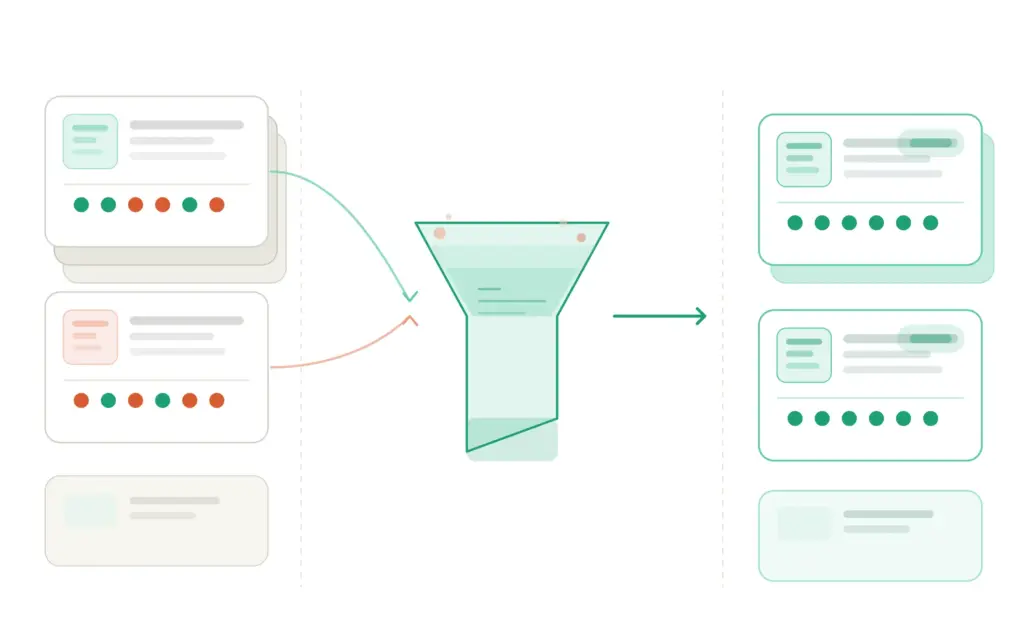
Why product data quality problems are more expensive than they look
The cost of bad product data is easy to underestimate because most of it is invisible. It does not show up as a single line item on a P&L. It shows up as a thousand small frictions that nobody traces back to their source.
Gartner research puts the average annual cost of poor data quality at $12.9 million per organisation. For ecommerce teams specifically, that number is made up of things like:
- Channel rejections. Google Merchant Center and Amazon reject or suppress products with missing required fields, invalid GTINs, or non-compliant attribute values. Every suppressed listing is revenue you are not generating.
- Higher return rates. Products with incomplete or inaccurate descriptions — missing size guides, wrong dimensions, vague material information — get returned at significantly higher rates. The customer received something different from what the product page implied.
- SEO underperformance. Product pages with thin or incomplete data have less content for search engines to index, fewer relevant terms to rank for, and lower engagement signals from the users who do land on them.
- Team time lost to firefighting. In organisations without a systematic data quality process, a meaningful portion of every product manager’s week goes to finding and fixing data problems that a structured quality framework would have caught automatically at input.
- Customer abandonment. Research from the Baymard Institute consistently shows that incomplete product information is one of the top reasons customers abandon product pages without purchasing. You cannot sell a product someone cannot fully evaluate.
The good news is that data quality problems are fixable — systematically, not just case by case. But you have to be able to measure them first.
The six dimensions of PIM data quality
Data quality is not a single score. It is a profile across six distinct dimensions, each of which can fail independently and each of which affects your catalog in different ways. Understanding which dimension is failing in your catalog tells you exactly what kind of fix is needed.

1. Completeness
Completeness is the most visible dimension: are all the required fields populated for a given product? It is also the easiest to measure — you can express it as a percentage. A product with 18 out of 24 required fields filled is 75% complete.
But completeness is category-specific. A 100% complete record for a T-shirt is missing essential information for a laptop. Your completeness measurement has to be applied against the attribute template for the product’s category, not against a universal field list. A T-shirt with no processor specification is not “incomplete” — a laptop with no processor specification is a serious problem.
This is why taxonomy design and data quality are inseparable. Without a well-defined taxonomy with category-specific attribute templates, you cannot accurately measure completeness at scale.
2. Accuracy
Accuracy means the data correctly reflects reality. A product listed as weighing 500g that actually weighs 750g is inaccurate. A jacket described as 100% cotton that is actually a cotton-polyester blend is inaccurate. A product listed as available in blue, black, and red when red has been discontinued for six months is inaccurate.
Accuracy is the hardest dimension to measure at scale because it often requires comparison against a source of truth outside the PIM — supplier specs, physical samples, or manufacturer documentation. The most effective approach is to build accuracy checks into supplier onboarding and product creation workflows, rather than trying to audit accuracy retroactively across a live catalog of thousands of SKUs.
3. Consistency
Consistency means the same information is represented the same way across all products where it applies. “Cotton,” “100% Cotton,” “cotton,” and “Ctn” are four representations of the same value that will all be treated as different values by any system that processes them — including Google Shopping’s feed parser, Amazon’s attribute matcher, and your own faceted search filters.
Consistency problems almost always originate from the absence of controlled value lists. If your Color attribute can accept any free-text input, “Black,” “black,” “Jet Black,” “Noir,” and “BLK” will all end up in your catalog representing the same colour. The fix is not cleanup — it is enforcing a controlled vocabulary at input so the problem cannot enter the system in the first place.
4. Timeliness
Timeliness means your data reflects the current state of the product. Prices that have not been updated since a supplier price increase, stock status fields that say “In Stock” for products that were discontinued two months ago, descriptions that reference a promotion that ended in January — these are timeliness failures.
Timeliness is particularly critical for anything that feeds into advertising. A Google Shopping ad that drives someone to a product page for an out-of-stock or discontinued item burns ad budget, damages trust, and inflates your bounce rate simultaneously.
5. Uniqueness
Uniqueness means each real-world product has exactly one record in your system. Duplicate product records — the same SKU appearing twice, or the same product entered under two different names by two different team members — create inventory reporting errors, inconsistent channel exports, and confusion during enrichment when both records get updated but in different ways.
Duplicates are most commonly introduced at supplier import when a product arrives that already exists in the catalog under a slightly different SKU or title. A deduplication check at import — comparing incoming GTINs, MPNs, or titles against existing records — catches most of them before they enter the live catalog.
6. Validity
Validity means the data conforms to the rules and formats that govern it. A GTIN field containing a 10-digit value is invalid — GTINs are 8, 12, 13, or 14 digits. A Size field containing “extra large” when the controlled list specifies “XL” is invalid. An EAN that fails its check digit calculation is invalid and will cause feed rejections in every channel that validates it.
Validity failures are particularly dangerous because they look fine to human reviewers but fail automated processing silently. A product with an invalid GTIN will not throw an obvious error on your product page — it will quietly underperform in Google Shopping while your team spends weeks trying to understand why that category is not converting.
If GTIN validity is a concern in your catalog, run your product identifiers through the GTIN Validator — it checks format, check digit, and compliance against GS1 standards instantly.
How to build a data quality score for your product catalog
A data quality score gives you a single number that represents the overall health of your catalog — and more usefully, a breakdown by dimension and by category that tells you exactly where to focus. Here is a straightforward scoring model that works for most ecommerce catalogs.

Step 1: Define your required fields per category
Scoring completeness only makes sense against a defined standard. For each leaf-level category in your taxonomy, document which fields are required for a product to be considered publishable. These become your completeness benchmark for that category.
Separate required fields from recommended fields. Required fields are those without which the product should not be published to any channel — things like title, description, primary image, category, and any channel-mandatory attributes. Recommended fields are those that significantly improve conversion or channel performance but are not technically blocking — things like secondary images, detailed care instructions, or enhanced marketing copy.
Step 2: Apply dimension weights
Not all six dimensions are equally important for every catalog. A simple weighting model for most ecommerce operations:
| Dimension | Weight | Why |
|---|---|---|
| Completeness | 30% | Missing fields block publishing and harm SEO |
| Accuracy | 25% | Wrong information drives returns and complaints |
| Validity | 20% | Invalid values cause silent channel failures |
| Consistency | 15% | Inconsistent values break filters and feed matching |
| Timeliness | 7% | Stale data creates customer trust issues |
| Uniqueness | 3% | Duplicates cause reporting and enrichment problems |
Adjust these weights based on your business. If you sell exclusively through Google Shopping and Amazon, validity should carry more weight because feed rejections from invalid GTINs are your most immediate revenue risk. If you have a large supplier-fed catalog with known duplicate problems, bump up uniqueness.
Step 3: Score at product level, aggregate at category level
Calculate a quality score for each individual product, then aggregate those scores by category. Aggregating by category is what makes the scores actionable — it tells you whether you have a system-wide problem or a category-specific one, and it lets you prioritise cleanup work by the categories that drive the most revenue.
A product-level completeness score is straightforward:
Completeness score = (fields populated / required fields for category) × 100

Example:
Running Shoes — required fields: 12
Fields populated on product ID 4821: 9
Completeness score: 9/12 × 100 = 75%
A product with a completeness score below your publishability threshold (typically 80–90% depending on your standards) should not go live. A category with an average completeness score below that threshold needs a systematic fix at the import or enrichment layer, not individual product-by-product patching.
Step 4: Set thresholds and automate alerts
Define three quality tiers for your catalog and configure your system to flag products accordingly:
- Publishable (green): Meets all required field minimums and passes validity checks. Can be published to all channels.
- Needs enrichment (amber): Meets required fields but missing recommended fields, or has consistency warnings. Can be published to primary channels but should not be considered complete.
- Blocked (red): Missing required fields, invalid values, or failing validity checks. Should not be published until fixed.
The blocked tier is the one that causes the most immediate revenue impact. Products in the blocked tier are either not live at all, or live but suppressed in channel feeds — both bad outcomes. Clearing the blocked tier should always be the first priority when improving data quality scores.
The most common PIM data quality problems — and exactly how to fix them
Problem: Missing required fields at category level
What it looks like: You run a completeness report and find that 40% of products in your Footwear category are missing the “Upper Material” field. The field exists in the system — it just never got populated.
Root cause: Usually one of three things. The attribute template for that category was not defined when the products were imported. The supplier’s data file did not contain that field. Or the field was added to the template after the products were already in the system and nobody went back to populate it retroactively.
Fix: Bulk enrichment against your supplier’s source data where the field exists there. For fields your supplier did not provide, this becomes a manual enrichment task — prioritise the highest-revenue products first. Going forward, enforce the attribute template at import so new products cannot enter the catalog with required fields missing. The guide on cleaning supplier product data covers the import hygiene side of this in detail.
Problem: Inconsistent values in key attributes
What it looks like: Your Color filter on the storefront returns 47 distinct values for what should be about 12 colours. “Navy,” “Navy Blue,” “Dark Blue,” “Midnight Blue,” and “NAVY” are all in there. Customers filtering by “Blue” miss half the relevant products.
Root cause: Free-text input on attributes that should use a controlled value list. Different suppliers use different colour terminology. Different team members entered values without a standard. The attribute was never standardised.
Fix: Create a controlled value list for the Color attribute with your approved values. Run a one-time bulk remap of all existing non-standard values to the correct standard ones (a find-and-replace operation in most PIM systems). Then enforce the controlled list going forward so new values can only be selected from the approved list. This is a one-time migration cost that pays back on every single feed export you run for the rest of the catalog’s life.
Problem: Invalid or missing GTINs
What it looks like: Your Google Merchant Center account shows “Limited performance due to missing value [GTIN]” warnings across a significant portion of your catalog. Some products have GTINs entered but they are failing validation — check digit errors, wrong digit count, or duplicate GTINs assigned to different products.
Root cause: GTINs were not collected from suppliers at import, were entered manually with errors, or were assigned internally without following GS1 GTIN standards. This is one of the most commercially damaging data quality problems in ecommerce because it directly affects Google Shopping performance — Google prioritises products with valid GTINs in Shopping auctions, and advertisers with correct GTINs see up to 40% higher click-through rates according to Google’s own data.
Fix: Validate your entire GTIN field against GS1 standards. The GTIN Validator checks format, digit count, and check digit compliance in seconds. For products with missing GTINs, request them from your suppliers — most legitimate branded products have assigned GTINs that suppliers are required to provide. For products genuinely without GTINs (custom products, handmade items), set the identifier_exists field to false in your Google feed rather than leaving the GTIN field blank or entering an invalid value.
Problem: Stale product descriptions after seasonal or specification changes
What it looks like: A product description still references a bundle component that was removed six months ago. A care instruction says “machine washable at 40°C” but the fabric changed to a wool blend in the latest version that requires hand wash only. A technical specification references last year’s component that has since been upgraded.
Root cause: Product updates happened in a sourcing or product development system but did not flow through to the PIM. Or product data was managed in spreadsheets and only part of it was updated when the change happened.
Fix: Establish a change notification process: when a product’s specification changes at source — in your ERP, in supplier documentation, in your product development workflow — there should be a trigger that flags the corresponding PIM record for review. This does not need to be fully automated (though automation is ideal). A simple process where spec changes are communicated to whoever owns the PIM record, with a 48-hour SLA for updates, prevents most timeliness failures.
Problem: Duplicate product records from supplier imports
What it looks like: You have two records for the same product — one created manually six months ago, one imported from a supplier feed last month. They have different titles, different image sets, and different completeness scores. Some channels are serving one, some are serving the other. Inventory reporting is wrong because both records are showing separate stock counts.
Root cause: No deduplication check at import. The import process does not compare incoming products against existing records before creating new ones.
Fix: Add a GTIN or MPN matching step to your import workflow. Before creating a new product record, check whether a product with the same GTIN or MPN already exists. If it does, update the existing record rather than creating a new one. For existing duplicates, merge records manually — preserving the richer data from each — then audit your channel mappings to ensure all channels are pointing to the consolidated record.
Building a data quality process that runs continuously — not as a one-time fix
The single biggest mistake teams make with product data quality is treating it as a cleanup project. They spend two weeks fixing everything, declare victory, and watch the problems come back within three months because nothing changed about how data enters or moves through the system.
Data quality is a process, not a state. Here is what a continuous quality process looks like in practice:
Quality gates at import
Every product entering the catalog — whether from a supplier feed, a manual entry, or a migration — should pass through a set of quality gates before it is added to the live catalog. At minimum: required field check, GTIN validation, controlled value list compliance, and duplicate check. Products that fail any gate go to a holding queue for review, not directly into the live catalog.
Weekly completeness monitoring
Run a completeness report by category every week. Look for categories where the average completeness score dropped — this usually means new products were added without full enrichment. Set a rule: no new products are considered “launched” until they hit your completeness threshold. Time-to-market pressure is the most common reason completeness scores degrade, because teams push products live before enrichment is complete. Embedding the quality threshold into the launch definition prevents this.
Monthly validity audits
Run your GTIN fields through a validator monthly. Check your channel feeds for any new suppression or rejection warnings in Google Merchant Center and Amazon Seller Central. Channel platforms update their requirements — what was a valid submission last quarter may fail a new validation rule this quarter. Monthly audits catch these changes before they compound into significant traffic losses.
Quarterly data quality reviews
Once a quarter, look at your full quality score across all six dimensions and compare it to the previous quarter. Are scores improving, degrading, or stable? Where are the biggest gaps? Which categories need the most attention? This review should feed directly into the following quarter’s enrichment prioritisation. The goal is not perfection — it is measurable, consistent improvement that you can point to as evidence of operational progress.
If you are not sure where to start with assessing your current data infrastructure, the PIM Readiness Assessment covers data quality governance as one of its five dimensions and gives you a concrete starting point. And if you want to understand what a PIM needs to provide to support the processes described in this guide, the 2026 PIM guide covers the full capability picture.
PIM data quality checklist
Use this as a starting-point audit for your catalog:
- ☐ Every leaf-level category has a defined required attribute template
- ☐ Controlled value lists are enforced for Color, Size, Material, and other key attributes
- ☐ All GTINs have been validated against GS1 standards
- ☐ Products without GTINs are marked
identifier_exists = falsein channel feeds - ☐ A completeness score is calculated per product against its category template
- ☐ Products below your publishability threshold are blocked from channel export
- ☐ Import workflows include duplicate detection (GTIN/MPN matching)
- ☐ Import workflows include required field validation before products enter the live catalog
- ☐ A process exists for propagating product specification changes from source into the PIM
- ☐ Completeness is monitored weekly, validity is audited monthly
- ☐ A quarterly data quality review compares scores across periods
If you checked fewer than seven of these, your catalog has quality gaps that are currently costing you in channel performance, team time, or both. The Completeness Checker is the fastest way to see exactly where the gaps are concentrated.
Frequently asked questions
What is PIM data quality?
PIM data quality refers to how well the product information stored in your Product Information Management system meets the standards required for it to be useful — for internal operations, for channel publishing, and for customer decision-making. It is measured across six dimensions: completeness, accuracy, consistency, timeliness, uniqueness, and validity. Poor PIM data quality results in channel rejections, higher return rates, lower search rankings, and customers who cannot find or evaluate your products effectively.
How do you measure product data quality?
The most practical approach for ecommerce teams is to start with completeness — the percentage of required fields populated for a given product against its category’s attribute template. From there, add validity checks (particularly GTIN validation), consistency monitoring (checking for non-standard values in controlled-list attributes), and periodic accuracy audits against supplier source documents. Aggregate scores by category rather than at the overall catalog level to make the results actionable.
What causes product data quality problems?
The most common causes are: supplier data arriving without required fields or in inconsistent formats; attribute templates that were not defined before import; free-text input on fields that should use controlled value lists; no duplicate detection at import; product specification changes that are not propagated into the PIM; and teams prioritising speed-to-market over completeness so products go live before enrichment is finished. Most data quality problems are process failures, not data failures — they are preventable with the right governance at input.
How do invalid GTINs affect Google Shopping performance?
Google uses GTINs to match your product listings against its product knowledge graph. Products with valid GTINs are matched to the right product in Google’s system, which improves ad relevance, Shopping feed placement, and eligibility for Google’s performance features. Products with missing or invalid GTINs receive a “Limited performance due to missing value [GTIN]” warning and are at a disadvantage in Shopping auctions. Google’s own data shows that advertisers with correct GTINs see up to 40% higher click-through rates. Invalid GTINs — those with wrong digit counts or failing check digit validation — can also cause product disapprovals in Merchant Center.
What is a good product data completeness score?
For products to be considered publishable to primary channels, a completeness score of 85–90% against the required attribute template is a reasonable threshold for most ecommerce catalogs. For high-consideration or high-value products — electronics, fashion, home furnishings — where the customer research process is more intensive, 95%+ completeness on required and recommended fields is a better target. For marketplace channels with strict data requirements (Amazon in particular), completeness requirements are effectively set by the channel’s mandatory fields, which vary by category and should be checked in the relevant Browse Tree Guide.
Leave a Reply