Product Taxonomy for Food and Beverage Ecommerce: Full Setup Guide
Food and beverage ecommerce has a taxonomy challenge that no other category faces at the same level: regulatory compliance. Allergen data, nutritional information, country of origin, and storage requirements are not optional attributes — they are legal requirements in most markets. A food taxonomy that gets the category hierarchy right but misses the compliance attribute layer is both incomplete and a legal liability.
This guide covers how to build a food and beverage taxonomy that works for customers, for Google Shopping, and for regulatory compliance simultaneously.
Why Food Taxonomy Needs a Compliance Layer
Food ecommerce has obligations that other ecommerce categories do not. In UK and EU markets, the Food Information for Consumers Regulation (FIC) requires that 14 major allergens are clearly identified on all pre-packaged food products sold online. Nutritional information per 100g is also required for most food products.
This means your product taxonomy must support a compliance attribute layer — not just a category hierarchy. Every food product record needs structured allergen fields, nutritional values, and country of origin. These cannot be buried in free-text descriptions — they must be structured attributes that can be displayed, filtered, and audited.
For the foundational taxonomy structure applicable to all industries before adding food-specific requirements, see How to Build a Product Taxonomy From Scratch.
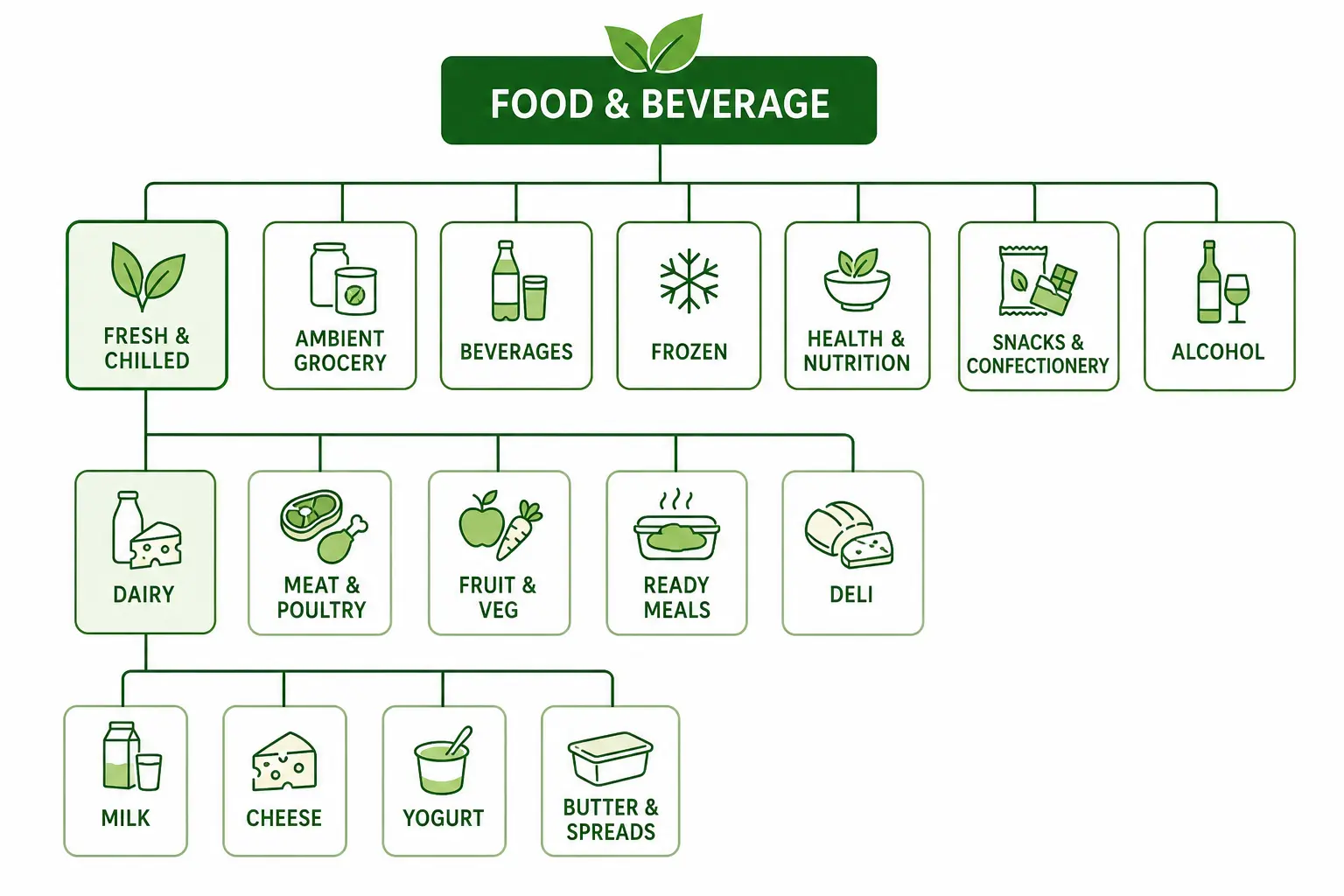
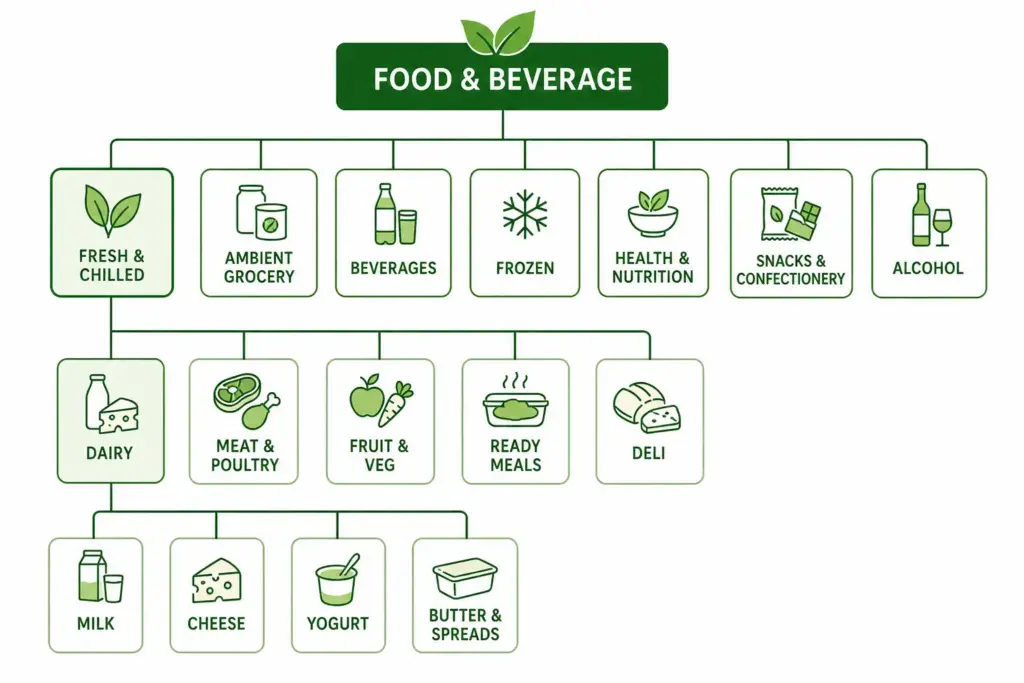
Recommended Top-Level Structure for Food and Beverage
| Level 1 | Level 2 Examples | Level 3 Examples |
|---|---|---|
| Fresh & Chilled | Dairy, Meat & Poultry, Fruit & Vegetables, Ready Meals, Deli | Milk, Cheese, Yogurt, Butter & Spreads |
| Ambient Grocery | Pasta & Rice, Tinned Goods, Sauces & Condiments, Oils & Vinegars | Dried Pasta, Tinned Tomatoes, Pasta Sauces |
| Beverages | Coffee, Tea, Soft Drinks, Juices, Water, Hot Chocolate | Ground Coffee, Whole Bean, Coffee Pods |
| Frozen | Frozen Meals, Frozen Meat, Ice Cream, Frozen Vegetables, Frozen Bakery | Frozen Pizza, Frozen Fish Fillets |
| Health & Nutrition | Protein Supplements, Vitamins, Sports Nutrition, Superfoods | Whey Protein, Plant Protein, BCAA |
| Snacks & Confectionery | Crisps, Nuts, Chocolate, Sweets, Cereal Bars, Biscuits | Dark Chocolate, Milk Chocolate, Vegan Chocolate |
| Bakery | Bread, Pastries, Cakes, Gluten-Free Bakery | Sourdough, White Sliced, Seeded Loaves |
| Alcohol | Wine, Beer & Cider, Spirits, Low & No Alcohol | Red Wine, White Wine, Champagne & Sparkling |
The 14 Mandatory Allergen Attributes
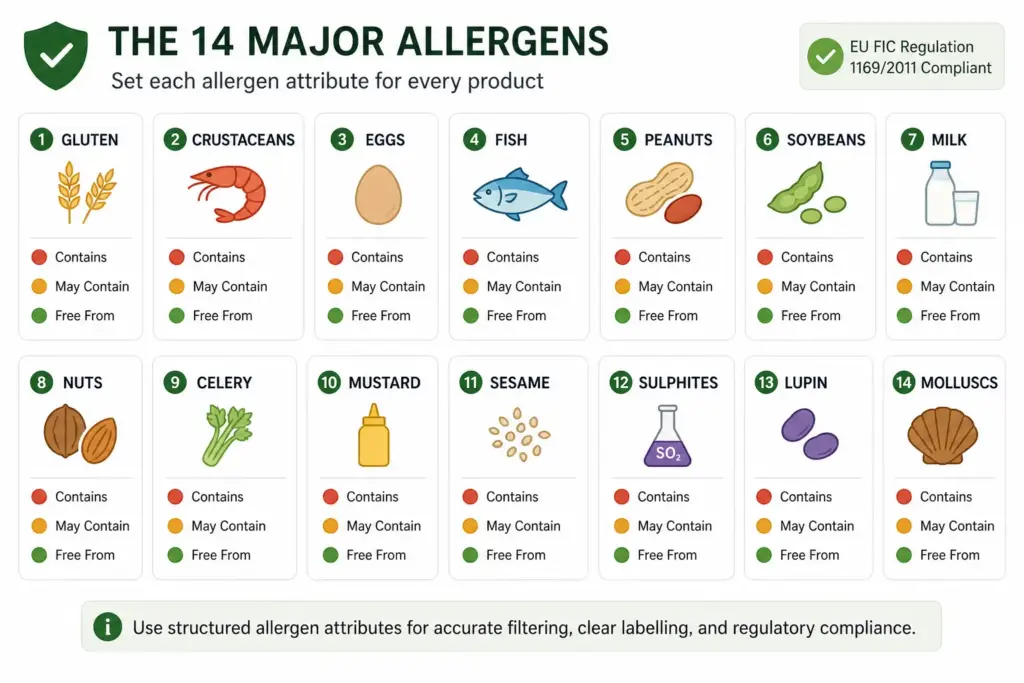
Each of the 14 major allergens must be a separate structured attribute on every food product record with three possible values:
- Contains — the allergen is a declared ingredient
- May Contain — manufactured in a facility that also processes this allergen (cross-contamination risk)
- Free From — the product does not contain and is not cross-contamination risk for this allergen
The 14 allergens are: Gluten, Crustaceans, Eggs, Fish, Peanuts, Soybeans, Milk, Nuts, Celery, Mustard, Sesame, Sulphur Dioxide & Sulphites, Lupin, Molluscs.
Structured allergen attributes enable allergen-specific filtering (customers can filter “Nut-Free” or “Gluten-Free”) and allow your compliance team to audit allergen data across the full catalog efficiently. Free-text allergen data in descriptions cannot be audited or filtered.
Dietary Attribute Set
Beyond the mandatory allergen layer, structured dietary attributes drive high-value customer filtering. These are among the most-used filters on food ecommerce sites:
- Vegan — contains no animal products or by-products
- Vegetarian — contains no meat or fish
- Gluten-Free — certified gluten-free (below 20ppm threshold)
- Dairy-Free — contains no milk or dairy derivatives
- Nut-Free — contains no nuts and produced in a nut-free facility
- Halal — certified Halal
- Kosher — certified Kosher
- Organic — certified organic (specify certification body)
- No Added Sugar
- Low Calorie (define threshold — e.g. <100kcal per serving)
Shelf Life and Storage Attributes
Storage and shelf life attributes serve both customer information and operational fulfilment routing. Products with different storage requirements (ambient, chilled, frozen) need to be identifiable programmatically — your fulfilment system needs to know which warehouse zone and which delivery service applies to each product.
- storage_type: ambient / chilled (2-8°C) / frozen (-18°C)
- shelf_life_days: total shelf life from production date
- minimum_remaining_life_on_despatch: minimum days remaining when shipped (e.g. 60% of total shelf life)
- best_before_guidance: “Best Before”, “Use By”, “Display Until” — the label type
Nutritional Attributes (Required for UK/EU Markets)
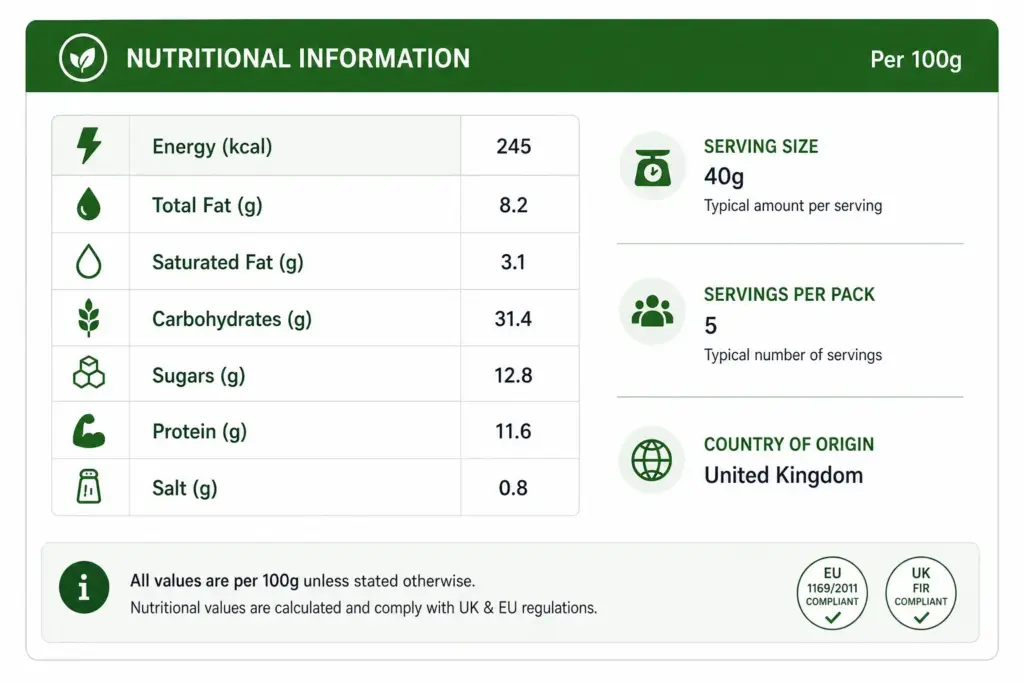
Under UK FIC regulations, the following nutritional values are required per 100g/100ml on food product pages:
- Energy (kJ and kcal)
- Total Fat (g)
- Saturated Fat (g)
- Carbohydrates (g)
- Sugars (g)
- Protein (g)
- Salt (g)
These must be structured attributes in your product data — not embedded in label images. Structured data can be indexed by search engines, displayed dynamically, and audited for completeness. Image-embedded nutritional data cannot.
Google Product Category Mapping for Food
| Product | Correct Google Category |
|---|---|
| Ground coffee | Food, Beverages & Tobacco > Beverages > Coffee |
| Whey protein powder | Health & Beauty > Health Care > Fitness Nutrition > Protein Supplements |
| Gluten-free pasta | Food, Beverages & Tobacco > Food Items > Grains, Rice & Pasta |
| Red wine | Food, Beverages & Tobacco > Beverages > Alcoholic Beverages > Wine |
| Vegan chocolate bar | Food, Beverages & Tobacco > Food Items > Sweets & Snacks > Candy & Chocolate |
Managing allergen data, nutritional values, and shelf life attributes at scale across a large food catalog requires a system that enforces attribute completeness before products are published. The PIM Readiness Score identifies exactly where your current data governance has gaps. Download the free Taxonomy Template at lynkpim.app — the Food & Beverage tab includes the full category hierarchy and compliance attribute set.
For context on how food taxonomy compares structurally to another attribute-heavy category, see the Home Goods Taxonomy guide.
Frequently Asked Questions
Are allergen attributes legally required for food ecommerce in the UK?
Yes. Under the UK Food Information for Consumers Regulation (FIC), all 14 major allergens must be clearly indicated on pre-packaged food products sold online. Structured allergen attributes ensure these are displayed accurately, consistently, and can be audited across the full catalog. Free-text allergen data in descriptions does not meet this standard reliably.
How should dietary attributes like Vegan and Gluten-Free be structured?
Dietary attributes should be structured boolean or controlled-value attributes on every food product — not free-text descriptions. Structured dietary attributes enable accurate site filtering, prevent manual errors when products are updated, and allow your compliance team to audit attribute accuracy across the full catalog at any time.
Should food categories be organised by cuisine type or by food category?
Organise by food type (Dairy, Bakery, Beverages) rather than cuisine (Italian, Asian, Mexican) for the primary taxonomy structure. Cuisine and origin work well as filterable attributes. Type-based categories map directly to Google’s taxonomy and match how customers search for food online — “gluten-free pasta” not “Italian gluten-free”.
What shelf life attributes should food products have?
Include storage_type (ambient / chilled / frozen), shelf_life_days (total from production), minimum_remaining_life_on_despatch (days remaining when shipped to customer), and best_before_guidance (Best Before / Use By / Display Until). These drive fulfilment routing, customer-facing freshness communication, and return rate management.
Does Google Shopping allow food and beverage products?
Yes, food and beverage products are allowed in Google Shopping with some exceptions. Alcohol requires age verification compliance and may be restricted by country targeting. Supplements and health food products must comply with local regulations. Most ambient grocery, beverages, and specialty food products can be advertised without restrictions — verify your specific product types in Google Merchant Center’s product data specification.
Leave a Reply