Tag: single source of truth

  • Single Source of Truth for Product Data: What It Actually Means (And How to Build One)

    “Single source of truth” is one of those phrases almost every product team agrees with in theory.

    TL;DR: One spreadsheet is considered the main file. Shopify has the latest images.

    In practice, it usually means something much messier.

    One spreadsheet is considered the main file. Shopify has the latest images. A supplier sheet has newer technical specs. Marketing has updated descriptions in another document. Someone exported a CSV last week and adjusted it “just for this channel.” Everyone is working with product data, and everyone thinks their version is the correct one.

    That is exactly why this topic matters. The real problem is rarely that teams have no product data. The real problem is that they have too many competing versions of product truth.

    If you are new to PIM as a category, start first with What Is PIM? The 2026 Guide for Ecommerce Brands & Retailers or PIM Basics. This article is the next step: understanding what product-data authority actually looks like in day-to-day operations.

    What “single source of truth” actually means

    A single source of truth does not mean that only one file exists. It does not mean one system does everything. And it definitely does not mean “whatever happens to be live right now.”

    What it really means is simple:

    There is one authoritative system for product information, and everyone knows which fields, rules, and workflows are controlled there.

    That system becomes the place where product truth is maintained, checked, updated, and distributed.

    What it is

    • One authoritative home for structured product information
    • A system where changes are visible and accountable
    • A place with rules around who can edit, approve, and publish
    • A controlled source that feeds channels consistently
    • A way to fix issues once instead of correcting the same fact in five places

    What it is not

    • One giant spreadsheet everyone edits carefully
    • A folder full of CSV exports
    • A marketplace listing that happens to be visible first
    • A storefront admin treated as the unofficial master
    • A team agreement that lives only in people’s heads

    The distinction matters because storage and authority are not the same thing. A spreadsheet can hold data. A storefront can display data. A DAM can hold assets. But none of those automatically become the authoritative layer for product truth.

    The real problem is not data. It is authority.

    Most product operations teams do not suffer from a lack of product data. They suffer from too many “authoritative” copies.

    • Marketing updates descriptions in one place
    • Merchandising manages categories somewhere else
    • Operations works from supplier files
    • Ecommerce edits what is visible in Shopify
    • Marketplace teams keep channel-specific exports

    Each source may be correct in context. The problem appears when those versions drift apart.

    That is why “single source of truth” is really a question of authority design. You are deciding which system is allowed to be final for which kind of product information.

    Why spreadsheets break down as a source of truth

    Spreadsheets are good at helping teams start. They are fast, flexible, and familiar. That is exactly why teams keep stretching them beyond their natural role.

    But once a spreadsheet becomes the system behind your product catalog, the weaknesses become operational, not just annoying.

    • No real ownership enforcement
    • Weak control over who edits what
    • Validation that is usually light or manual
    • No proper publishing state
    • No category-aware completeness logic
    • No reliable way to govern variants at scale
    • No controlled channel-output layer

    Yes, Google Sheets has version history. But version history is not the same thing as an authoritative operating model. It helps you see what changed. It does not define which structure is canonical, which team owns which fields, or whether incomplete product data should be publishable at all.

    If spreadsheets are still your main operating layer, also read PIM vs spreadsheets: when your Excel-based product catalog becomes a liability.

    What a real single source of truth looks like day to day

    In practical terms, a working source of truth changes how people behave.

    • There is one canonical product record, not several “master” versions
    • Teams stop asking which file is current
    • Changes become visible and accountable
    • Structured fields are governed instead of guessed
    • Channels are fed from the same maintained record
    • Fixes happen upstream instead of being patched repeatedly downstream

    That last point matters a lot. A real source of truth does not just reduce confusion. It changes the direction of work. Teams stop reconciling differences after the fact and start maintaining correctness at the source.

    Why structure matters so much

    Many teams talk about source of truth as if it were only a process decision. It is also a structure decision.

    If your attribute model is weak, your source of truth will stay weak. If your category logic is inconsistent, your source of truth will stay inconsistent. If parent and variant relationships are unclear, your source of truth will create downstream confusion no matter how disciplined the team is.

    That is why this topic connects directly to Product Data Modeling for PIM and Product Taxonomy Guide. Authority is not only about where data lives. It is also about how that data is structured and controlled.

    Where PIM fits into a single source of truth

    PIM exists specifically to act as the authoritative layer for product information.

    That does not mean PIM replaces ERP, DAM, or storefronts. It means PIM becomes the governed layer where product information is structured, enriched, validated, approved, and prepared for distribution.

    In a healthy setup, the contract is clear:

    • Some systems feed data into PIM
    • PIM governs the authoritative product-information layer
    • Other systems consume approved data from PIM

    Once that contract is clear, product information stops drifting so easily.

    PIM does not magically create truth. It enforces where truth is maintained.

    If you want the category comparison behind this, go next to PIM vs MDM vs DAM vs PXM: What to Use (and When).

    Ownership matters more than software

    No system can become a real source of truth without ownership.

    That usually means:

    • clear owners for attribute groups
    • defined approval roles
    • shared rules for what “ready to publish” means
    • clarity about who can create, update, approve, and publish changes

    This is why “single source of truth” is not just a platform feature. It is an operating model backed by software.

    If your team needs the language around this, send readers to the PIM Glossary.

    Common mistakes teams make

    • Treating Shopify as the source of truth. It may be the publishing layer, but that does not automatically make it the right place to govern all product structure.
    • Letting exports become editable masters. CSVs should be outputs, not unofficial core systems.
    • Ignoring variants in ownership design. Variant-level confusion spreads quickly into listings, imagery, and identifiers.
    • Assuming everyone knows the rules. If the rules are implicit, they are not operationally reliable.
    • Confusing version history with governance. Knowing who changed something is useful. It is not the same as controlling what should exist and where.

    Why identifiers and structured fields support authority

    Authority gets stronger when key fields are structured properly.

    For example, GTIN is the global identifier used to uniquely identify trade items. That kind of identifier becomes much easier to trust when it is governed as part of a structured product record instead of scattered across sheets, channel exports, and ad hoc custom fields.

    The same is true for custom fields in storefront platforms. Shopify’s own metafield-definition documentation explains that definitions act as templates specifying what part of the store a metafield applies to and what values it can have. That is useful, but it still needs a broader product-data operating model behind it if the business wants real catalog authority.

    In other words: structure supports authority, but structure alone does not replace governance.

    How LynkPIM supports a single source of truth

    LynkPIM fits in the part of the stack where product information needs to become governed, consistent, and channel-ready.

    That means helping teams:

    • define ownership at attribute and category level
    • track changes and approvals
    • validate product data before publishing
    • distribute consistent product information across channels
    • reduce the number of unofficial “master” files in daily work

    The result is not only cleaner data. It is more confidence that what is live is actually correct.

    For action-oriented next steps, point people to the PIM Readiness Assessment, Catalog Health Score, and the main Features and Solutions pages.

    Final takeaway

    A single source of truth is not a slogan. It is a decision about authority, backed by structure, ownership, and workflow.

    If your team still depends on spreadsheets, exports, shared drives, and memory to keep product information aligned, then the issue is not that you lack data. It is that your product truth is spread too thin.

    Once that happens, the smartest move is not to keep policing the chaos harder. It is to create one governed layer where product information can actually be trusted.

    FAQs

    Does single source of truth mean one system does everything?

    No. It means one system is authoritative for product information, while other systems may still provide inputs or consume approved outputs.

    Why can’t a spreadsheet be the source of truth?

    A spreadsheet can store data, but it does not reliably enforce ownership, validation, approval states, or governed multichannel output once product operations become more complex.

    Is Shopify my source of truth if my store is live there?

    Not necessarily. Shopify can be the publishing layer, but many businesses still need a separate authoritative layer for structured product data, governance, and channel control.

    What’s the difference between version history and source of truth?

    Version history helps you see what changed. A source of truth defines where product authority lives, who owns what, and how approved data should flow to channels.

    What makes a source of truth fail?

    Usually unclear ownership, weak product structure, uncontrolled exports, and the habit of letting multiple systems behave like unofficial masters at the same time.
  • What is PIM? The 2026 Guide for E-commerce Brands & Retailers

    What is PIM? The 2026 Guide for E-commerce Brands & Retailers

    If you’ve ever had the feeling that your catalog is somehow “working” and still exhausting everyone at the same time, you’re probably already close to understanding what a PIM is.

    TL;DR: Most teams do not wake up one morning and decide they need product information management software. What usually happens is slower and messier.

    Most teams do not wake up one morning and decide they need product information management software. What usually happens is slower and messier. A product title changes in one channel but not another. A variant image is wrong. Marketing asks for cleaner attributes. Operations is chasing supplier files. Merchandising wants launches to move faster. Support keeps answering questions that should have been clear on the product page.

    That is the moment a spreadsheet stops being “simple” and starts becoming expensive.

    This guide explains what PIM actually is, what it is not, who it is for, who it is not for, and how to tell whether you need one now or later. If you are completely new to the topic, you may also want to start from the PIM Basics hub before going deeper.

    TL;DR

    • A PIM is the operational home for structured, sellable product information.
    • It helps teams centralize, enrich, govern, and publish product data across channels.
    • You usually need PIM when complexity increases across channels, variants, teams, and approvals, not just when SKU count grows.
    • PIM is not ERP, not DAM, not CMS, and not a marketplace uploader.
    • The biggest win is not “storage.” It is control: cleaner data, faster launches, fewer repeated mistakes.

    What is PIM?

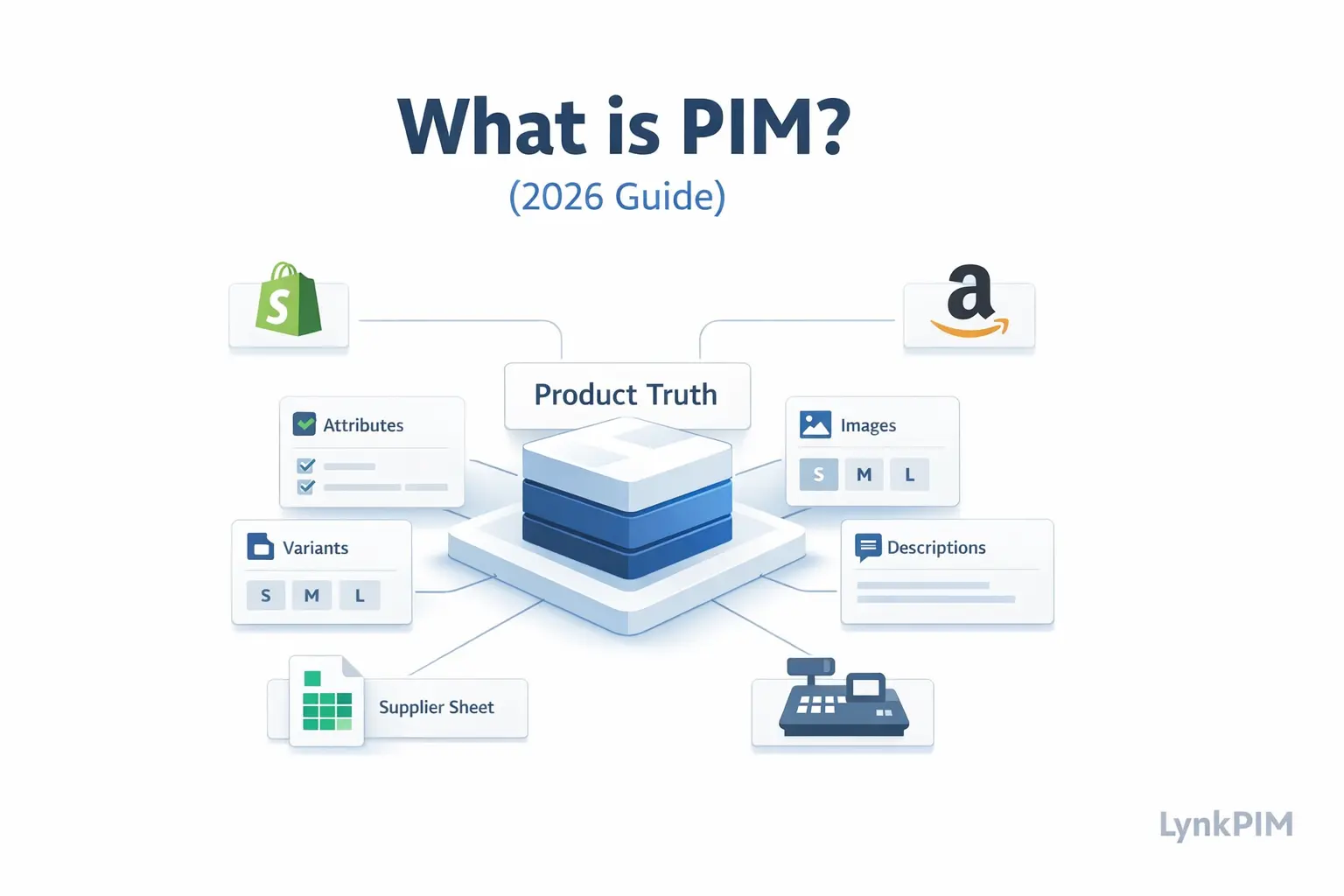
    PIM stands for Product Information Management. In practical terms, it is the system where your team manages the product information customers and channels actually depend on: titles, descriptions, attributes, specifications, variants, images, documents, translations, and channel-specific output.

    A simple way to explain it internally is this: your ERP may know that an item exists, your storefront may show it, and your DAM may store the media for it. But a PIM is the place that makes the product record usable, structured, trustworthy, and ready to publish.

    A PIM is the central system used to structure, enrich, govern, and distribute product information across teams and channels.

    If you want a clearer system-by-system breakdown, read PIM vs MDM vs DAM vs PXM: What to Use (and When).

    What PIM is not

    PIM gets misunderstood because it overlaps with several other systems. That overlap is exactly why teams sometimes buy the wrong tool.

    • PIM is not ERP. ERP is built for operational and financial records like inventory, purchasing, and accounts. PIM is built for sellable product content and structure.
    • PIM is not DAM. DAM manages files and usage rights. PIM manages the relationship between product records and the assets attached to them.
    • PIM is not CMS. A CMS manages pages and articles. PIM manages structured catalog data.
    • PIM is not “just another spreadsheet.” The value of PIM is not that it stores product data. It is that it adds governance, validation, workflow, ownership, and repeatable publishing.

    What problems does a PIM solve?

    Most teams think the problem is “we have product data in too many places.” That is true, but it is not the full problem. The bigger issue is that nobody is fully sure which version is final, which fields are required, who approves changes, and what “ready to publish” actually means.

    • Different teams maintain different versions of the same product.
    • Attributes are inconsistent, so filters and feeds break.
    • Variants get flattened into messy rows that are hard to manage.
    • Channel requirements keep changing, and every update becomes manual cleanup.
    • Launches stall because approvals happen in Slack, email, and memory.
    • Supplier files arrive in formats nobody wants to work with.

    If that sounds familiar, also read PIM vs spreadsheets: when your Excel-based product catalog becomes a liability and What “Single Source of Truth” Really Means in Product Operations.

    Who PIM is for

    PIM is not just for one department. The reason it becomes valuable is that product data crosses teams constantly.

    • Ecommerce teams need cleaner product pages, filters, feed fields, and faster publishing.
    • Merchandising teams need better taxonomy, variant structure, and catalog control.
    • Marketing teams need better descriptions, consistent brand language, and reusable content.
    • Operations teams need cleaner supplier intake, fewer manual fixes, and less duplication.
    • IT and RevOps teams need rules, integrations, auditability, and predictable data flow.

    In other words, PIM is for organizations where product information is already a shared operational responsibility, even if nobody has formally named it that yet.

    Who PIM is not for

    Not every business needs PIM right away. A lot of software content on this topic pretends the answer is always yes. It is not.

    • If you have a very small catalog, one editor, one channel, and very few variants, a spreadsheet or native platform setup may still be enough.
    • If your bigger problem is inventory accuracy, purchasing, or finance, PIM is not the first fix.
    • If your catalog changes rarely and your team is not struggling with approvals, enrichment, or channel formatting, PIM might be premature.

    The trigger is usually not “number of products.” It is the combination of channels + contributors + variants + required fields + workflow friction.

    Where PIM sits in the product data flow

    The easiest way to understand PIM is to picture the flow of product data from raw source to live channel.

    • Input: supplier sheets, ERP exports, image folders, technical documents, brand content
    • Structuring: taxonomy, attribute sets, variant model, controlled values
    • Enrichment: descriptions, bullets, SEO fields, translations, compliance notes
    • Governance: ownership, validation rules, review states, approvals
    • Output: storefronts, marketplaces, Google feeds, B2B catalogs, partner exports, print/PDF catalogs

    If you want to go deeper into the structure piece specifically, read Product Data Modeling for PIM: Taxonomy, Attributes, Variants.

    What good PIM implementation changes day to day

    The real benefit of PIM is not abstract. It shows up in daily work.

    • People stop asking which file is current.
    • Variant mistakes become easier to catch before they go live.
    • Required attributes are visible instead of buried in someone’s checklist.
    • Teams can enrich once and publish many times.
    • Launches become less dependent on one person who “knows where everything is.”

    This is why the phrase “single source of truth” matters in product operations. It is not branding language. It is a control mechanism.

    Identifiers, channel requirements, and why structure matters more than people think

    One place product operations often go wrong is identifiers. Teams focus on copy and images, but marketplaces and feeds care just as much about structured identifiers and field quality. If you sell products that have valid identifiers, you need to handle values like GTIN, MPN, and brand correctly and consistently. That matters for matching, syndication, and channel approval readiness.

    For reference, see the official GS1 explanation of GTIN and Google Merchant Center guidance on unique product identifiers.

    Three common PIM use cases by buyer stage

    1. Shopify and multichannel growth

    If you are running Shopify plus a Google feed, marketplaces, or a growing set of collections and variants, PIM becomes useful when your product updates start multiplying across places. The goal here is not enterprise complexity. It is reducing repetitive work and keeping channel output consistent.

    Read next: PIM vs spreadsheets and LynkPIM Features.

    2. B2B and technical catalog complexity

    B2B product data is a different kind of difficult. It usually involves deeper specifications, buyer-specific outputs, more documentation, and more governance risk. If that is your world, generic “better product pages” messaging is not enough. You need structure that reflects how the catalog actually works.

    Read next: PIM for B2B Ecommerce: Managing Complex Product Specs, Variants, and Buyer-Specific Catalogs.

    3. DPP and structured compliance readiness

    For teams thinking about Digital Product Passport readiness, the conversation shifts from “where do we store product content?” to “can we trust the structure, field ownership, supplier data, and traceability of the catalog?” PIM becomes important here because compliance work usually fails at the operational layer first.

    Read next: LynkPIM Solutions and your Digital Product Passport content cluster.

    How PIM is different from just “better product data management”

    People often use “product data management” as a general phrase, and that is fine in conversation. But the reason PIM matters as a category is that it gives product data an operational home. It does not just improve the content. It creates rules around the content.

    That includes things like:

    • attribute ownership
    • taxonomy logic
    • controlled values
    • variant inheritance
    • approval workflows
    • channel mappings
    • audit history

    That is why PIM becomes more valuable as your operation becomes more collaborative.

    When should you implement PIM?

    Usually earlier than teams expect, but not as early as vendors suggest.

    A good rule of thumb is this: if your team is already compensating for catalog chaos with process hacks, extra review steps, duplicate sheets, export files, and “don’t touch that tab” instructions, you are already doing PIM work manually. The question is whether you want to keep doing it invisibly.

    Most successful implementations start with the basics first: taxonomy, core attributes, variant logic, ownership, and the fields that most affect conversion and channel readiness. Not everything at once.

    Final takeaway

    PIM is not interesting because it is fashionable software. It is useful because product data gets complicated faster than most teams expect.

    If your catalog is still small and stable, you may not need PIM yet. But if your team is already managing product truth across spreadsheets, channels, supplier files, and memory, then PIM is not a “nice to have.” It is the system that turns product operations from reactive cleanup into a repeatable process.

    And once you get to that point, the upside is not just cleaner data. It is faster launches, fewer avoidable mistakes, better channel output, and a team that trusts the catalog again.

    FAQs

    Is PIM only for large catalogs?

    No. The trigger is usually complexity, not just SKU volume. A smaller catalog with many variants, multiple channels, and multiple contributors can need PIM before a larger but simpler catalog does.

    Do I need PIM if I only sell on Shopify?

    Not always. But if Shopify is only the storefront while your real work happens in spreadsheets, supplier files, and feed tooling, PIM can still reduce errors and speed up updates.

    How is PIM different from ERP?

    ERP manages operational and financial records. PIM manages sellable product information, structured attributes, and publishing workflows.

    What should go into PIM first?

    Start with taxonomy, required attributes for your main categories, variant structure, identifiers, core images, and the fields that directly affect channel readiness and conversion.

    Can PIM help with B2B catalogs?

    Yes. In many B2B setups, that is where PIM becomes even more valuable because of deeper specs, buyer-specific views, and stronger governance requirements.

    Why do PIM projects fail?

    Usually because the team treats it as a migration project instead of an operating model. If ownership, taxonomy, approvals, and field standards are unclear, the tool cannot rescue the process on its own.