Job Title Category Mapping: How to Classify CEO, Founder, Director and Every Other Role in Your Taxonomy
You are building a CRM, a B2B contact database, a startup classification system, or an internal org taxonomy — and you keep hitting the same wall. Where does a Founder go? Is a Co-Founder the same category as a CEO? Does “Head of Sales” map to Director or VP? Is a “Chief of Staff” an executive or an operations function?
Job title category mapping is one of those problems that looks simple until you try to make it consistent across thousands of records. This guide gives you a complete, practical framework: how to classify every major role type across seniority levels and job functions, with specific answers for the titles that cause the most confusion.
Why job title category mapping is harder than it looks
Job titles are not standardised. Two people with identical responsibilities at different companies might be called “Director of Marketing” at one and “Head of Growth” at another. A “VP of Engineering” at a 20-person startup has a completely different scope than the same title at a 5,000-person enterprise. A “Founder” might be actively running the business as CEO, or might have stepped back to an advisory role years ago.
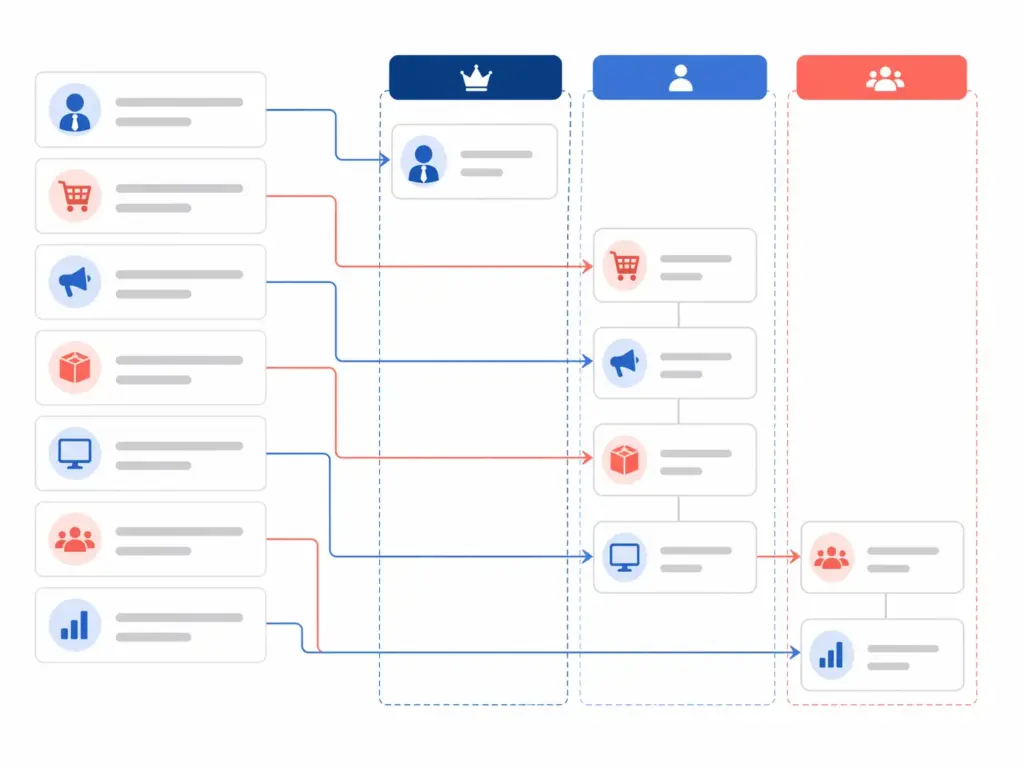
This inconsistency is the core challenge of job title taxonomy. The solution is a two-dimensional classification model: every role gets mapped to a seniority level and a job function. These two dimensions together give you a consistent, queryable classification regardless of how many ways people describe the same role.
This same two-dimensional principle applies in product taxonomy too — every product maps to a category (what it is) and carries attributes (what it is like). The logic is structurally identical. If you are building taxonomy systems more broadly, the ecommerce category mapping guide covers the same principles applied to product data.
The two dimensions of job title classification
Dimension 1: Seniority level
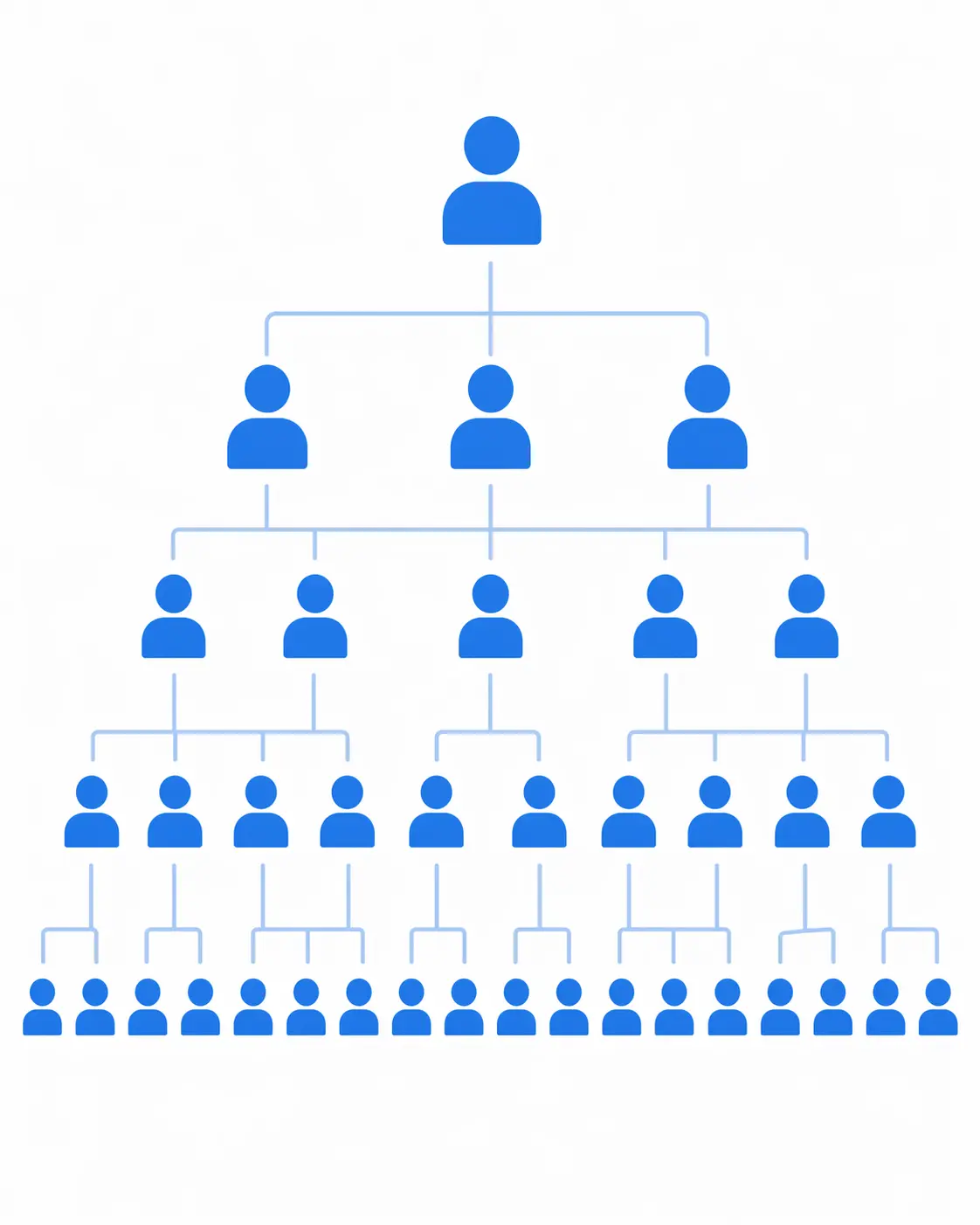
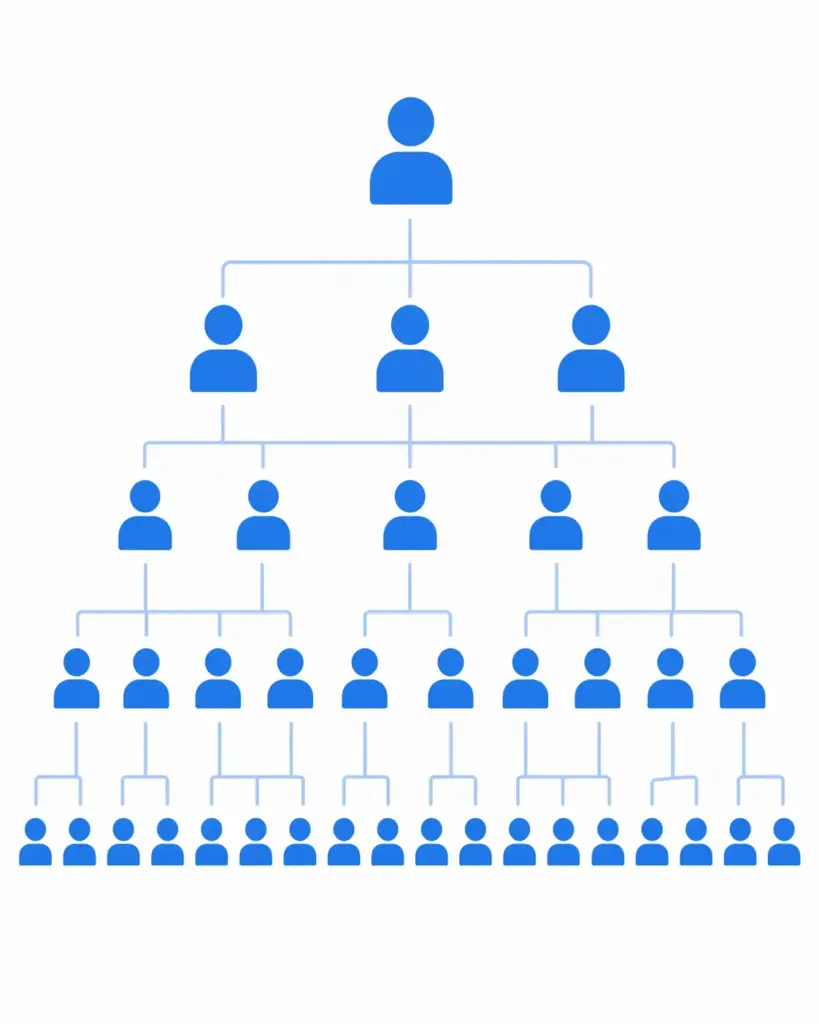
Seniority level describes where a role sits in the organisational hierarchy — the vertical dimension of your taxonomy. Most organisations and classification systems use five to seven levels:
| Level | Common titles at this level | Typical scope |
|---|---|---|
| C-Suite / Owner | CEO, CFO, CTO, COO, CMO, CPO, CISO, Founder, Co-Founder, Owner, Managing Director, President | Company-wide strategy, ultimate accountability for a function or the whole business |
| VP / SVP / EVP | Vice President, Senior VP, Executive VP, Group VP | Cross-team leadership, owns a large function or business unit, usually reports to C-suite |
| Director | Director, Senior Director, Head of [function] | Owns a department or team, sets strategy for their area, manages managers |
| Manager | Manager, Senior Manager, Team Lead, Principal | Manages a team directly, executes departmental strategy |
| Senior Individual Contributor | Senior [role], Lead [role], Staff [role], Specialist | Deep expertise, no direct reports or minimal mentorship role |
| Individual Contributor | [Role] without prefix, Associate, Analyst, Coordinator, Executive (in UK usage) | Executes tasks within a team, reports to a manager |
| Entry Level | Junior, Assistant, Intern, Graduate, Trainee | Learning the role, supervised closely |
Dimension 2: Job function
Job function describes what area of the business a role belongs to — the horizontal dimension. LinkedIn’s professional taxonomy, which covers over 900 million profiles and is the most widely used professional classification system, uses these top-level functions:

- Commercial / Sales — sales, business development, account management, revenue
- Marketing — brand, growth, content, performance marketing, product marketing
- Technology / Engineering — software development, infrastructure, data, security, IT
- Operations — supply chain, logistics, fulfilment, customer service, project management
- Finance / Legal — accounting, FP&A, legal, compliance, risk
- People / HR — talent acquisition, HR business partners, learning & development, culture
- Product — product management, UX, design, research
- General Management / Executive — cross-functional leadership, strategy, board-level roles
Every job title maps to one seniority level and one function. A “Director of Marketing” is Director × Marketing. A “VP of Engineering” is VP × Technology. A “Sales Analyst” is Individual Contributor × Commercial. The classification is unambiguous once you have defined the two dimensions clearly.
How to classify the titles that cause the most confusion
Founder and Co-Founder
Seniority level: C-Suite / Owner
Function: General Management
Founder and Co-Founder are ownership titles, not role titles. They describe how someone came to be at the company, not what they do now. For classification purposes, always map Founder and Co-Founder to C-Suite level — they have founder-level authority regardless of their current day-to-day role.
For function, use General Management as the default unless the founder has a specific functional title alongside it (Founder & CTO maps to Technology; Founder & CMO maps to Marketing). A plain “Founder” with no other qualifier goes to General Management.
Co-Founder follows exactly the same logic. Map them identically to Founder unless they have a functional title that tells you otherwise.
President
Seniority level: C-Suite
Function: General Management
President is a C-Suite title that typically sits alongside or just below CEO, with responsibility for operations, revenue, or a specific business unit. In some organisations President is used interchangeably with CEO, particularly in family businesses and smaller companies. Always classify as C-Suite, General Management.
Managing Director
Seniority level: C-Suite
Function: General Management
Managing Director (MD) is the UK and European equivalent of CEO in most contexts. In investment banking and consulting it is a senior individual contributor level below Partner — but for most ecommerce and retail organisations, MD is C-Suite. When in doubt, context matters: if the MD runs a company or a business unit, classify as C-Suite. If they are in a professional services firm, check whether the title follows the IC-track convention.
Head of [function]
Seniority level: Director
Function: whatever follows “Head of”
“Head of” is the most common Director-equivalent title in modern tech and ecommerce companies. “Head of Sales” = Director × Commercial. “Head of Product” = Director × Product. “Head of People” = Director × HR. The function is always in the title — just map accordingly.
The exception: “Head of” at a very small company (under 20 people) sometimes means the only person doing that function, which is more Individual Contributor than Director. If context is available, use it. If not, default to Director — it is better to over-rank than under-rank when segmenting for outreach or analysis.
VP vs Director — where is the line?
This is the most frequently contested boundary in job title taxonomy, and it varies significantly by company size and industry. The general rule:
- VP owns a large function, manages multiple directors or teams, typically reports to C-suite directly, and has cross-functional influence
- Director owns a specific department or team within a function, typically reports to a VP, and manages managers or senior ICs
In practice, at companies under 100 people these lines blur significantly. A “VP of Marketing” at a 15-person startup may have zero direct reports and be doing IC-level work. For taxonomy purposes, honour the title as given unless you have strong contextual evidence to reclassify. Titles are how people self-identify, and reclassifying them based on company size alone creates inconsistency that is hard to maintain.
Chief of Staff
Seniority level: Director or VP depending on scope
Function: General Management / Operations
Chief of Staff is a cross-functional role that supports a C-suite executive. It does not fit cleanly into any single function — it typically spans strategy, operations, communication, and project management. For seniority, classify at Director level for most organisations; VP level if the role has been explicitly positioned as VP equivalent or if the Chief of Staff manages other people. Function: General Management is the safest default.
Owner
Seniority level: C-Suite / Owner
Function: General Management
“Owner” is most common in small businesses where the person is both the business owner and the operator. Treat identically to Founder — C-Suite, General Management. In a product context, “Product Owner” is a specific Agile role that maps to Individual Contributor or Senior IC × Product, not C-Suite.
Partner
Seniority level: C-Suite or VP depending on industry
Function: depends on firm type
Partner means very different things by industry. In professional services (law, consulting, accounting), Partner is the top ownership/equity level — C-Suite equivalent. In technology companies, “Partner” often refers to a business development or channel role at Director or VP level. In venture capital, General Partner is C-Suite; Principal or Associate are lower levels. Always use industry context when classifying Partner titles.
C-suite titles: the full reference
| Title | Level | Function |
|---|---|---|
| CEO — Chief Executive Officer | C-Suite | General Management |
| CFO — Chief Financial Officer | C-Suite | Finance / Legal |
| CTO — Chief Technology Officer | C-Suite | Technology |
| COO — Chief Operating Officer | C-Suite | Operations |
| CMO — Chief Marketing Officer | C-Suite | Marketing |
| CPO — Chief Product Officer | C-Suite | Product |
| CHRO — Chief Human Resources Officer | C-Suite | People / HR |
| CRO — Chief Revenue Officer | C-Suite | Commercial |
| CISO — Chief Information Security Officer | C-Suite | Technology |
| CCO — Chief Customer Officer | C-Suite | Operations / Commercial |
| CDO — Chief Data Officer | C-Suite | Technology |
| CSO — Chief Strategy Officer | C-Suite | General Management |
Ecommerce-specific job title taxonomy
Ecommerce organisations have a set of role titles that do not exist in general corporate taxonomies and that cause classification confusion when you try to map them to standard systems. Here is how to handle the most common ones.
| Ecommerce Title | Seniority Level | Function | Notes |
|---|---|---|---|
| Director of Ecommerce | Director | Commercial / Operations | Owns online channel strategy and P&L |
| VP of Ecommerce | VP | Commercial / Operations | Typically manages multiple ecommerce directors |
| Head of Digital | Director | Marketing / Technology | Function varies — check if reporting to CMO or CTO |
| Ecommerce Manager | Manager | Commercial / Operations | Day-to-day platform and campaign management |
| Merchandising Director | Director | Commercial | Owns product assortment and pricing strategy |
| Category Manager | Manager | Commercial | Manages a product category’s performance |
| Product Manager (ecommerce) | IC to Senior IC | Product | Distinct from Category Manager — owns platform features |
| CX Director / Head of CX | Director | Operations | Customer experience across channels |
| Marketplace Manager | Manager | Commercial | Manages Amazon, eBay, marketplace channel |
| Performance Marketing Manager | Manager | Marketing | Paid search, shopping ads, paid social |
| Head of Growth | Director | Marketing / Commercial | Acquisition-focused; classify as Marketing unless revenue-owning |
| Trading Manager | Manager | Commercial | UK/EU term for ecommerce trading and promotions management |
Building your job title taxonomy: practical rules
Rule 1: Always map to two dimensions
Every title in your taxonomy needs a seniority level AND a function. A flat list of titles with no structure is a lookup table, not a taxonomy. The value of a taxonomy is the ability to query across dimensions — show me all Director-level contacts in Marketing, or all C-suite contacts in companies under 50 people. That querying only works if both dimensions are populated consistently.
Rule 2: Standardise synonyms into canonical forms
Build a synonym mapping table that normalises variant titles to a canonical form before classification. “Head of Sales,” “Sales Director,” “Director of Sales,” and “Commercial Director” should all map to the same canonical classification: Director × Commercial. Without this normalisation step, your taxonomy produces inconsistent results every time a new title variant enters your data.
This is the same principle that applies in product data taxonomy — where “Cotton,” “100% Cotton,” and “Ctn” need to map to the same canonical value before they can be classified consistently. The taxonomy design guide covers this in depth for product catalogs, but the logic applies equally to any classification system.
Rule 3: Use a fallback category for ambiguous titles
Not every title will map cleanly. “Evangelist,” “Fellow,” “Advisor,” “Consultant,” “Board Member” — these do not fit neatly into standard seniority or function categories. Build an explicit fallback: an “Unclassified” or “Needs Review” category that catches ambiguous titles rather than forcing them into a wrong category. A wrong classification is worse than no classification — it silently corrupts your downstream analysis.
Rule 4: Separate the title from the classification
Store the original title as-given in one field, and your canonical classification in separate seniority level and function fields. Never overwrite the original title. This preserves the source data for future re-classification if your taxonomy rules change, and it means you can always audit your mapping logic against real examples.
Rule 5: Review your mapping rules when your data changes
Job title conventions evolve. “Growth Hacker” was an IC role in 2015 and is now closer to Director or VP in established organisations. “Chief of Staff” barely existed as a title in tech before 2018. Review your synonym mapping and classification rules at least annually, and any time you onboard a significant new data source with different title conventions.
Standard classification systems: LinkedIn, O*NET and Schema.org
If you are building a classification system that needs to interoperate with external platforms or standards, it is worth knowing the three most widely used reference systems:
LinkedIn Job Functions
LinkedIn uses 26 top-level job functions and a seniority level system with eight levels (Internship, Entry Level, Associate, Mid-Senior Level, Director, Executive, Owner, Partner). These are the de facto standard for B2B contact classification because LinkedIn is where most professionals self-identify their role. For any system that sources data from LinkedIn or needs to match against LinkedIn audiences, aligning your taxonomy to LinkedIn’s function and seniority structure is strongly recommended.
O*NET SOC Taxonomy
The US Bureau of Labor Statistics Standard Occupational Classification (SOC) system is the official US government classification for occupations, maintained through O*NET. It covers over 1,000 occupational categories across 23 major groups. It is the reference system for labour market research and workforce analytics. For most commercial CRM or contact classification purposes it is more granular than needed, but it is the right reference if you need to map your taxonomy to government or research datasets.
Schema.org JobPosting
If you are publishing job listings or building a system that needs to be understood by search engines, the Schema.org JobPosting structured data format defines how to mark up job titles, employment types, and organisational roles in a way that Google and other search engines can parse. The occupationalCategory field accepts O*NET-SOC codes, making it the bridge between your taxonomy and SEO-visible structured data.
Job title taxonomy in product data contexts
If you arrived at this article through a product data or PIM context — specifically mapping role-based access, defining who in an organisation manages which product categories, or building a classification system for B2B product catalog permissions — the principles are identical but the application is slightly different.
In a PIM or product data context, job title taxonomy typically comes up in two scenarios:
- Role-based access control: which team members (by role) can create, edit, approve, or publish product data. A Category Manager can edit products in their category. A Merchandising Director can approve. A VP of Ecommerce can publish to all channels.
- B2B catalog permissions: which customer roles (by job title) see which products, pricing tiers, or catalog sections. A purchasing manager at a wholesale customer sees trade pricing. A finance director sees contract terms. An end user sees retail pricing.
Both scenarios require a clean job title taxonomy as the input. If you are building this for a PIM implementation, the PIM guide covers how role-based governance works within product data management systems, and the PIM Readiness Assessment will tell you whether your current infrastructure can support role-based catalog governance.
Frequently asked questions
What category does Founder belong to?
Founder maps to C-Suite level, General Management function. Founder is an ownership title that indicates the highest level of authority in a company, regardless of the founder’s current day-to-day role. If the founder has a specific functional title alongside it (Founder & CTO, Founder & CMO), use that function instead. A plain “Founder” with no qualifier always goes to General Management at C-Suite level.
Is Co-Founder the same category as CEO?
For classification purposes, yes — both map to C-Suite level. The distinction is that CEO is a functional role (runs the company operationally) while Co-Founder is an ownership title (helped start the company). In many startups the Co-Founder is also the CEO, but not always. If someone is listed as both Co-Founder and CEO, classify as CEO × General Management. If listed as Co-Founder only, classify as C-Suite × General Management.
What category does “Head of Sales” map to?
“Head of Sales” maps to Director level × Commercial function. “Head of” is the standard Director-equivalent title in modern technology and ecommerce companies — it indicates ownership of a function without the traditional corporate “Director” label. The function is always derived from what follows “Head of”: Head of Sales = Commercial, Head of Product = Product, Head of People = HR.
What is the difference between VP and Director in a job title taxonomy?
VP (Vice President) sits above Director in the standard seniority hierarchy. A VP typically owns a large function, manages multiple directors or teams, and reports directly to C-suite. A Director owns a specific department or team within a function, typically reports to a VP, and manages managers or senior individual contributors. At smaller companies these lines blur — a “VP” at a 15-person startup may be doing Director-level work — but for taxonomy purposes, honour the title as given.
Where does Managing Director sit in a job title taxonomy?
Managing Director (MD) maps to C-Suite level for most organisations — it is the standard UK and European equivalent of CEO. The exception is investment banking and consulting, where MD is a senior individual contributor level below Partner. For ecommerce and retail organisations, always classify Managing Director as C-Suite × General Management.
How do I handle job titles that don’t fit standard categories?
Build an explicit “Unclassified” or “Needs Review” fallback category for titles that do not map cleanly — Evangelist, Fellow, Advisor, Board Member, Consultant, and similar. Never force an ambiguous title into a wrong category to avoid leaving a field blank. A wrong classification corrupts downstream analysis silently, while an unclassified record is clearly flagged for human review. Log all unclassified titles and review them periodically — patterns in what gets flagged often reveal gaps in your taxonomy rules that are worth closing.