Tag: product catalog management

  • What Is Product Catalog Management? The Complete Guide for Ecommerce

    What Is Product Catalog Management? The Complete Guide for Ecommerce

    What Is Product Catalog Management? The Complete Guide for Ecommerce

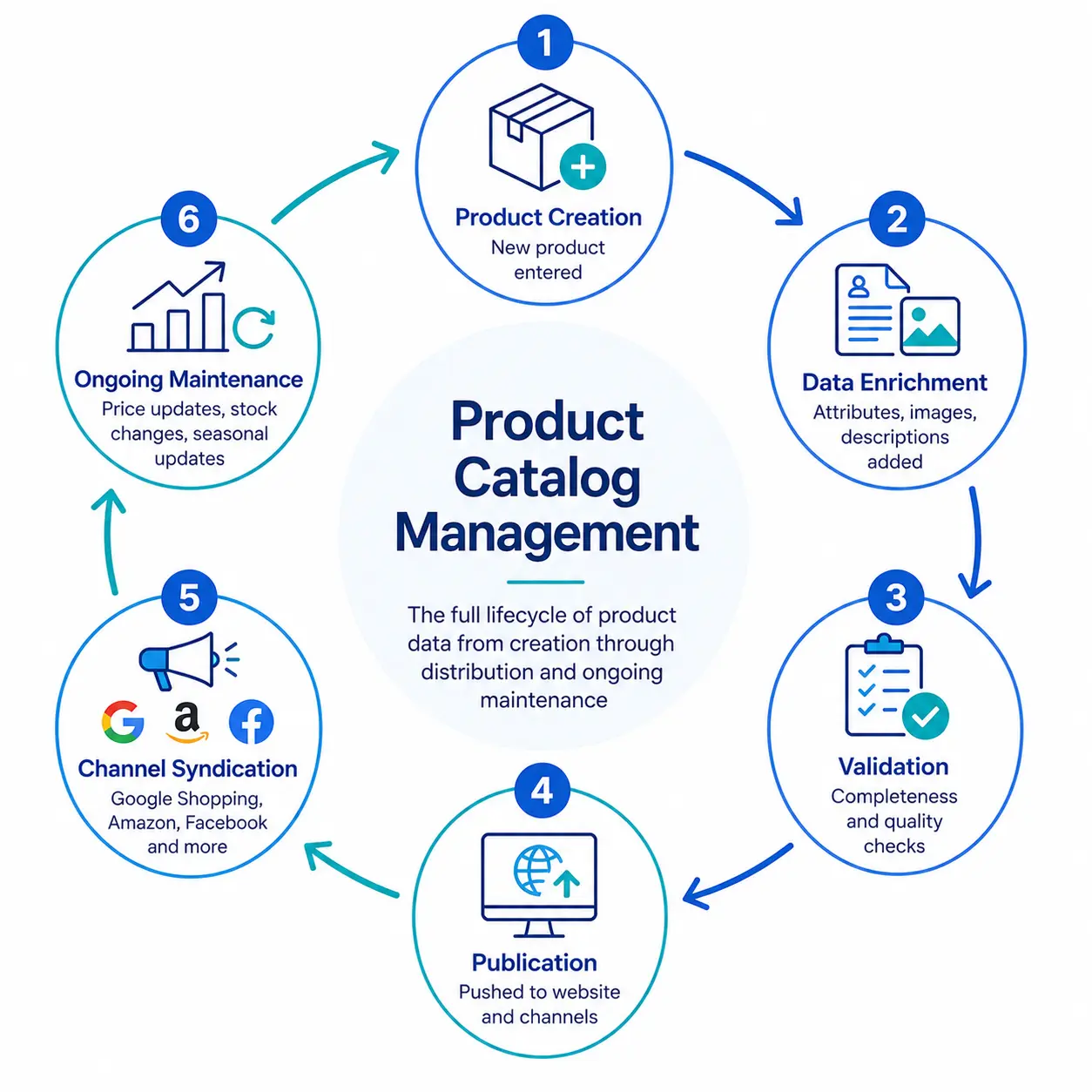
    Product catalog management is how ecommerce businesses organise, maintain, and distribute their product data. It sounds operational — because it is. But it is also one of the highest-leverage functions in ecommerce growth, because product data quality directly determines how well products perform in search, on channels, and with customers.

    This guide covers what catalog management is, what it involves, why it matters at scale, and how to approach it without enterprise software or a large team.
    What Product Catalog Management Covers

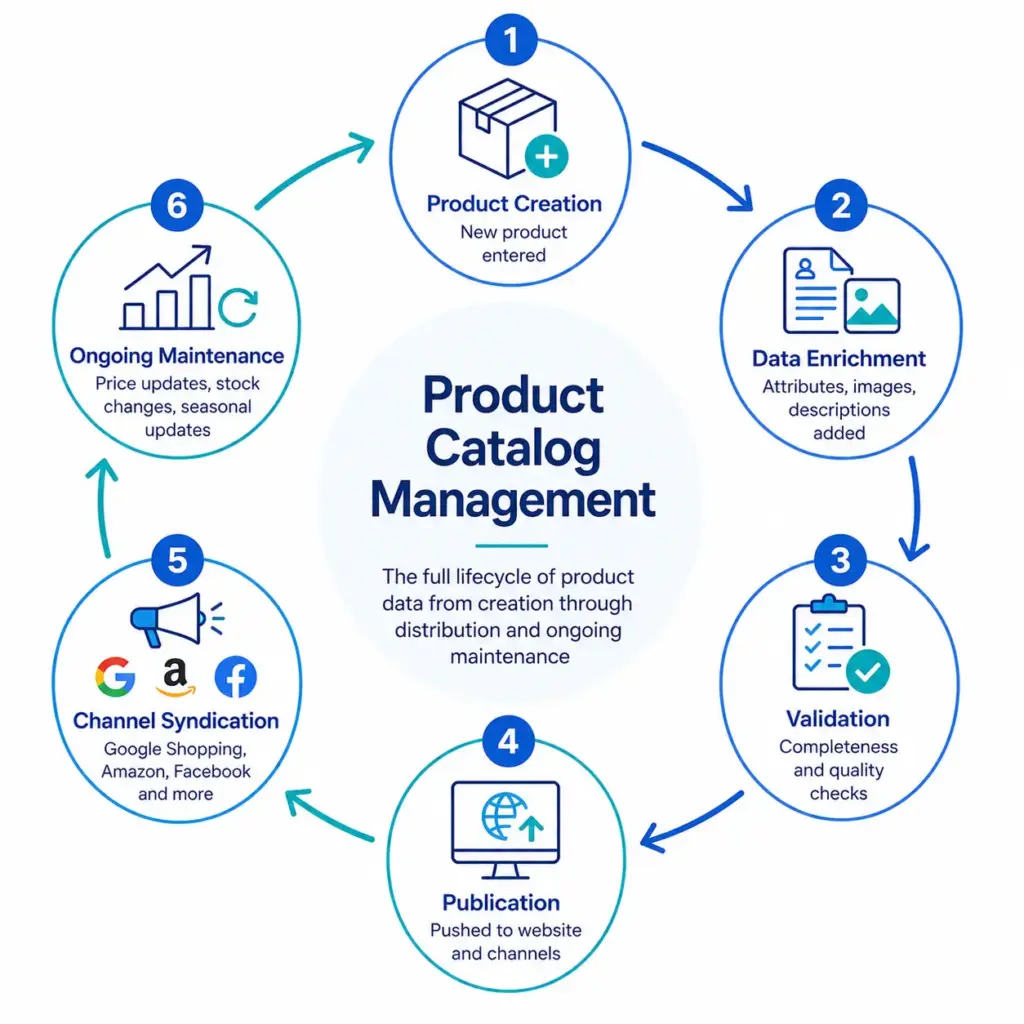
    Product catalog management encompasses every activity involved in making product data accurate, complete, and available where it needs to be. In practice, this means:

    Product data creation and onboarding

    Creating new product records when products are added to the catalog — entering base data (SKU, name, description, price), assigning taxonomy categories, and populating attribute fields. For businesses with many suppliers, this includes receiving, cleaning, and transforming supplier-provided data into your catalog’s format.

    Taxonomy and category management

    Building and maintaining the category structure that organises your catalog — defining hierarchies, attribute sets per category, and the rules that determine where products belong. This is the structural foundation everything else is built on. See What Is Product Taxonomy for the full overview.

    Content enrichment

    Adding and improving the content that makes products sell — writing product descriptions, capturing or sourcing product images, adding marketing copy, and ensuring completeness of attributes that drive search and filter performance.

    Data quality management

    Monitoring and maintaining the accuracy and completeness of product data over time — fixing errors, normalising inconsistent attribute values, validating GTINs and product identifiers, and auditing for missing required data. This is ongoing, not a one-time project.

    Channel syndication

    Distributing product data to every channel where products are sold or marketed — website, Google Shopping, Amazon, Facebook Catalogue, wholesale buyers, print catalogs. Each channel has different format requirements, and catalog management includes managing those transformations without duplicating manual work.

    Variant management

    Managing the relationship between parent products and their variants (sizes, colours, materials) — ensuring each variant has correct identifiers, images, pricing, and stock information while maintaining the link to the parent product for shopping feed purposes (item_group_id).

    Why Catalog Management Matters for Ecommerce Growth
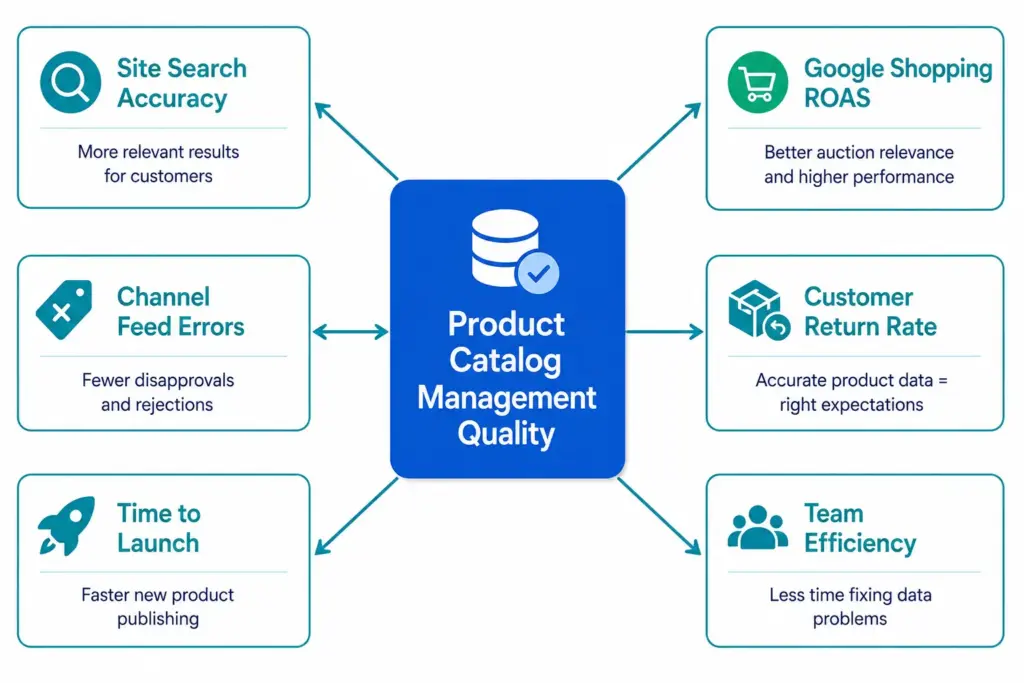
    Catalog management quality touches every commercial outcome in ecommerce:

    • Search and discovery: Complete, structured product data means products appear for the queries they should appear for — in site search and Google Shopping
    • Conversion rate: Accurate product data sets correct buyer expectations, which reduces returns and increases repeat purchase
    • Channel performance: Clean feed data means fewer disapprovals, better auction relevance, and higher ROAS
    • Operational efficiency: A well-managed catalog means teams spend less time fixing data errors and more time on commercial activities
    • Speed to market: A systematic catalog management process means new products launch faster because the workflow is defined, not ad hoc

    The Catalog Management Maturity Stages

    StageHow it looksTypical SKU range
    Stage 1: Ad HocProduct data in spreadsheets, one person “knows everything”, no formal processes1–200 SKUs
    Stage 2: StructuredDefined taxonomy, consistent attribute entry, single platform for product data, basic workflows200–2,000 SKUs
    Stage 3: GovernedValidation rules enforce completeness, channel-specific content, automated feed syndication, data quality monitoring2,000–20,000 SKUs
    Stage 4: AutomatedAI-assisted enrichment, real-time channel sync, self-service product publishing, catalog health dashboards20,000+ SKUs

    Most SMB ecommerce stores start at Stage 1 and need to reach Stage 2 or 3 to scale effectively. The transition from Stage 1 to Stage 2 is the most impactful — it is where the spreadsheet chaos ends and a governed catalog begins.

    What You Need to Manage a Product Catalog

    • A taxonomy: The category structure that organises your products. Without this, product data has no consistent home and filters do not work.
    • Attribute sets per category: The defined list of fields that must be filled for a product in each category to be considered complete.
    • A single source of truth: One place where authoritative product data lives. Either a spreadsheet (for small catalogs) or a PIM system (for anything larger).
    • Data validation rules: Rules that prevent incorrect or incomplete data from being published — required fields, controlled value lists, format checks.
    • Channel mapping: The translation layer that converts your internal product data to the format each channel requires — Google Shopping feed, Amazon flat file, Facebook catalogue.

    The PIM Readiness Score assesses where your current catalog management setup sits across all five of these dimensions and gives you a prioritised improvement list. The Catalog Health Score benchmarks the quality of your actual product data. Both are free, take under 10 minutes, and give you a clear picture of what to address first.

    For the practical next steps, start with How to Build a Product Catalog From Scratch, or if you are managing an existing catalog that has grown without structure, How to Audit Your Product Catalog in One Weekend.

    Frequently Asked Questions

    What is product catalog management?

    Product catalog management is the process of creating, organising, enriching, maintaining, and distributing product data across all the places it is used — your website, sales channels, marketing, and internal operations. It covers product data entry, taxonomy structure, attribute management, image management, channel syndication, and ongoing data quality.

    What is the difference between product catalog management and PIM?

    Catalog management is the practice — the ongoing process of managing your product data. PIM (Product Information Management) is the software category used to do it at scale. You can practice catalog management using spreadsheets, but at scale — more than a few hundred SKUs, multiple channels, multiple team members — a dedicated PIM becomes necessary to maintain data quality and operational efficiency.

    When does a business need formal product catalog management?

    Most businesses need formal catalog management processes once they cross approximately 200 SKUs, sell on more than one channel, have more than one person managing product data, or start experiencing data quality problems. The trigger is usually a data incident (wrong prices going live, products missing from Shopping) or a growth milestone that makes the current approach visibly unscalable.

    What does product catalog management software do?

    It centralises all product data in one place, enforces completeness and validation rules, manages relationships between products and variants, enables channel-specific content, automates feed generation and syndication, and provides visibility into data quality across the full catalog. The goal is a single source of truth that feeds every channel consistently and accurately.
  • What is PIM? The 2026 Guide for E-commerce Brands & Retailers

    What is PIM? The 2026 Guide for E-commerce Brands & Retailers

    If you’ve ever had the feeling that your catalog is somehow “working” and still exhausting everyone at the same time, you’re probably already close to understanding what a PIM is.

    TL;DR: Most teams do not wake up one morning and decide they need product information management software. What usually happens is slower and messier.

    Most teams do not wake up one morning and decide they need product information management software. What usually happens is slower and messier. A product title changes in one channel but not another. A variant image is wrong. Marketing asks for cleaner attributes. Operations is chasing supplier files. Merchandising wants launches to move faster. Support keeps answering questions that should have been clear on the product page.

    That is the moment a spreadsheet stops being “simple” and starts becoming expensive.

    This guide explains what PIM actually is, what it is not, who it is for, who it is not for, and how to tell whether you need one now or later. If you are completely new to the topic, you may also want to start from the PIM Basics hub before going deeper.

    TL;DR

    • A PIM is the operational home for structured, sellable product information.
    • It helps teams centralize, enrich, govern, and publish product data across channels.
    • You usually need PIM when complexity increases across channels, variants, teams, and approvals, not just when SKU count grows.
    • PIM is not ERP, not DAM, not CMS, and not a marketplace uploader.
    • The biggest win is not “storage.” It is control: cleaner data, faster launches, fewer repeated mistakes.

    What is PIM?

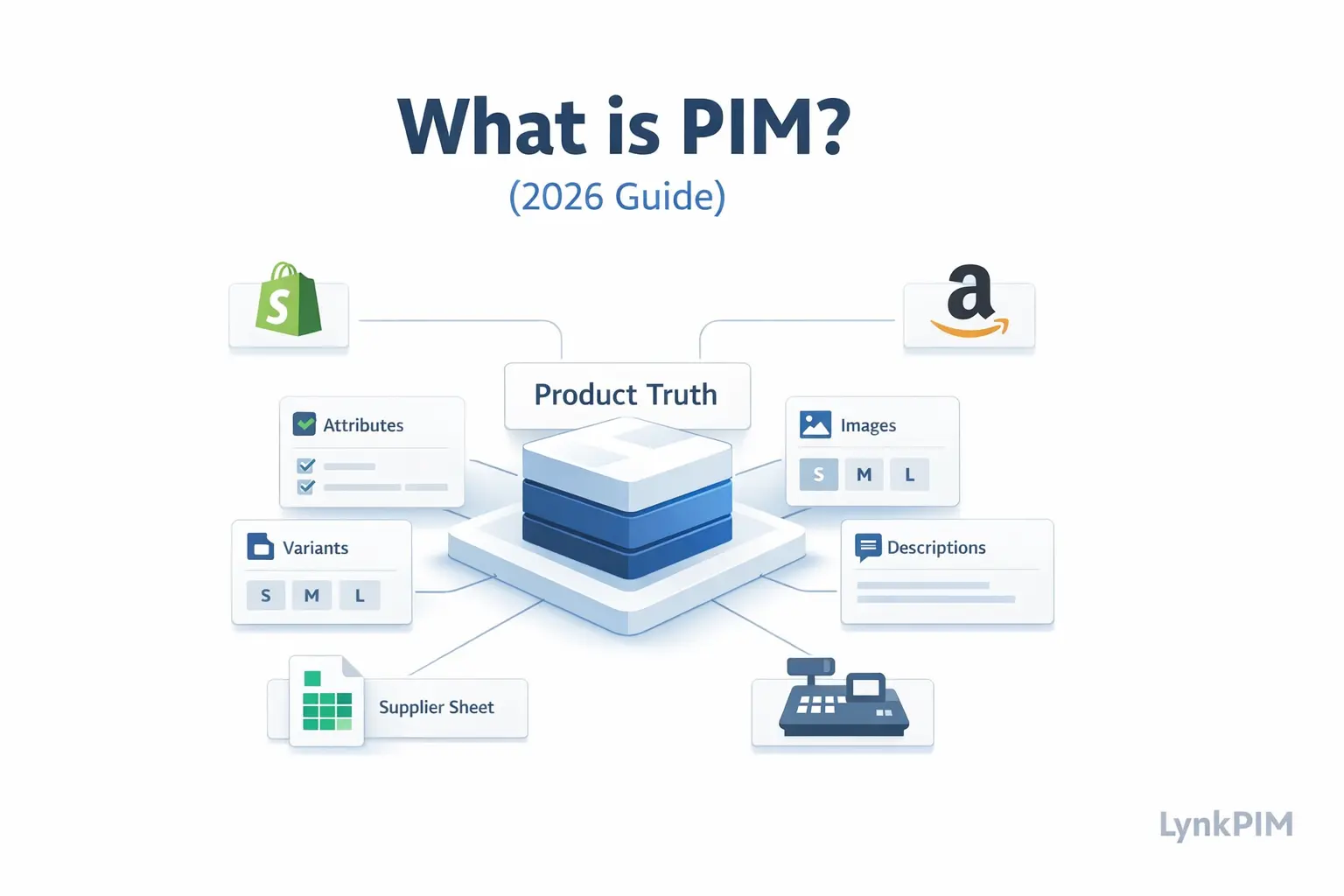
    PIM stands for Product Information Management. In practical terms, it is the system where your team manages the product information customers and channels actually depend on: titles, descriptions, attributes, specifications, variants, images, documents, translations, and channel-specific output.

    A simple way to explain it internally is this: your ERP may know that an item exists, your storefront may show it, and your DAM may store the media for it. But a PIM is the place that makes the product record usable, structured, trustworthy, and ready to publish.

    A PIM is the central system used to structure, enrich, govern, and distribute product information across teams and channels.

    If you want a clearer system-by-system breakdown, read PIM vs MDM vs DAM vs PXM: What to Use (and When).

    What PIM is not

    PIM gets misunderstood because it overlaps with several other systems. That overlap is exactly why teams sometimes buy the wrong tool.

    • PIM is not ERP. ERP is built for operational and financial records like inventory, purchasing, and accounts. PIM is built for sellable product content and structure.
    • PIM is not DAM. DAM manages files and usage rights. PIM manages the relationship between product records and the assets attached to them.
    • PIM is not CMS. A CMS manages pages and articles. PIM manages structured catalog data.
    • PIM is not “just another spreadsheet.” The value of PIM is not that it stores product data. It is that it adds governance, validation, workflow, ownership, and repeatable publishing.

    What problems does a PIM solve?

    Most teams think the problem is “we have product data in too many places.” That is true, but it is not the full problem. The bigger issue is that nobody is fully sure which version is final, which fields are required, who approves changes, and what “ready to publish” actually means.

    • Different teams maintain different versions of the same product.
    • Attributes are inconsistent, so filters and feeds break.
    • Variants get flattened into messy rows that are hard to manage.
    • Channel requirements keep changing, and every update becomes manual cleanup.
    • Launches stall because approvals happen in Slack, email, and memory.
    • Supplier files arrive in formats nobody wants to work with.

    If that sounds familiar, also read PIM vs spreadsheets: when your Excel-based product catalog becomes a liability and What “Single Source of Truth” Really Means in Product Operations.

    Who PIM is for

    PIM is not just for one department. The reason it becomes valuable is that product data crosses teams constantly.

    • Ecommerce teams need cleaner product pages, filters, feed fields, and faster publishing.
    • Merchandising teams need better taxonomy, variant structure, and catalog control.
    • Marketing teams need better descriptions, consistent brand language, and reusable content.
    • Operations teams need cleaner supplier intake, fewer manual fixes, and less duplication.
    • IT and RevOps teams need rules, integrations, auditability, and predictable data flow.

    In other words, PIM is for organizations where product information is already a shared operational responsibility, even if nobody has formally named it that yet.

    Who PIM is not for

    Not every business needs PIM right away. A lot of software content on this topic pretends the answer is always yes. It is not.

    • If you have a very small catalog, one editor, one channel, and very few variants, a spreadsheet or native platform setup may still be enough.
    • If your bigger problem is inventory accuracy, purchasing, or finance, PIM is not the first fix.
    • If your catalog changes rarely and your team is not struggling with approvals, enrichment, or channel formatting, PIM might be premature.

    The trigger is usually not “number of products.” It is the combination of channels + contributors + variants + required fields + workflow friction.

    Where PIM sits in the product data flow

    The easiest way to understand PIM is to picture the flow of product data from raw source to live channel.

    • Input: supplier sheets, ERP exports, image folders, technical documents, brand content
    • Structuring: taxonomy, attribute sets, variant model, controlled values
    • Enrichment: descriptions, bullets, SEO fields, translations, compliance notes
    • Governance: ownership, validation rules, review states, approvals
    • Output: storefronts, marketplaces, Google feeds, B2B catalogs, partner exports, print/PDF catalogs

    If you want to go deeper into the structure piece specifically, read Product Data Modeling for PIM: Taxonomy, Attributes, Variants.

    What good PIM implementation changes day to day

    The real benefit of PIM is not abstract. It shows up in daily work.

    • People stop asking which file is current.
    • Variant mistakes become easier to catch before they go live.
    • Required attributes are visible instead of buried in someone’s checklist.
    • Teams can enrich once and publish many times.
    • Launches become less dependent on one person who “knows where everything is.”

    This is why the phrase “single source of truth” matters in product operations. It is not branding language. It is a control mechanism.

    Identifiers, channel requirements, and why structure matters more than people think

    One place product operations often go wrong is identifiers. Teams focus on copy and images, but marketplaces and feeds care just as much about structured identifiers and field quality. If you sell products that have valid identifiers, you need to handle values like GTIN, MPN, and brand correctly and consistently. That matters for matching, syndication, and channel approval readiness.

    For reference, see the official GS1 explanation of GTIN and Google Merchant Center guidance on unique product identifiers.

    Three common PIM use cases by buyer stage

    1. Shopify and multichannel growth

    If you are running Shopify plus a Google feed, marketplaces, or a growing set of collections and variants, PIM becomes useful when your product updates start multiplying across places. The goal here is not enterprise complexity. It is reducing repetitive work and keeping channel output consistent.

    Read next: PIM vs spreadsheets and LynkPIM Features.

    2. B2B and technical catalog complexity

    B2B product data is a different kind of difficult. It usually involves deeper specifications, buyer-specific outputs, more documentation, and more governance risk. If that is your world, generic “better product pages” messaging is not enough. You need structure that reflects how the catalog actually works.

    Read next: PIM for B2B Ecommerce: Managing Complex Product Specs, Variants, and Buyer-Specific Catalogs.

    3. DPP and structured compliance readiness

    For teams thinking about Digital Product Passport readiness, the conversation shifts from “where do we store product content?” to “can we trust the structure, field ownership, supplier data, and traceability of the catalog?” PIM becomes important here because compliance work usually fails at the operational layer first.

    Read next: LynkPIM Solutions and your Digital Product Passport content cluster.

    How PIM is different from just “better product data management”

    People often use “product data management” as a general phrase, and that is fine in conversation. But the reason PIM matters as a category is that it gives product data an operational home. It does not just improve the content. It creates rules around the content.

    That includes things like:

    • attribute ownership
    • taxonomy logic
    • controlled values
    • variant inheritance
    • approval workflows
    • channel mappings
    • audit history

    That is why PIM becomes more valuable as your operation becomes more collaborative.

    When should you implement PIM?

    Usually earlier than teams expect, but not as early as vendors suggest.

    A good rule of thumb is this: if your team is already compensating for catalog chaos with process hacks, extra review steps, duplicate sheets, export files, and “don’t touch that tab” instructions, you are already doing PIM work manually. The question is whether you want to keep doing it invisibly.

    Most successful implementations start with the basics first: taxonomy, core attributes, variant logic, ownership, and the fields that most affect conversion and channel readiness. Not everything at once.

    Final takeaway

    PIM is not interesting because it is fashionable software. It is useful because product data gets complicated faster than most teams expect.

    If your catalog is still small and stable, you may not need PIM yet. But if your team is already managing product truth across spreadsheets, channels, supplier files, and memory, then PIM is not a “nice to have.” It is the system that turns product operations from reactive cleanup into a repeatable process.

    And once you get to that point, the upside is not just cleaner data. It is faster launches, fewer avoidable mistakes, better channel output, and a team that trusts the catalog again.

    FAQs

    Is PIM only for large catalogs?

    No. The trigger is usually complexity, not just SKU volume. A smaller catalog with many variants, multiple channels, and multiple contributors can need PIM before a larger but simpler catalog does.

    Do I need PIM if I only sell on Shopify?

    Not always. But if Shopify is only the storefront while your real work happens in spreadsheets, supplier files, and feed tooling, PIM can still reduce errors and speed up updates.

    How is PIM different from ERP?

    ERP manages operational and financial records. PIM manages sellable product information, structured attributes, and publishing workflows.

    What should go into PIM first?

    Start with taxonomy, required attributes for your main categories, variant structure, identifiers, core images, and the fields that directly affect channel readiness and conversion.

    Can PIM help with B2B catalogs?

    Yes. In many B2B setups, that is where PIM becomes even more valuable because of deeper specs, buyer-specific views, and stronger governance requirements.

    Why do PIM projects fail?

    Usually because the team treats it as a migration project instead of an operating model. If ownership, taxonomy, approvals, and field standards are unclear, the tool cannot rescue the process on its own.