Product Taxonomy for Home Goods and Furniture: The Complete Guide
Home goods and furniture present a taxonomy challenge that is distinct from fashion or electronics. Products are large, physical, and often customisable. Customers search by room, by style, by material, and by dimension — sometimes all at once. A sofa is not just a sofa: it is a 3-seater, right-hand-facing, grey velvet, Scandi-style corner sofa with a specific width that must fit through a standard doorframe.
This guide covers how to build a home goods taxonomy that handles all of those dimensions without becoming unmanageable.
Room-Based vs Type-Based Hierarchy: Which to Choose
The first decision in home goods taxonomy is whether to organise by room or by product type at the top level. Both approaches appear in the market. Both have genuine pros and cons.
| Room-Based (Living Room, Bedroom, Kitchen) | Type-Based (Sofas, Beds, Tables) | |
|---|---|---|
| Customer navigation | Intuitive for browsing by project (“doing up my bedroom”) | Intuitive for specific product search (“I need a sofa”) |
| Cross-room products | Problem — a side table works in bedroom AND living room | No problem — side tables are just side tables |
| Google Shopping mapping | Difficult — Google organises by type, not room | Easy — maps directly to Google taxonomy |
| SEO | Room keywords have high volume but low commercial intent | Type + material + size keywords have high commercial intent |
| Verdict | Works for editorial/inspiration content | Better for ecommerce catalog and feed performance |
The recommended approach: use type-based categories as your primary taxonomy structure and add room as a filterable attribute on each product. This gives customers both navigation paths without creating structural problems for products that belong in multiple rooms. For a full comparison of hierarchy approaches, see Flat vs Hierarchical Taxonomy.
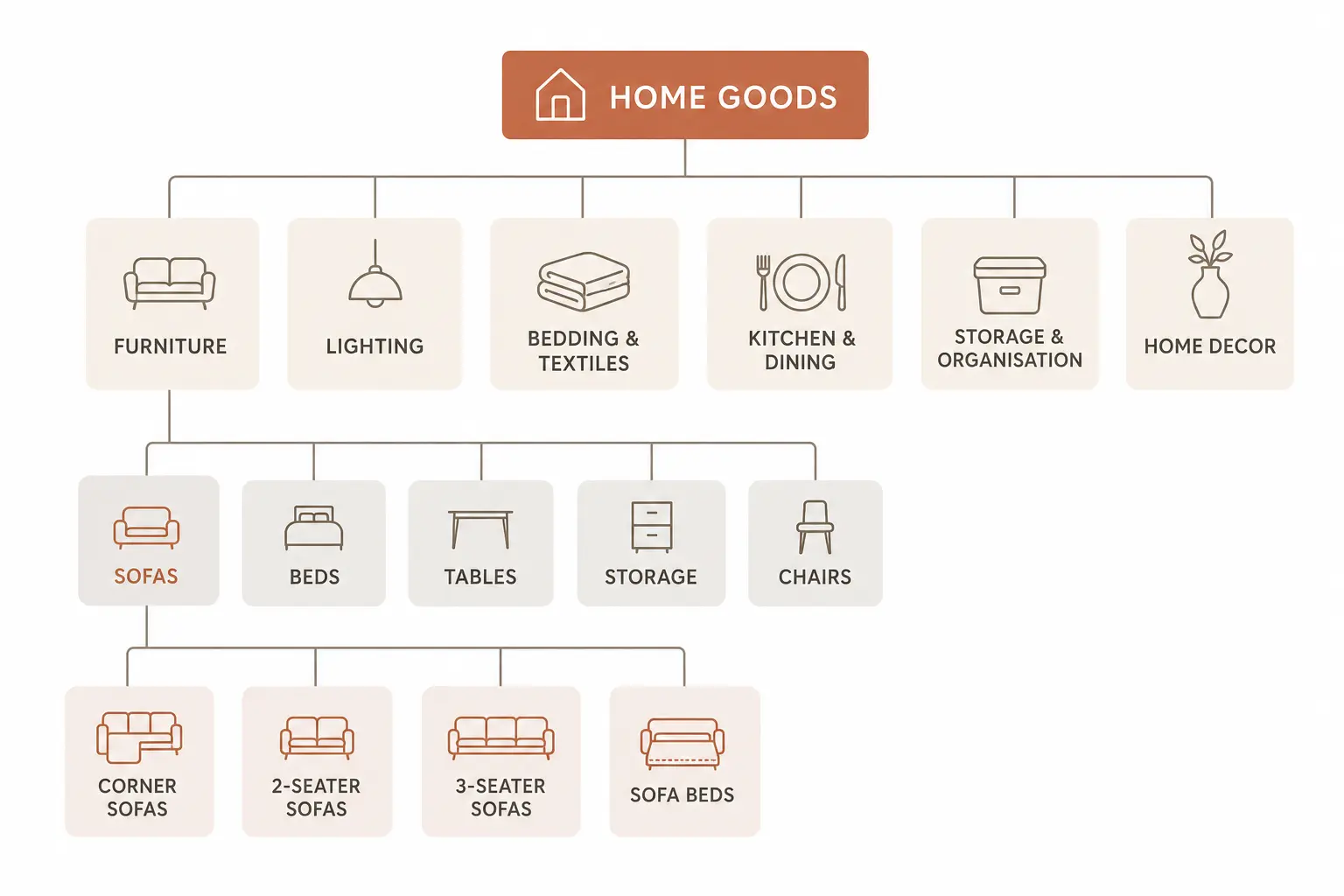
Recommended Top-Level Structure for Home Goods
| Level 1 | Level 2 Examples | Level 3 Examples |
|---|---|---|
| Furniture | Sofas, Beds, Tables, Storage, Chairs, Wardrobes | Corner Sofas, 2-Seater Sofas, Sofa Beds |
| Lighting | Ceiling Lights, Floor Lamps, Table Lamps, Wall Lights | Pendant Lights, Chandeliers, Spotlights |
| Bedding & Textiles | Duvet Sets, Pillowcases, Throws, Curtains, Rugs | King Duvet Sets, Blackout Curtains |
| Kitchen & Dining | Cookware, Tableware, Kitchen Storage, Appliances | Non-stick Pans, Dinner Sets, Knife Blocks |
| Storage & Organisation | Shelving, Boxes & Baskets, Hooks, Drawer Organisers | Floating Shelves, Wicker Storage Baskets |
| Home Decor | Mirrors, Vases, Picture Frames, Candles, Artwork | Wall Mirrors, Full-Length Mirrors |
| Outdoor | Garden Furniture, Outdoor Lighting, Planters, BBQs | Garden Dining Sets, Garden Sofas |
Attribute Sets for Home Goods
Furniture (Sofas, Tables, Chairs, Beds)
- Required: Brand, Colour, Material (primary), Dimensions (W × H × D in cm), Weight (kg), Assembly required (yes/no)
- Recommended: Frame material, Leg material, Interior style, Room (Living Room / Bedroom / etc.), Maximum load (kg), Flat pack (yes/no), Number of seats (sofas/chairs)
- Google category: Furniture → [specific type] e.g. Furniture > Sofas & Sectionals
Lighting
- Required: Brand, Colour/Finish, Fitting type (E27, B22, GU10 etc.), IP rating (for outdoor/bathroom), Material
- Recommended: Bulb included (yes/no), Bulb type, Max wattage, Dimmable (yes/no), Height (cm), Shade diameter (cm), Interior style
- Google category: Furniture > Lamps & Lighting > [specific type]
Bedding & Textiles
- Required: Brand, Colour, Size (Single / Double / King / Super King), Material composition, Care instructions
- Recommended: Thread count (sheets), Tog rating (duvets), Pattern, Weave type, Hypoallergenic (yes/no)
- Google category: Home & Garden > Linens & Bedding > [specific type]
Dimension Attributes — Non-Negotiable for Furniture
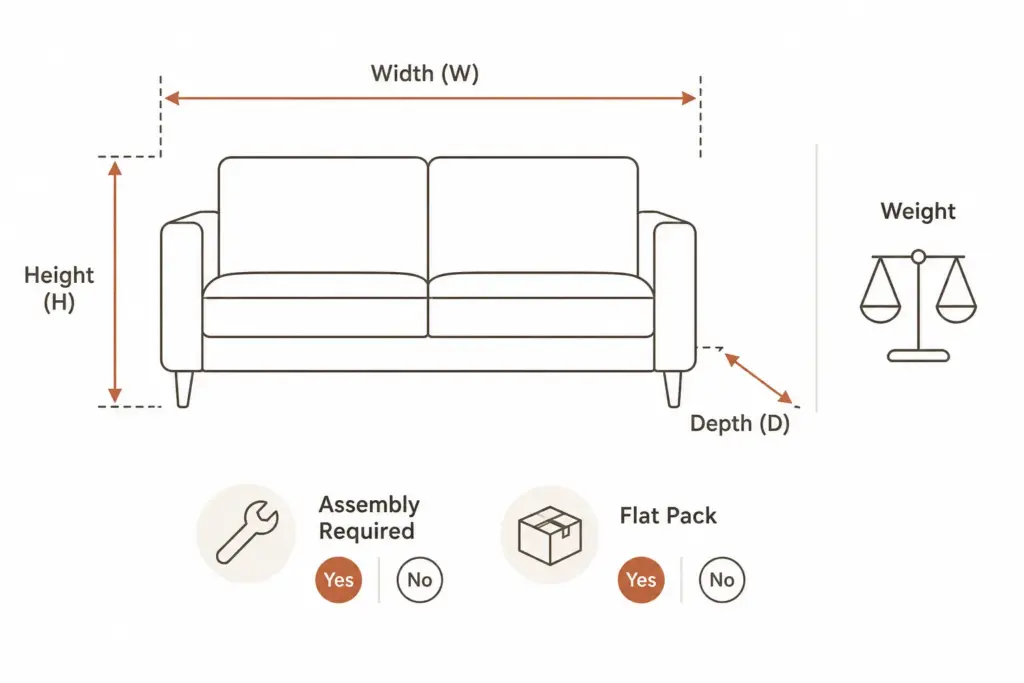
Dimension data is the most common missing attribute in home goods feeds, and it is the attribute customers are most likely to abandon without when making a buying decision. Furniture customers need to know if a sofa fits their space before they buy. A sofa listing without dimensions loses that sale before it begins.
- Width, Height, Depth: In centimetres. Required for all furniture and large home goods.
- Seat height: For chairs and sofas — critical for accessibility and ergonomics.
- Weight: In kilograms. Important for customer planning and delivery expectations.
- Assembly required: Yes / No — customers plan their time around this.
- Flat pack: Yes / No — relevant for customers with size-restricted access (e.g. lifts, narrow staircases).
Material Management in Home Goods
Material naming in home goods has the same problem as colour naming in fashion. Marketing names (“Smoked Oak”, “Brushed Concrete Effect”, “Warm Walnut”) are meaningful to buyers but problematic for site filters and Google Shopping.
Use a two-field approach: store the marketing material name for product copy and an additional normalised material value for filtering and feed submission:
- Smoked Oak → Oak
- Brushed Concrete Effect → Concrete / MDF
- Warm Walnut Veneer → Walnut
- Hammered Antique Brass → Brass
Without normalised material values, your filter “Shop by Material” becomes unusable — customers cannot find all oak products because they appear under fifteen different marketing material names.
Style as a Filterable Attribute
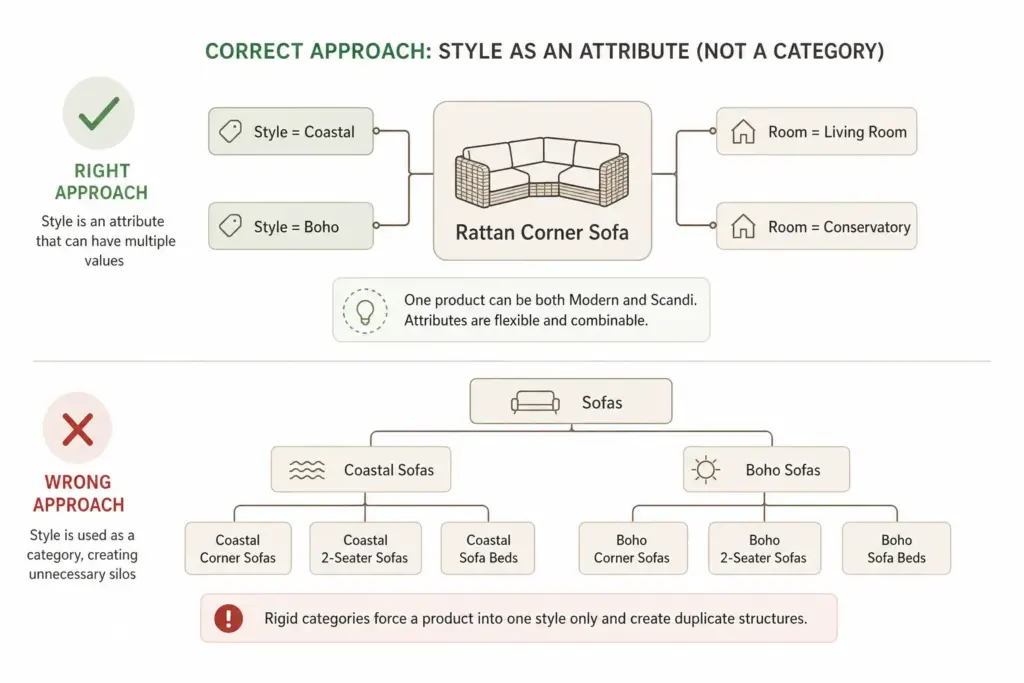
Interior style — Modern, Scandinavian, Industrial, Traditional, Coastal, Maximalist — is a genuine purchase driver for home goods customers. But style should be a filterable attribute, not a category. Here is why:
- A product can have multiple applicable styles — a rattan sofa is both Coastal and Boho
- Style trends change — “Cottagecore” did not exist as a search term five years ago; you cannot build permanent category structure on trends
- Style categories create structural debt — “Industrial Living Room Furniture” and “Scandinavian Living Room Furniture” as subcategories double your category maintenance without adding navigational value
Assign style values as multi-value attributes and surface them as filters. A product can carry two or three style tags and appear in all relevant filter results without duplicating the product record.
Google Product Category Mapping for Home Goods
| Product | Correct Google Category |
|---|---|
| 3-seater sofa | Furniture > Sofas & Sectionals |
| King size bed frame | Furniture > Beds & Bed Frames |
| Pendant ceiling light | Furniture > Lamps & Lighting > Ceiling Lights & Fans |
| King duvet set | Home & Garden > Linens & Bedding > Duvet Covers |
| Non-stick frying pan | Kitchen & Dining > Cookware > Frying Pans & Skillets |
| Floating shelf | Furniture > Shelving > Wall Shelves & Ledges |
Once your home goods taxonomy is structured, managing dimension attributes and material values at scale benefits significantly from a PIM that enforces attribute completeness before products are published. Take the PIM Readiness Score to identify your current gaps, or download the free Taxonomy Template — including the Home Goods & Furniture tab — at lynkpim.app.
For a broader framework applicable across all industries before diving into home-specific requirements, see How to Build a Product Taxonomy From Scratch.
Frequently Asked Questions
Should a home goods taxonomy be room-based or product-type-based?
Product-type-based is recommended for the primary taxonomy structure. Room should be a filterable attribute on each product, not a top-level category. This avoids the structural problem of cross-room products and maps far more cleanly to Google’s product taxonomy — which organises by type, not by room.
What dimension attributes are required for furniture?
Width, Height, and Depth in centimetres are required for all furniture and large home goods. Additionally include Weight (kg), Assembly Required (yes/no), and Flat Pack (yes/no). Seat height is strongly recommended for chairs and sofas as it is a key purchase decision factor.
How should interior style be handled in a home goods taxonomy?
Style should be a multi-value filterable attribute, not a permanent category. One product can carry multiple style tags — Coastal and Boho, for example — and appear in all relevant filter results without duplicating the product record. Creating style-named categories creates structural debt that becomes difficult to manage when interior trends shift.
What Google product category should I use for sofas?
Use the leaf-node: Furniture > Sofas & Sectionals. Avoid parent categories like “Furniture” alone. The more specific your Google product category, the better your Shopping feed relevance and the more accurately Google matches your products to buyer queries.
How should material be managed in a home goods taxonomy?
Use a two-field approach: marketing material name (Smoked Oak, Warm Walnut Veneer) for customer-facing copy, and a normalised material value (Oak, Walnut) for feed attributes and site filters. Without normalised values, your “Shop by Material” filter becomes a list of marketing names rather than a useful browsing tool.