Product Taxonomy for B2B Industrial Products: The Complete Guide
B2B industrial product taxonomy is the most technically demanding category structure in ecommerce. Industrial buyers know exactly what they need — often down to a part number, material grade, and certification standard. A taxonomy that cannot surface products by technical specification loses B2B buyers immediately, because they will not browse to find the right hydraulic fitting. They will go somewhere that lets them specify it.
This guide covers how to build an industrial taxonomy that works for procurement buyers, engineers, and maintenance teams — not just for general consumers.
Why B2B Industrial Taxonomy Differs from B2C
- Part number is the primary identifier: B2B buyers often search by manufacturer part number (MPN) or internal reference code. Your taxonomy must support this lookup path, not just category browsing.
- Technical specifications are purchase criteria: An industrial buyer does not choose a bolt by colour. They specify thread standard (M6, M8, M10), material grade (Grade 8.8, 304 stainless, A4 marine grade), head type (hex, socket cap, button head), and length in millimetres.
- Compliance is non-negotiable: Many industrial products require specific certifications (CE, ATEX, RoHS, REACH, IP ratings) and buyers will not purchase without visible certification data.
- Volume and price structures: B2B products often have quantity-break pricing and minimum order quantities — these need to be attributes, not ad hoc product descriptions.
For the foundational taxonomy build process before B2B-specific requirements, see How to Build a Product Taxonomy From Scratch.
Start With a Standard Classification System
Unlike B2C categories where you build from customer search behaviour, B2B industrial taxonomy should be anchored to an established classification standard. Do not build from scratch.
- UNSPSC (United Nations Standard Products and Services Code) — widely used in procurement and public sector. Free to access at unspsc.org. Four-level hierarchy: Segment → Family → Class → Commodity.
- eCl@ss — European standard, widely used in manufacturing and industrial supply chains. More granular than UNSPSC for technical components.
- GS1 GPC (Global Product Classification) — used in retail and wholesale supply chains. Better for MRO and maintenance products than for pure manufacturing components.
You do not need to expose these classification codes to buyers. Use them as the structural backbone of your internal taxonomy, then create buyer-friendly category names as a display layer on top.
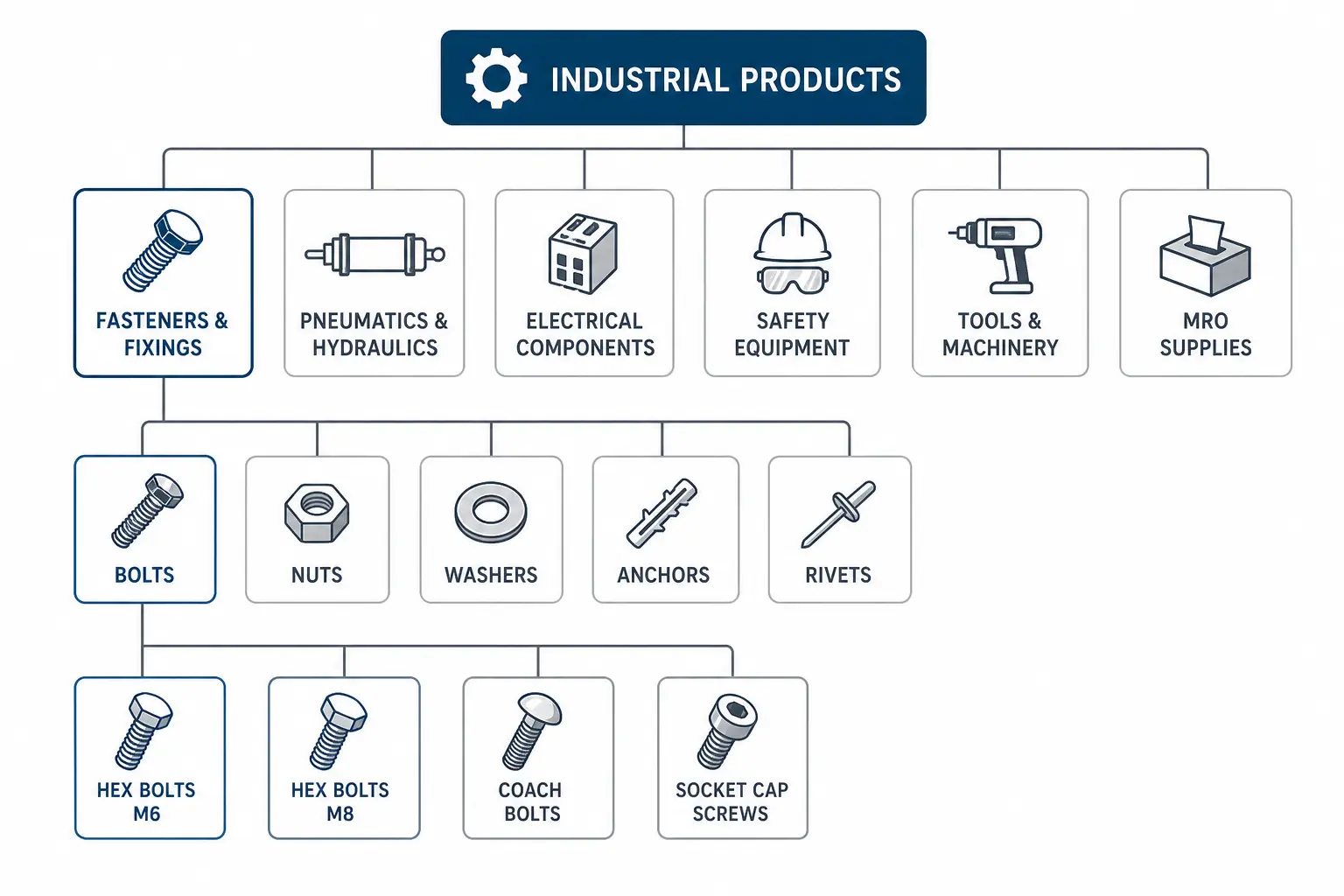
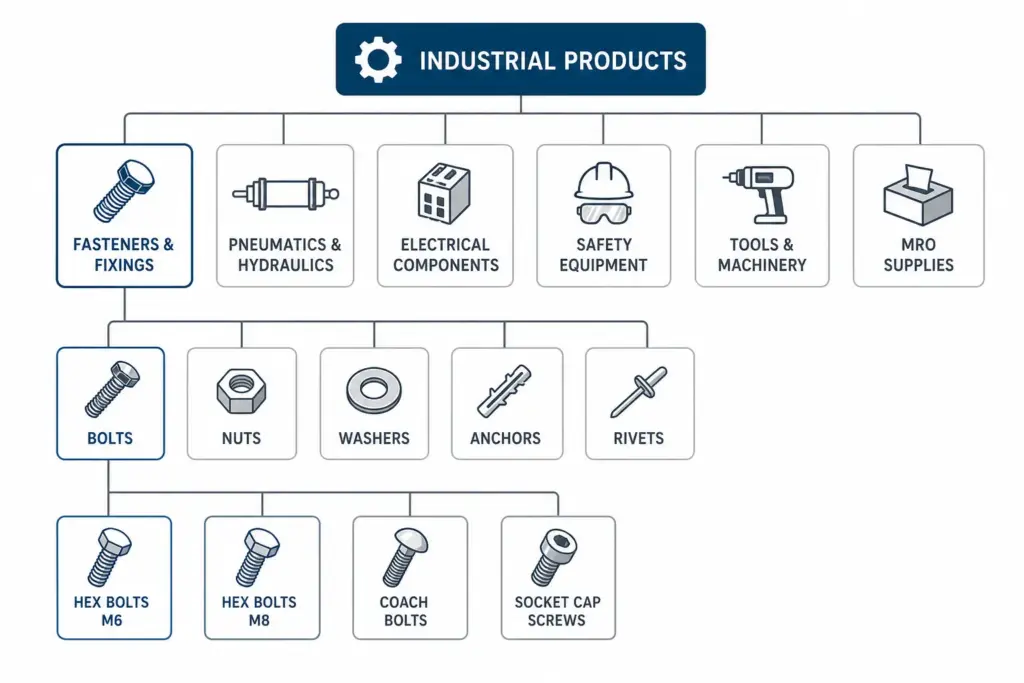
Recommended Top-Level Structure for Industrial
| Level 1 | Level 2 Examples | Level 3 Examples |
|---|---|---|
| Fasteners & Fixings | Bolts, Nuts, Washers, Anchors, Rivets, Screws | Hex Bolts, Socket Cap Screws, Coach Bolts |
| Pneumatics & Hydraulics | Fittings, Valves, Cylinders, Hoses, Pumps | Push-fit Fittings, Compression Fittings |
| Electrical Components | Connectors, Cable Management, Switches, Relays | DIN Rail Connectors, Terminal Blocks |
| Safety Equipment | PPE, Eye Protection, Respiratory, Fall Protection | Safety Helmets, Hi-Vis Jackets |
| Tools & Machinery | Hand Tools, Power Tools, Measuring, Cutting | Torque Wrenches, Digital Callipers |
| MRO Supplies | Lubricants, Cleaning, Sealing, Adhesives | Bearing Grease, Thread Sealant |
| Pipe & Tube | Steel Pipe, Copper Tube, Plastic Pipe, Fittings | Stainless Steel Tube, HDPE Pipe |
Technical Specification Attributes
Fasteners (Bolts, Nuts, Screws)
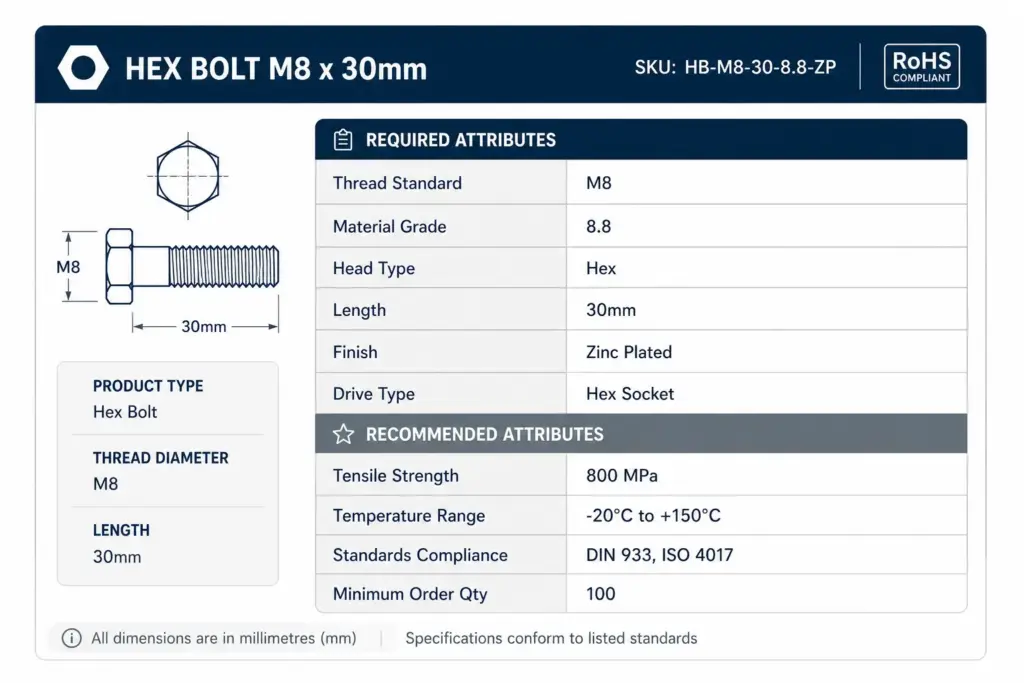
- Required: Thread standard (M4, M6, M8, M10 etc.), Material grade (Grade 8.8, Grade 10.9, A2 stainless, A4 marine), Head type, Length (mm), Finish (zinc plated, hot dip galvanised, plain)
- Recommended: Tensile strength (MPa), Hardness (HRC), Drive type, Standards compliance (DIN, ISO, BS, ANSI), Minimum order quantity, Pack size
Pneumatic Fittings
- Required: Connection type (push-fit, compression, threaded), Port size (BSP, NPT, metric), Tube OD (mm), Material (brass, stainless, nylon), Max pressure (bar), Temperature range (°C)
- Recommended: Flow rate (l/min), Seal material (NBR, EPDM, PTFE), ATEX rated (yes/no), IP rating
Safety Equipment (PPE)
- Required: CE marking (yes/no), Standard compliance (EN 397, EN 388, EN 166 etc.), Protection class, Size/Fit range, Material
- Recommended: EN standard version year, Shelf life, Cleaning instructions, Compatible with other PPE items
Compliance and Certification Attributes
Compliance data is what separates a functional industrial taxonomy from an inadequate one. B2B buyers in regulated industries (construction, oil and gas, food processing, pharmaceuticals) cannot purchase without verified compliance data.
- CE marking: Yes / No — mandatory for products sold in EU/UK regulated categories
- ATEX certification: Zone rating — for equipment used in explosive atmospheres
- RoHS compliance: Yes / No — restriction of hazardous substances in electrical equipment
- REACH compliance: SVHC declaration — substances of very high concern disclosure
- IP rating: IP54, IP65, IP67 etc. — ingress protection for electrical and electronic products
- Industry standards: DIN, ISO, BS, ANSI, ASTM — the specific standard and version the product is manufactured to
Part Number Structure as Taxonomy Signal
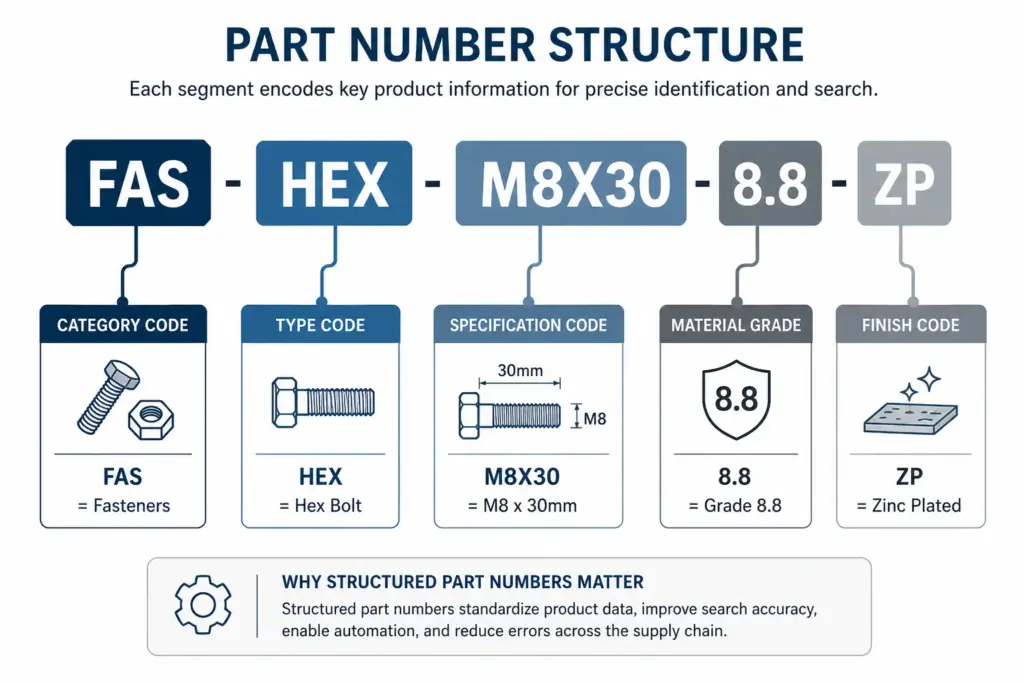
In B2B industrial catalogs, the part number (MPN — Manufacturer Part Number) is often the most important search term. Procurement buyers copy part numbers from approved vendor lists and search for exact matches. Your product records must include manufacturer part numbers, and your site search must index them.
Beyond search, consider encoding category information into your internal part number format. A part number structure like CAT-MFR-SPEC-VARIANT means any product ID immediately signals its category, manufacturer, and variant — making catalog management programmatic rather than dependent on correct manual categorisation.
The PIM Readiness Score identifies where your current B2B catalog data governance has gaps — particularly around technical specification completeness and compliance attribute coverage. The free Taxonomy Template at lynkpim.app includes the B2B Industrial tab with a pre-built category structure and attribute set.
For a comparison of how B2B industrial taxonomy differs structurally from consumer categories, see the Home Goods Taxonomy guide as a contrast point.
Frequently Asked Questions
What classification standard should I use for B2B industrial taxonomy?
UNSPSC is the most widely adopted standard for industrial and procurement catalogs globally. eCl@ss is preferred in European manufacturing and engineering contexts. Use the standard most common in your target buyer’s procurement system — many enterprise procurement platforms require UNSPSC codes on purchase orders and will not process invoices without them.
How important is part number (MPN) in B2B industrial taxonomy?
Extremely important. B2B buyers frequently search by exact manufacturer part number copied from an approved vendor list or Bill of Materials. Your site search must index MPNs and your product records must include both your internal part number and the manufacturer’s part number. Missing MPN data means losing buyers who search by part number — which is a significant share of B2B industrial search volume.
What compliance attributes should industrial products have?
At minimum: CE marking status, relevant EN/ISO/DIN/ANSI standards compliance, RoHS status for electrical products, and IP rating where applicable. ATEX certification is mandatory for products used in potentially explosive atmospheres. REACH SVHC declarations are required for products containing substances of very high concern sold in EU/UK markets.
How do you handle quantity pricing in a B2B product taxonomy?
Quantity break pricing and minimum order quantities should be structured product attributes, not free-text in descriptions. Store them as structured fields: min_order_qty, pack_size, and pricing tiers with corresponding quantity thresholds. This enables filter by minimum order, automated price calculation, and correct price display in Shopping feeds.
Should B2B industrial products use the same Google Shopping feed structure?
Yes, the same Merchant Center feed structure applies. B2B industrial products benefit significantly from detailed technical specifications in the product description (which Google indexes), and from the deepest available google_product_category value. Many B2B industrial searches are long-tail and highly specific — title construction should include thread standard, material grade, and key certifications where character limits allow.