What Is Product Taxonomy? Definition, Examples and Why It Matters
Product taxonomy is the classification system that organises your products into a structured hierarchy. It determines how products are grouped, named, and navigated — on your website, inside your catalog management system, and across every sales channel you use.
Get it right and customers find products faster, your Google Shopping feed performs better, and your team can manage thousands of SKUs without chaos. Get it wrong and you end up with inconsistent categories, broken filters, and channel mapping errors that cost you sales daily.
Product Taxonomy Definition
A product taxonomy is a hierarchical system for classifying products into groups based on shared characteristics. The word comes from the Greek taxis (arrangement) and nomos (law or method) — it is, literally, the rules by which products are arranged.
In practical ecommerce terms, a product taxonomy answers three questions for every product in your catalog:
What type of product is this? (Product Type / Subcategory)
What category does it belong to? (Category)
What department does that category sit under? (Department)
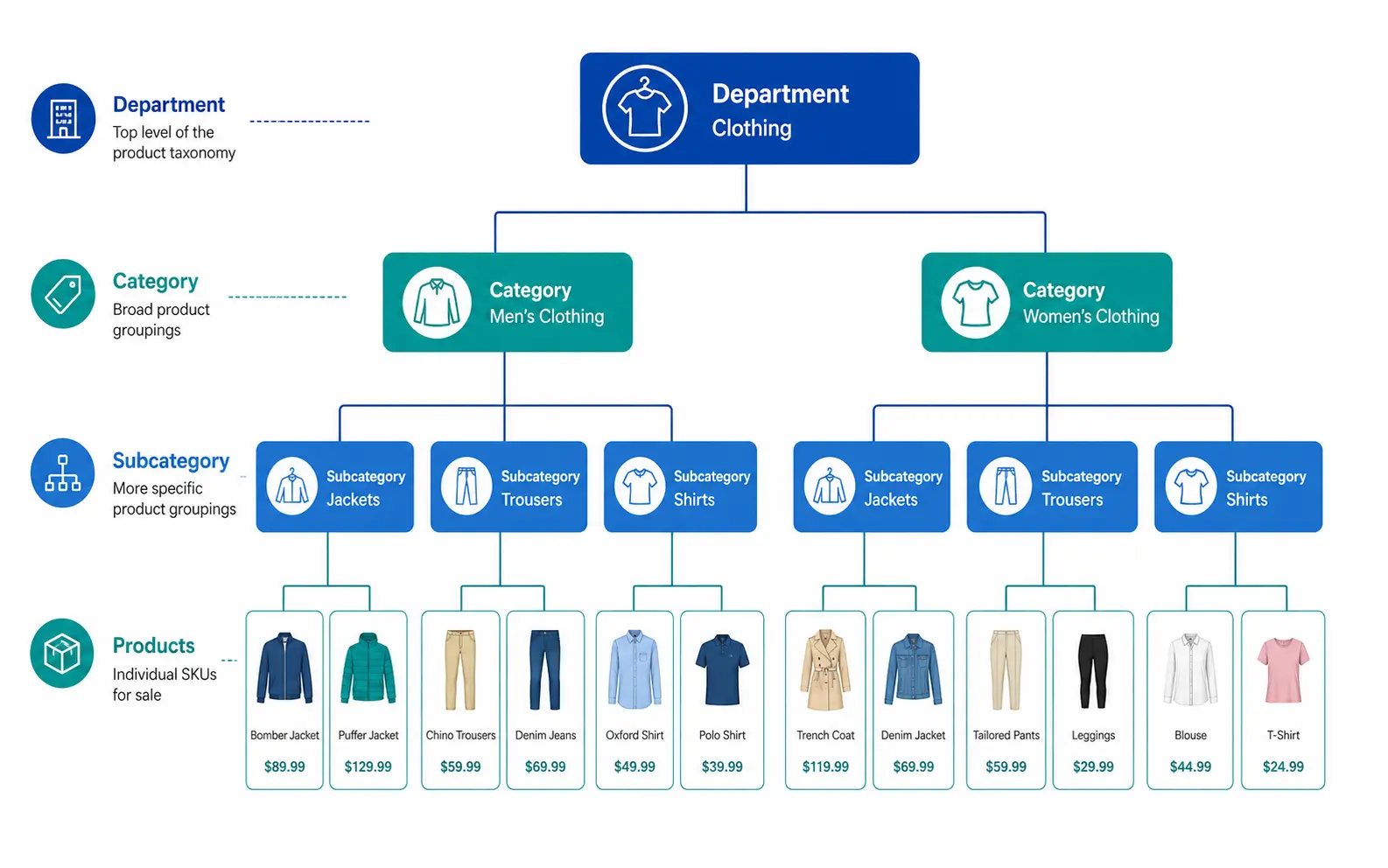
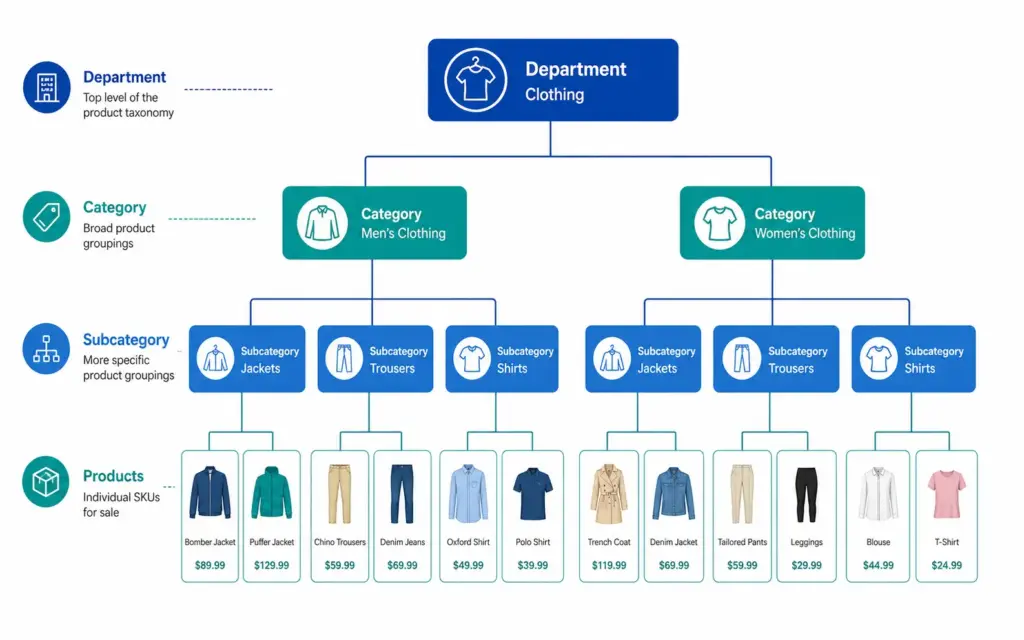
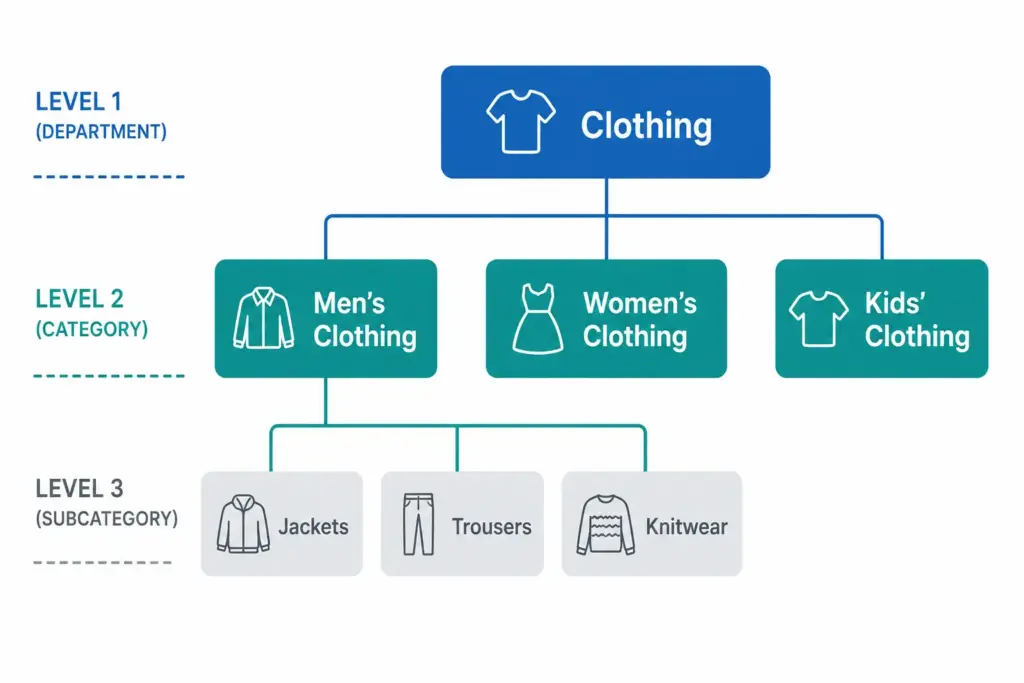
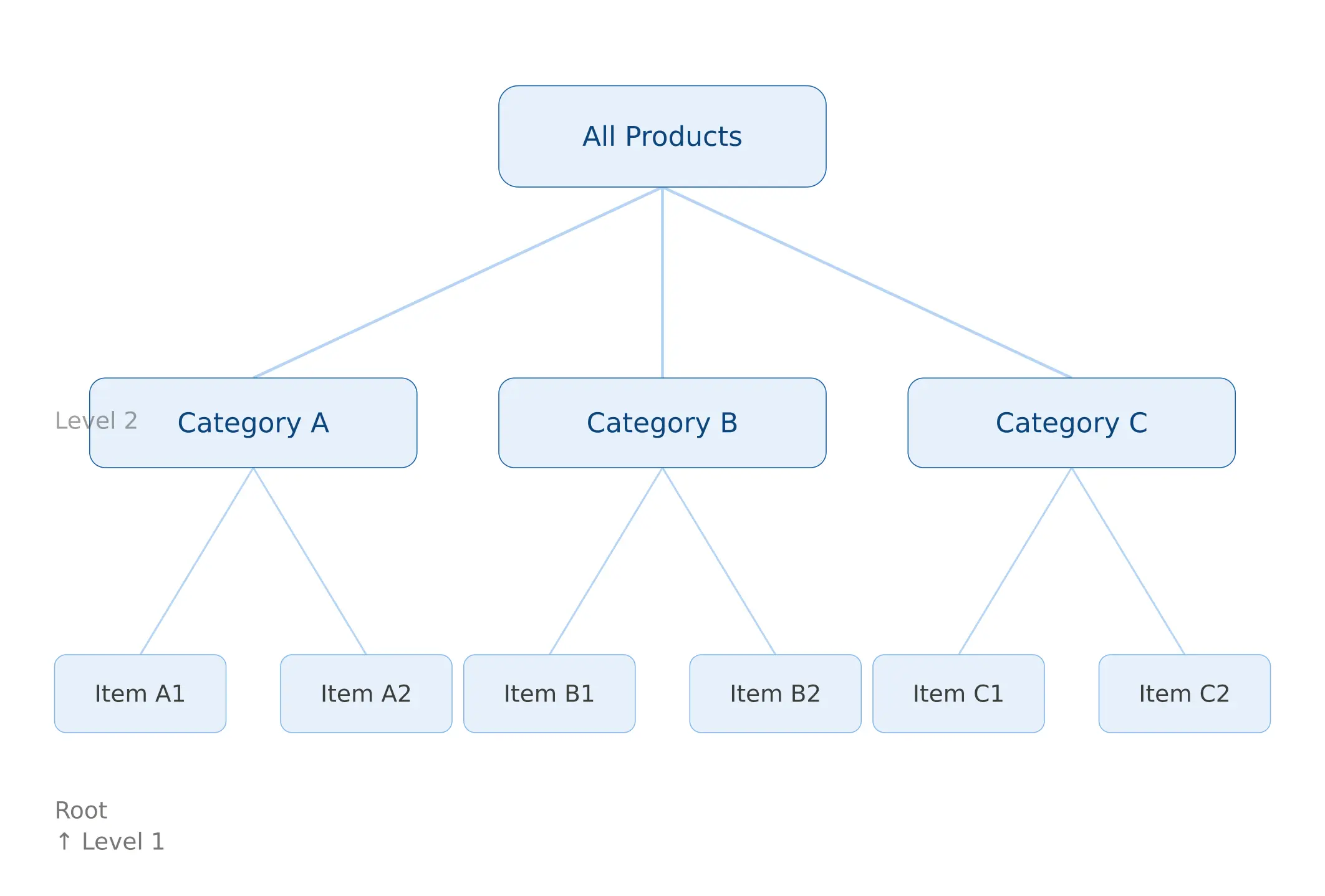
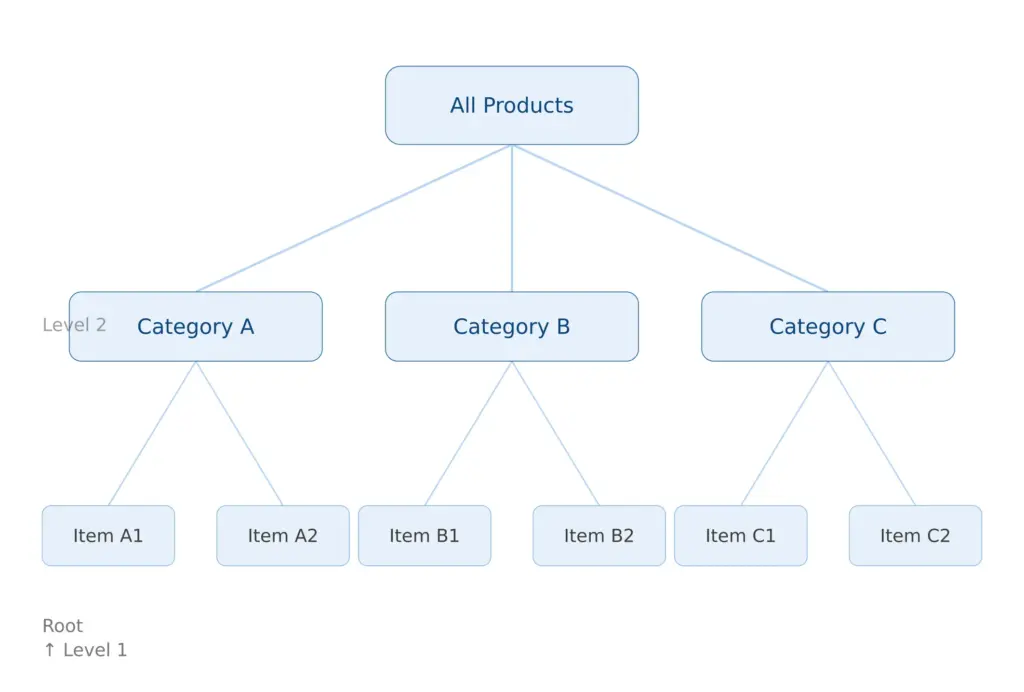
Those three questions map to the three levels every functional taxonomy needs: Department → Category → Subcategory.
A Simple Product Taxonomy Example
Level
Name
Example
Level 1 — Department
Clothing
Clothing, Footwear, Accessories
Level 2 — Category
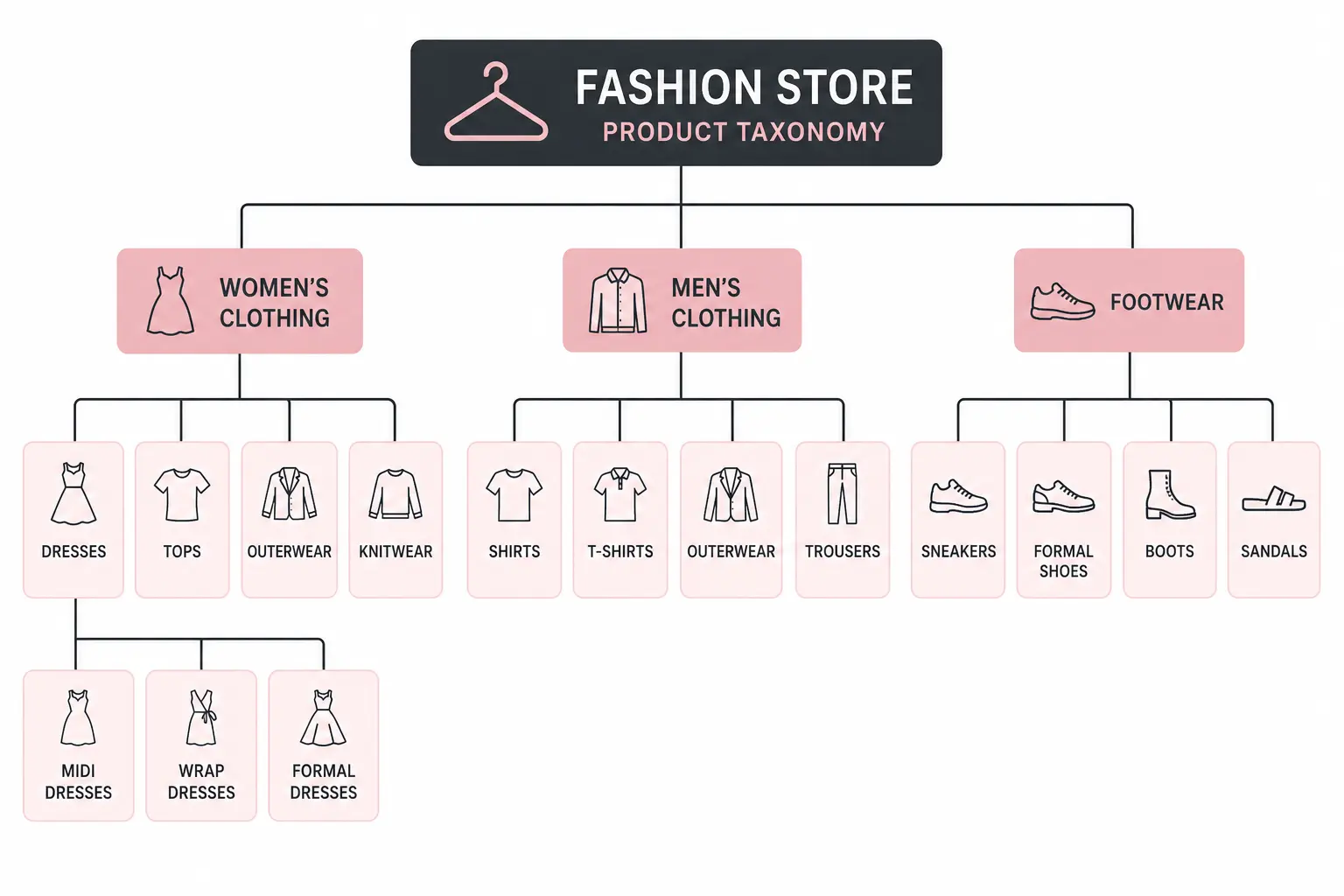
Men’s Clothing
Men’s, Women’s, Kids’
Level 3 — Subcategory
Men’s Jackets
Jackets, Trousers, Shirts, Knitwear
Level 4 — Product Type
Men’s Rain Jackets
Rain Jackets, Leather Jackets, Puffer Jackets
Every product in the catalog sits at the most specific level — Level 3 or Level 4 — not at the top. A product is never just “Clothing”. It is always “Men’s Rain Jackets” or “Women’s Running Shoes”.
Taxonomy vs Categories vs Attributes — What’s the Difference?
These three terms are often used interchangeably but they are distinct concepts.
Taxonomy — the overall classification system and its rules. The framework.
Categories — the individual nodes within the taxonomy. Men’s Jackets is a category.
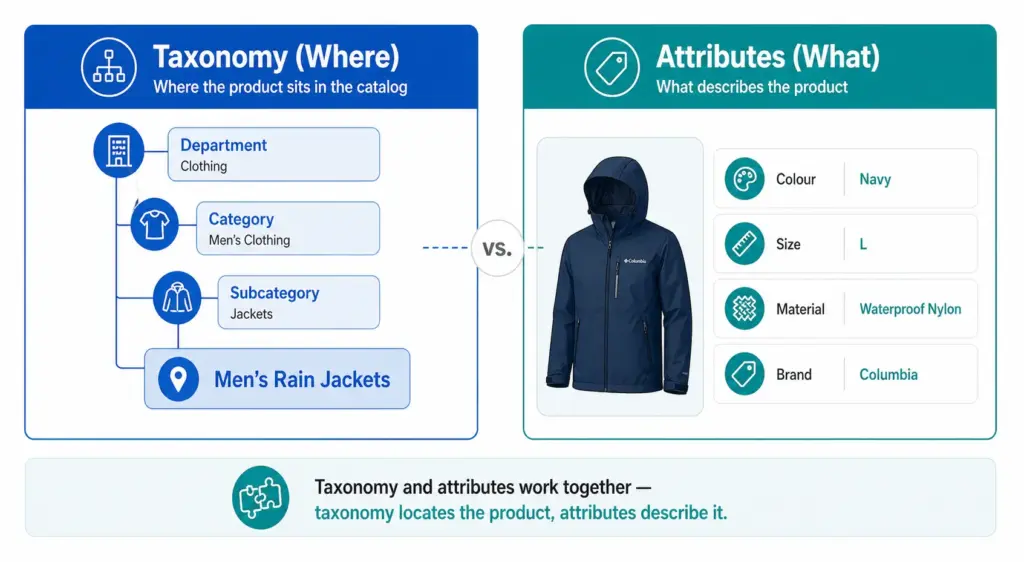
Attributes — the properties of a product within its category. Colour, Size, Material, Brand are attributes of a product in Men’s Jackets.
Taxonomy tells you where the product lives. Attributes describe what the product is. Both are necessary. A product without a taxonomy position cannot be found by browsing. A product without attributes cannot be filtered or matched to specific search queries.
Why Product Taxonomy Matters for Ecommerce
1. Site navigation and search
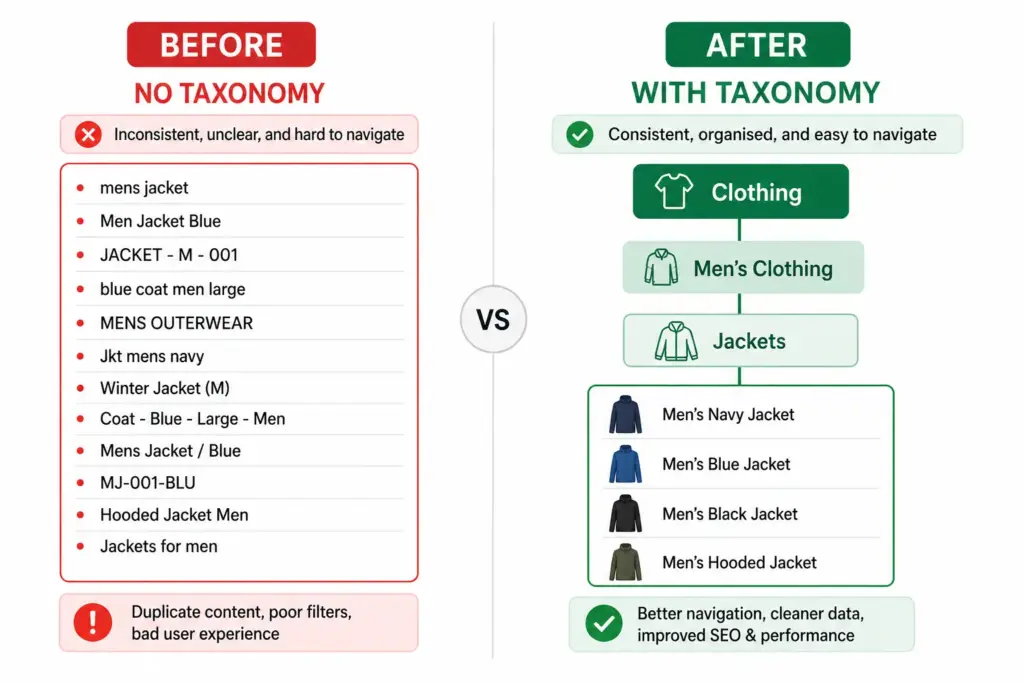
Your taxonomy is the structure your site navigation and filters are built on. If your taxonomy is flat or inconsistent, your filters do not work. Customers searching for “blue running shoes women size 7” cannot filter to that result if Colour, Activity, Gender, and Size are not structured attributes on products in the correct subcategory.
2. Google Shopping performance
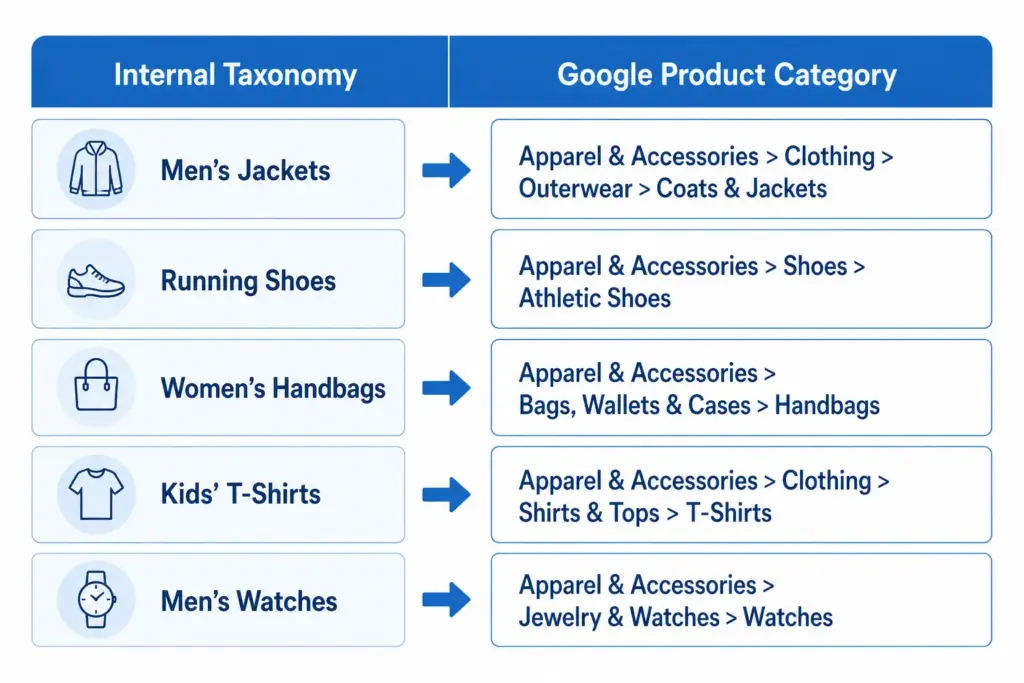
Google Shopping requires a google_product_category value for every product. This value must map to Google’s own taxonomy at the most specific level available. A jacket submitted as “Apparel & Accessories” instead of “Apparel & Accessories > Clothing > Outerwear > Coats & Jackets” loses relevance in every Shopping auction it enters. Your taxonomy must map to Google’s.
3. Channel feed mapping
Every major channel — Google Shopping, Amazon, Facebook Catalogue, retail marketplaces — has its own category taxonomy. Your internal taxonomy needs to translate cleanly to each one. A well-structured internal taxonomy makes this mapping straightforward. A chaotic one makes it a manual monthly project.
4. Internal catalog management
A consistent taxonomy means your team can find, update, and report on products by category without ambiguity. Without it, “running shoes” might live under “Athletic Footwear”, “Sports”, “Men’s Sports”, and “Women’s Running” in the same catalog — making bulk updates, seasonal campaigns, and channel exports all harder than they need to be.
Flat vs Hierarchical Taxonomy
Two structural approaches exist for product taxonomy. For most ecommerce stores with more than a few hundred products, the difference matters significantly. The full comparison is covered in the Flat vs Hierarchical Taxonomy guide, but the key distinction is:
Flat taxonomy: One level of categories, no subcategories. Simple but breaks down above ~200 products. Filters become unwieldy and Google category mapping becomes imprecise.
Hierarchical taxonomy: Multiple nested levels. Scales to any catalog size. Enables precise Google category mapping and deep attribute-based filtering.
Product Taxonomy in Practice — Real Examples
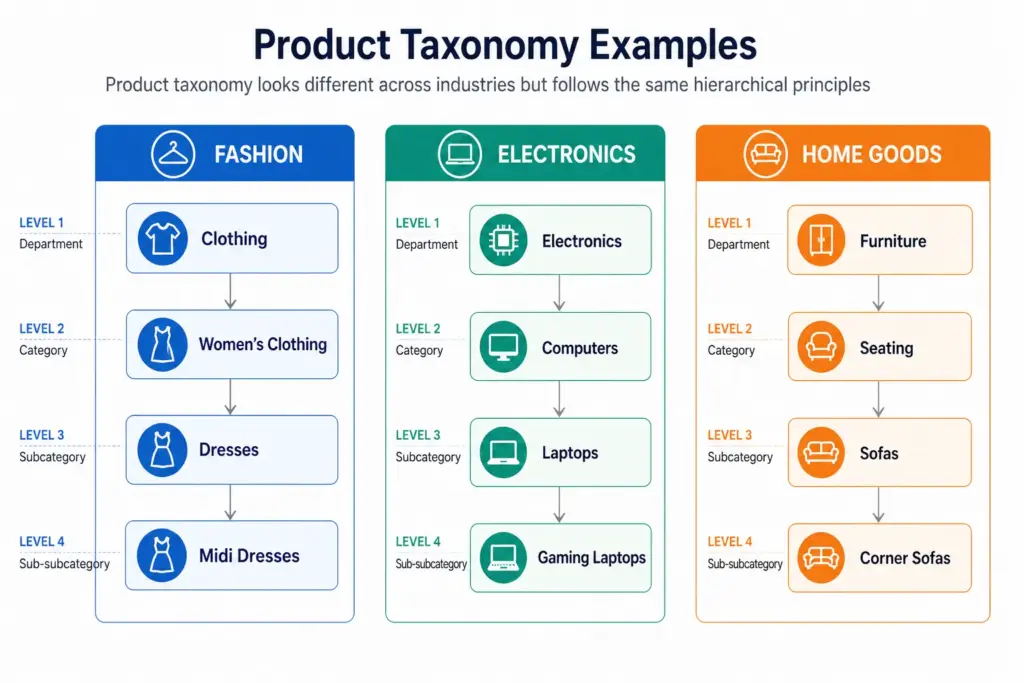
Across industries the hierarchy principle stays the same but the depth and attribute requirements differ significantly. A fashion taxonomy needs colour normalisation, size system declarations, and seasonal attribute management. An electronics taxonomy needs technical specification attributes and compatibility data. A home goods taxonomy needs dimension attributes and material normalisation. Each industry guide is linked below.
How to Build Your Product Taxonomy
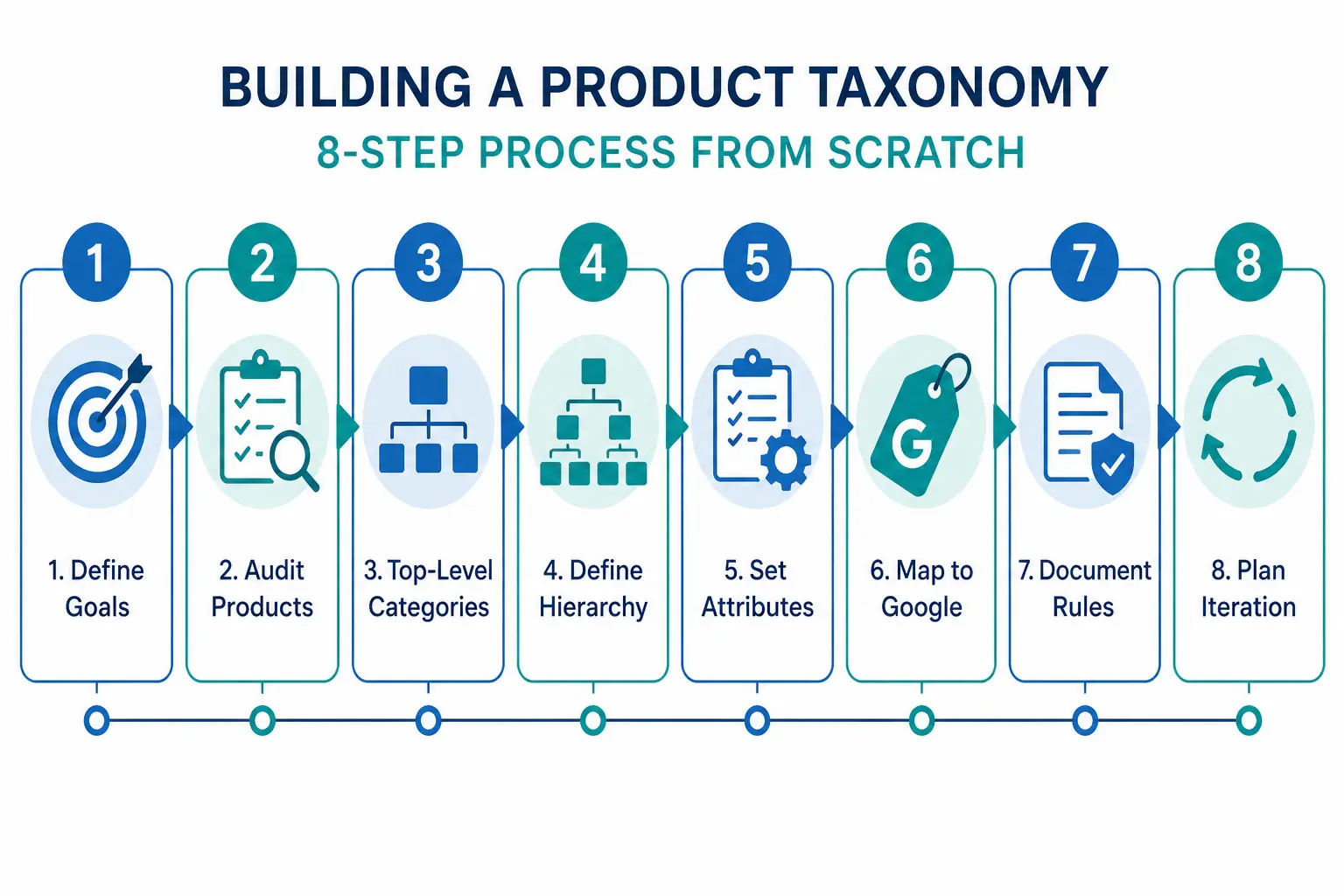
The full step-by-step build process is covered in How to Build a Product Taxonomy From Scratch — from auditing your products through to Google category mapping and documentation. The short version:
Define what your taxonomy needs to do — navigation, channel mapping, or both
Audit your existing products before designing any categories
Design 5–12 top-level departments
Build at minimum three levels of hierarchy
Define attribute sets per subcategory
Map every subcategory to a Google product category leaf node
Document the rules
Before building, take the PIM Readiness Score to identify where your current product data governance has gaps. The free Taxonomy Template at lynkpim.app gives you a pre-built starting point for 5 industries.
Frequently Asked Questions
What is product taxonomy in ecommerce?
Product taxonomy is the hierarchical classification system used to organise products into categories, subcategories, and product types. It defines the structure that powers site navigation, search filters, channel feeds, and internal catalog management.
What is the difference between product taxonomy and product attributes?
Taxonomy defines where a product sits in the hierarchy — Men’s Clothing > Jackets. Attributes define the properties of that product within its category — Colour: Navy, Size: L, Material: Nylon. Taxonomy organises the catalog structure; attributes describe individual products within it.
Why does product taxonomy matter for Google Shopping?
Google Shopping requires a google_product_category value for every product in your feed, mapped to Google’s own taxonomy at the most specific leaf-node level. Broad or incorrect category values reduce relevance matching and hurt Shopping auction performance — your products appear for fewer relevant queries and at lower positions.
How many levels should a product taxonomy have?
A minimum of three levels: Department (Level 1), Category (Level 2), and Subcategory (Level 3). Larger catalogs benefit from a fourth level (Product Type). More than four levels rarely adds value and increases maintenance complexity without meaningful benefit to navigation or channel mapping.
What is the difference between a flat and hierarchical product taxonomy?
A flat taxonomy has one level of categories with no subcategories — simple but breaks down above ~200 products. A hierarchical taxonomy has multiple nested levels that scale to any catalog size, enable precise Google category mapping, and support deep attribute-based filtering. For the full comparison see Flat vs Hierarchical Taxonomy.
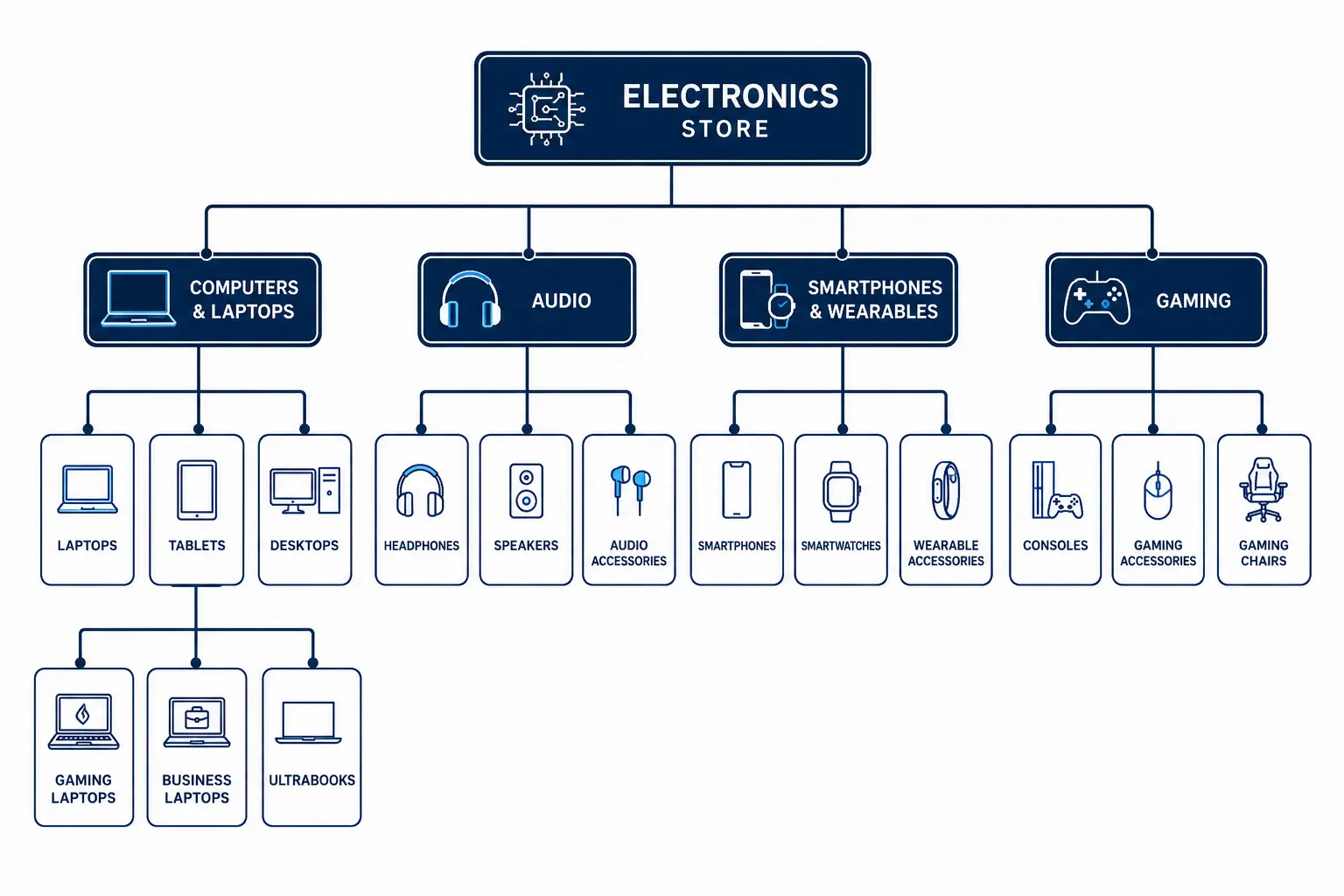
Product Taxonomy for Electronics: Handling Complex Variants at Scale
Electronics catalogs present a different set of taxonomy challenges than fashion or general merchandise. The variant complexity is not size and colour — it is processor speed, RAM configuration, storage tier, connectivity standard, and compatibility matrix. Customers buying a laptop know exactly what specs they need. Your taxonomy either surfaces those specs in filters or loses the sale.
What Makes Electronics Taxonomy Complex
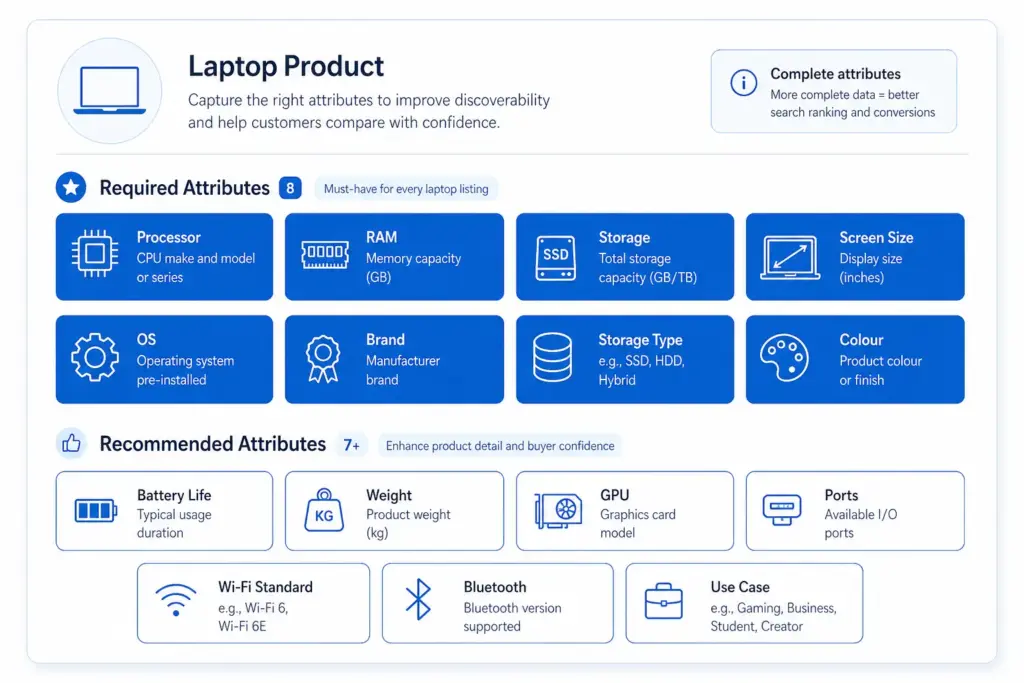
Technical specification depth: A single laptop model can have 12+ relevant attributes. All need to be captured, validated, and filterable.
Rapid product obsolescence: New chipsets and standards appear constantly. Your taxonomy needs to accommodate new attributes without breaking existing products.
Compatibility dependencies: Accessories are valid only for specific parent products. A charger is not just a charger — it is a charger for a specific voltage, connector type, and device family.
High-consideration buying: Electronics customers compare on specifications more than any other category. Incomplete data does not just affect discoverability — it directly prevents conversion.
Recommended: Driver size, Frequency response, Noise cancellation type, Battery life, Impedance, Microphone (yes/no), Codec support (AAC, aptX, LDAC)
Handling Variant Structures in Electronics
Electronics variants behave differently from fashion variants. In fashion, variants of the same product differ only in size and colour — the product is the same. In electronics, different storage configurations can have meaningfully different prices, performance profiles, and target buyers.
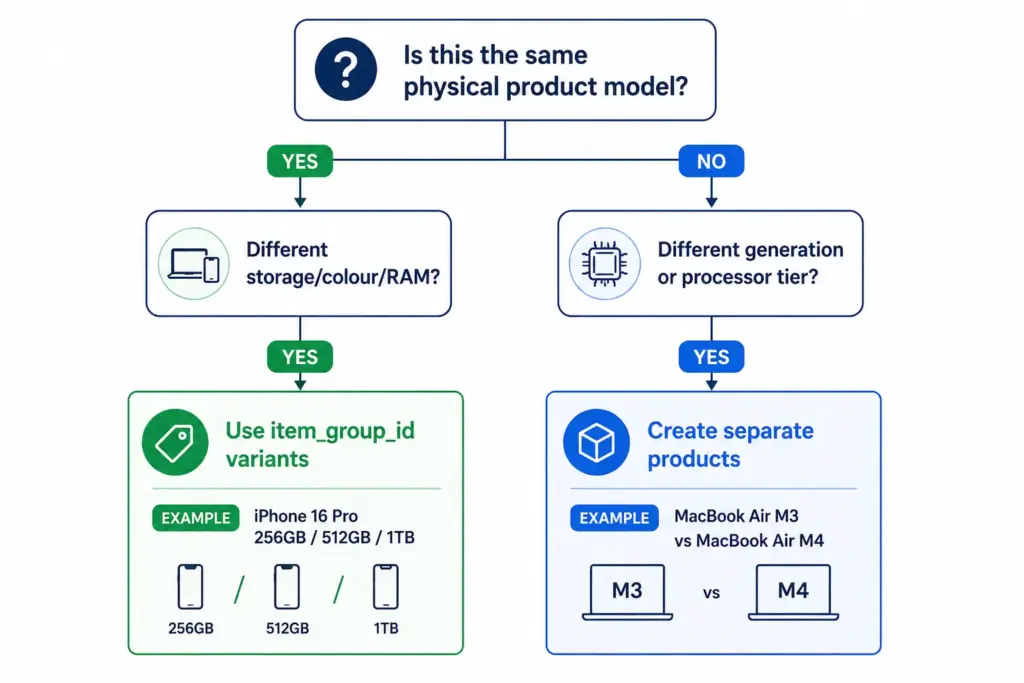
Variant approach (same item_group_id): All configurations of the same physical product model are variants. Customers can switch between them on the same product page. Use this when the products are the same model with configuration differences only.
Separate product approach: When the “variant” is effectively a different product — different processor tier, different generation, meaningfully different positioning — treat as separate products. Different model generations should be separate products, not variants of each other.
For how variant management compares across categories, the fashion taxonomy guide covers the simpler size/colour variant model as a useful contrast.
Compatibility Attributes — The Electronics-Specific Challenge
Accessories in electronics require compatibility data that no other category demands at the same scale. A USB-C cable not rated for Thunderbolt 4 is useless to someone buying it for a high-end laptop. A phone case for one model does not fit its larger variant.
Build compatibility into your taxonomy as a structured attribute, not as free-text description:
compatible_with — a list of compatible product IDs or model references from your own catalog
connector_type — USB-C, USB-A, Lightning, Thunderbolt 4, HDMI 2.1 etc.
voltage / wattage — for chargers and power accessories
form_factor — for components (ATX, Micro-ATX, Mini-ITX for PC cases and motherboards)
Structured compatibility data enables “compatible accessories” widgets on product pages — a meaningful cross-sell driver in electronics where accessory attach rates are high.
Electronics > Computers > Computer Components > Hard Drives & Storage > Solid State Drives
Mirrorless camera body
Cameras & Optics > Cameras > Digital Cameras
Smart TV 65″
Electronics > Video > Televisions
Managing Rapid Product Turnover
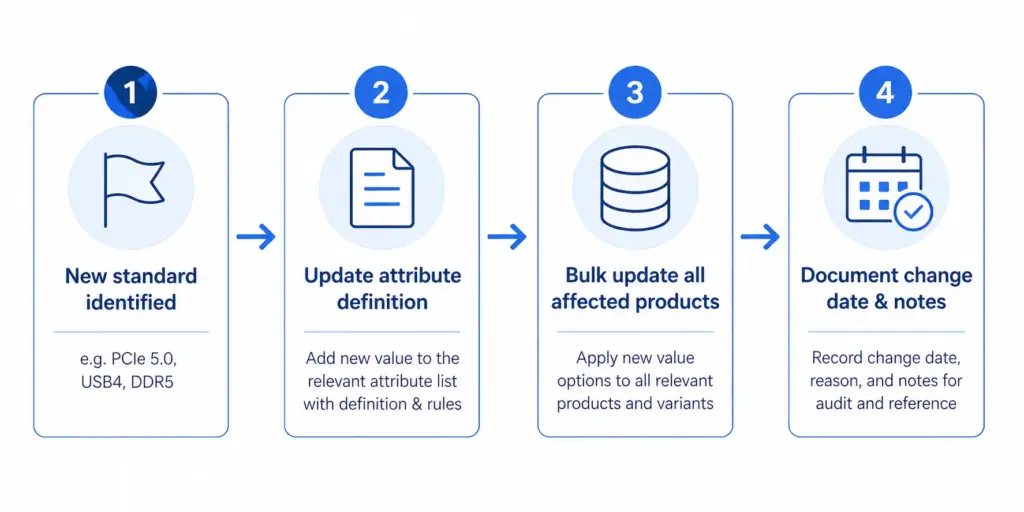
Electronics catalogs face a unique taxonomy maintenance challenge: product generations. A new processor standard, connectivity format, or storage type can require new attribute values across hundreds of products simultaneously.
Build this into your taxonomy governance from the start: attribute value lists need a version-controlled update process, not ad hoc additions. When a new standard appears, update the attribute definition, update all products in that category in bulk, and document the change date.
At scale, this requires product data tooling that can apply bulk attribute updates to entire categories. The PIM Readiness Score will show you where your current setup has gaps — and the LynkPIM free plan lets you start managing this properly without a large budget or implementation timeline.
For a broader comparison of how taxonomy decisions differ across industries, see the Flat vs Hierarchical Taxonomy guide — the structural decision matters more for electronics than for most other categories due to the depth of specification attributes required at every level.
Frequently Asked Questions
Should different laptop storage configurations be variants or separate products?
Use variants (same item_group_id) for storage, colour, and RAM configuration differences within the same physical model — customers can switch between them on the same product page. Create separate products for different processor generations or model tiers that represent meaningfully different products with different performance profiles and target buyers.
What compatibility attributes should electronics accessories have?
At minimum: compatible_with (list of compatible product IDs or model references), connector_type (USB-C, USB-A, Thunderbolt 4, HDMI 2.1 etc.), voltage and wattage for chargers and power accessories, and form_factor for PC components. Structured compatibility data enables “compatible accessories” widgets on product pages and reduces returns from incompatible purchases.
How do you handle new technical standards in an electronics taxonomy?
Treat attribute value lists as version-controlled documents. When a new standard appears — PCIe 5.0, USB4, DDR5 — update the attribute definition for the affected subcategory, bulk-update all products in that category, and document the change date. Ad hoc additions without bulk updates leave older products with stale or missing values, which hurts both filter accuracy and feed performance.
What Google product category should I use for NVMe SSDs?
Use the leaf-node category: Electronics > Computers > Computer Components > Hard Drives & Storage > Solid State Drives. Never use a parent category like “Electronics” or “Electronics > Computers” — Shopping relevance and auction performance depend on using the most specific category available for every product.
How many required attributes does a laptop product need?
At minimum 8 required attributes: Brand, Processor family, Processor model, RAM (GB), Storage capacity (GB), Storage type (SSD/HDD/NVMe), Screen size (inches), and Operating system. Recommended additions that significantly improve discoverability and conversion include GPU, battery life, weight, screen resolution, ports, Wi-Fi standard, and use case (gaming / business / ultrabook).
Product Taxonomy for Fashion Ecommerce: The Complete Industry Guide
Fashion is the most complex product taxonomy challenge in ecommerce. No other category has the same combination of variant depth (size × colour × material), seasonal rotation, brand complexity, and the need to align with both customer search language and Google’s own category hierarchy simultaneously.
This guide covers how to structure a fashion taxonomy that works for site navigation, Google Shopping, and internal catalog operations at the same time.
Why Fashion Taxonomy Is Uniquely Difficult
High variant depth: A single jacket style can generate 40+ variants (4 colours × 5 sizes × 2 materials). Each needs proper categorisation.
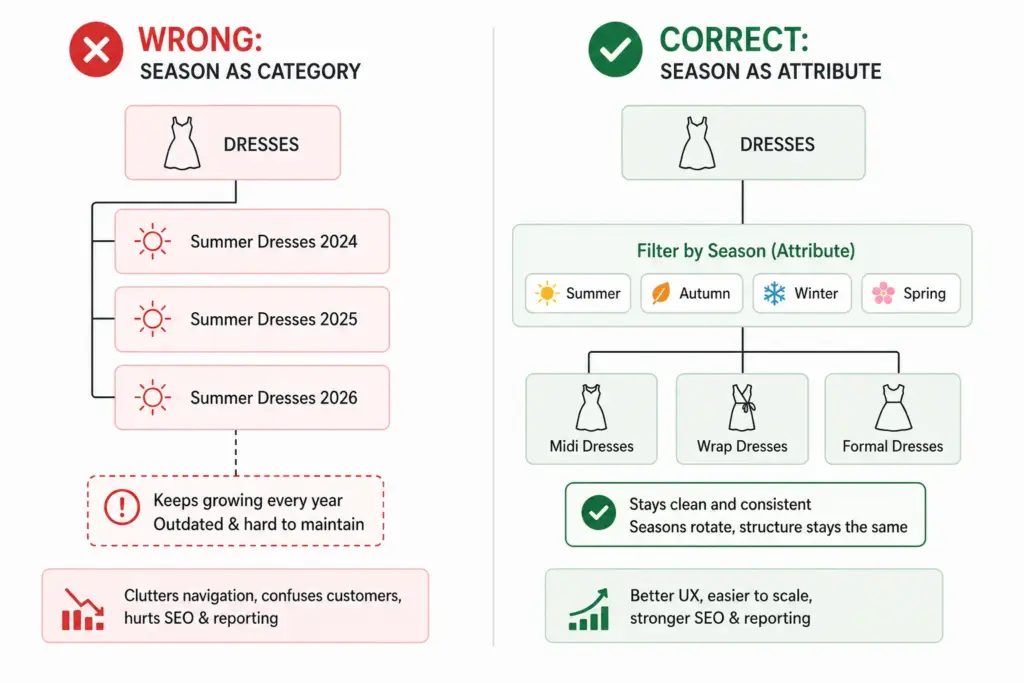
Seasonal rotation: Categories like “Summer Dresses” need to exist, disappear, and reappear without breaking your taxonomy structure.
Cross-gender categorisation: Unisex products that appear in both Men’s and Women’s categories require clear rules.
Trend-driven additions: New product types appear faster in fashion than almost any other category — your taxonomy needs to accommodate them without restructuring.
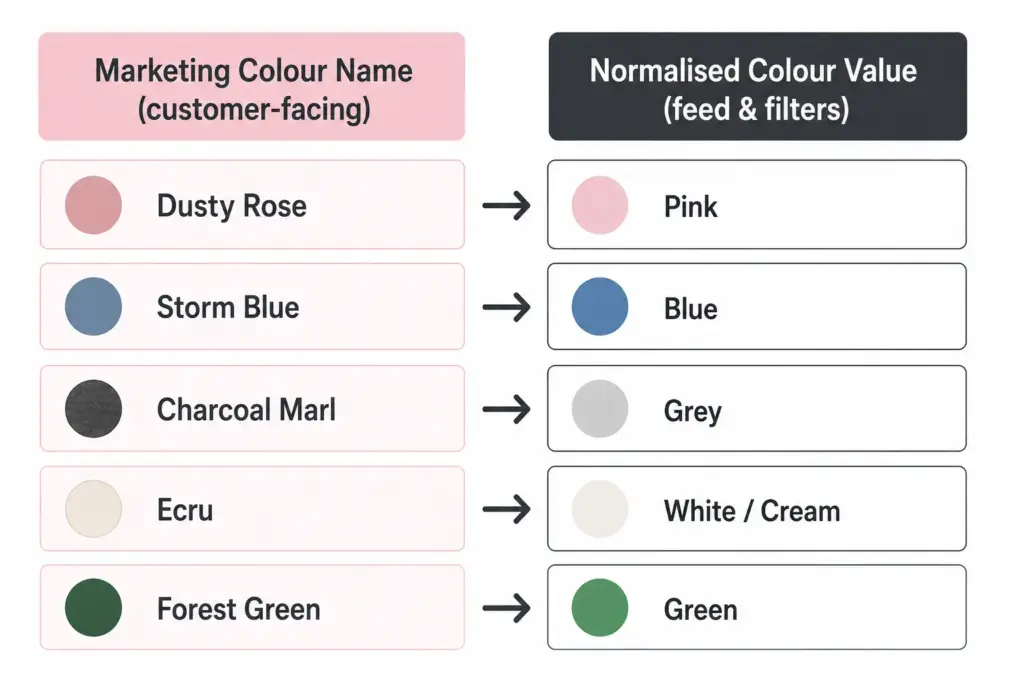
Colour management is where fashion taxonomy most often breaks down. Fashion brands use marketing colour names (“Dusty Rose”, “Storm Blue”) that are meaningful to buyers but problematic for Google Shopping and site search filtering.
The solution is a two-field colour approach:
Marketing colour name: Used in product titles and descriptions facing customers — “Storm Blue Puffer Jacket”
Normalised colour value: Used for feed submission and filter attributes — “Blue”. This maps to Google’s accepted colour values and makes site filters work correctly (“Filter by: Blue, Green, Red”).
Without normalised colour values, your “Navy”, “Dark Navy”, “Midnight Navy”, and “Storm Blue” all appear as separate filter options rather than grouping under “Blue”. Customers cannot find what they are looking for and conversion on filtered searches drops.
Size Management and International Sizing
Fashion brands selling internationally face size system conflicts. A UK 10 dress and a US 10 dress are different sizes. A European 40 and a US 8 are the same women’s dress size. Declare your size system in every product record using the size_system attribute.
For brands selling across regions from a single catalog, the cleanest solution is to store size in your primary size system and maintain a size conversion reference table as a documented data standard — not as additional product fields that will create mapping errors when updated.
Seasonal Category Management
Fashion taxonomy needs seasonal flexibility without permanent structural changes. Two approaches work well:
Season as an attribute, not a category: Keep “Summer Dresses” as a filter value (season = Summer) rather than a permanent subcategory. This prevents your taxonomy from accumulating dead branches as seasons pass.
Evergreen subcategories with seasonal tags: “Dresses” is the permanent subcategory. “Summer” is a tag or attribute. Products appear in the Dresses subcategory year-round; the Summer filter surfaces them seasonally. This is the more scalable approach for catalogs with high seasonal turnover.
Mapping Fashion Taxonomy to Google Product Categories
Every fashion subcategory needs a Google product category mapping. Use Google’s leaf-node values (the most specific level) for best Shopping performance. The mapping should be documented and applied consistently — not manually re-entered per product.
The difference between flat and hierarchical taxonomy structures for fashion is covered in detail in the Flat vs Hierarchical Taxonomy guide — worth reading before finalising your structure.
Once your fashion taxonomy is structured correctly, implementing it at scale requires a system that can enforce attribute validation and apply category-level rules automatically. The PIM Readiness Score takes 5 minutes and shows you where your current product data setup has gaps.
Download the free Product Taxonomy Template at lynkpim.app — the Fashion & Apparel tab includes the full category hierarchy, attribute set, and Google mapping pre-built for clothing, footwear, and accessories.
Frequently Asked Questions
How should fashion ecommerce handle seasonal categories in a product taxonomy?
Use season as an attribute rather than a permanent category. Keep “Dresses” as the permanent subcategory and assign season = Summer as a tag or attribute value. This prevents the taxonomy from accumulating obsolete branches (Summer Dresses 2024, Summer Dresses 2025) that clog navigation and require ongoing cleanup.
What is the two-field colour approach for fashion product data?
Store two colour values per product: a marketing colour name for customer-facing content (Dusty Rose, Storm Blue) and a normalised colour value for feed submission and site filters (Pink, Blue). Without normalised values, multiple shades of the same colour appear as separate filter options — “Navy”, “Dark Navy”, “Midnight Navy” become three separate filter choices instead of one “Blue” group.
How many top-level categories should a fashion taxonomy have?
Most fashion stores work well with 6 to 8 top-level departments: Women’s Clothing, Men’s Clothing, Kids’ Clothing, Footwear, Accessories, Swimwear, and Lingerie & Nightwear. Avoid creating top-level categories for product types you carry fewer than 20 products in — use attributes and filters instead.
How do you handle unisex products in a fashion taxonomy?
Set gender = unisex in the product attributes and assign the product to the most appropriate department based on primary customer intent. For your Google Shopping feed, use gender = unisex and surface products in both Men’s and Women’s navigation via tags or multi-category assignment depending on your platform.
What Google product category should I use for women’s dresses?
Use the leaf-node value: Apparel & Accessories > Clothing > Dresses. Avoid the parent category Apparel & Accessories > Clothing — the more specific your Google product category, the better your Shopping feed relevance. For formal dresses, go one level deeper if possible.
How to Build a Product Taxonomy From Scratch (Step-by-Step Guide)
Most product taxonomy problems do not start with bad intentions. They start with a spreadsheet, a growing catalog, and someone who just needed to categorise 50 products quickly. Three years later there are 3,000 products, four naming conventions, and no one knows which category rules apply where.
Building a taxonomy properly from the start — or rebuilding one that has grown without structure — requires the same process regardless of catalog size. This guide walks through every step.
Step 1: Define What Your Taxonomy Needs to Do
Before you name a single category, decide what jobs your taxonomy needs to perform. Most ecommerce catalogs need it to do three things simultaneously:
Power site navigation and search — customers browse by category and use filters. Your taxonomy is the structure those filters sit on.
Map to channel requirements — Google Shopping, Amazon, and marketplaces have their own taxonomies. Yours needs to translate cleanly to theirs.
Organise internal operations — product teams, buyers, and merchandisers use the taxonomy to find, update, and report on products.
These three jobs sometimes conflict. A taxonomy built purely for internal operations often does not map well to how customers search. Understanding the priority before you build prevents rework. For background on what taxonomy is and why it matters, the What Is Product Taxonomy guide covers the foundations.
Step 2: Audit Your Existing Products
Export every SKU you have. Look at the full list before designing any categories. You are looking for:
Natural groupings — what products obviously belong together?
Edge cases — products that do not fit neatly into an obvious category
Volume distribution — how many products fall into each potential category?
Attribute patterns — what attributes do products in the same group share?
A category with 2 products and a category with 2,000 products suggest the hierarchy is off. Aim for relative balance across categories at the same level, with narrow subcategories only where genuine product differentiation exists.
Step 3: Design Your Top-Level Categories
Top-level categories are your broadest groupings. For most ecommerce catalogs, 5–12 top-level categories is the right range. Too few and subcategories get unwieldy. Too many and customers cannot find their starting point.
The test for a top-level category: a customer with no prior knowledge of your store should be able to assign a product to the correct top-level category without thinking about it. If it requires judgment, the category is too vague.
Two approaches to defining top-level categories
Customer-first approach: Start with how customers describe what they are looking for. Use your site search data, Google Search Console queries, and competitor category names as evidence of natural language groupings.
Google-first approach: Start with Google’s product taxonomy at the top level. This makes channel mapping easier later and ensures your categories align with how the largest product discovery platform in the world organises products. You can always use internal-facing names that differ from the Google-facing values.
Step 4: Define 3 Levels of Hierarchy (Minimum)
A functional product taxonomy needs at least three levels:
For larger catalogs, Level 4 (product type) is worth adding: Men’s Jackets → Rain Jackets, Leather Jackets, Padded Jackets.
The difference between a flat and hierarchical taxonomy matters significantly for navigation and channel mapping. The Flat vs Hierarchical Taxonomy guide covers when each structure is appropriate.
Step 5: Define Attributes per Category
Attributes are the product properties that apply within a category. Every category in your taxonomy needs a defined attribute set — the list of fields that must be filled for a product in that category to be considered complete.
Category
Required Attributes
Recommended Additions
Men’s Jackets
Brand, Colour, Size, Material, Gender
Waterproof rating, Fill weight, Packable
Running Shoes
Brand, Colour, Size, Gender, Surface type
Drop height, Cushioning level, Width
Laptops
Brand, Processor, RAM, Storage, Screen size
Battery life, Weight, Graphics card
Step 6: Map to Google’s Product Taxonomy
Once your internal taxonomy is defined, create a mapping document that links each of your subcategories to its corresponding Google product category value. Use Google’s official taxonomy file to find the correct IDs. Map at the most specific level possible — leaf nodes, not parent categories.
Step 7: Document the Rules
A taxonomy that exists only in someone’s head is a single point of failure. Document:
Category definitions — what does and does not belong in each category
Naming conventions — title case vs sentence case, singular vs plural
Attribute validation rules — acceptable values for controlled attributes like colour and size
Exception handling — what happens to products that span categories
The PIM Readiness Score assessment helps you identify where your current product data governance has gaps before you build on top of it. Free, takes 5 minutes.
Step 8: Build with Iteration in Mind
No taxonomy survives contact with a growing catalog unchanged. You will need to add categories as you expand into new product areas. You will discover edge cases your initial rules did not cover. You will probably need to split an overpopulated subcategory 18 months after launch.
Build with this in mind: keep hierarchy levels consistent, avoid category names that are too specific, and review your taxonomy structure annually against site search data and channel performance.
Ready to apply this? Download the free Product Taxonomy Template at lynkpim.app — pre-built for Fashion, Electronics, Home Goods, Food & Beverage, and B2B Industrial. Use it as a starting point rather than building from a blank page.
Once your taxonomy structure is set, see how it applies to specific industries: fashion ecommerce taxonomy and electronics taxonomy both cover the unique requirements of their categories in detail.
Frequently Asked Questions
How many levels should a product taxonomy have?
A minimum of three levels: Department (Level 1), Category (Level 2), and Subcategory (Level 3). Larger catalogs benefit from a fourth level (Product Type). Going beyond four levels rarely adds value and increases maintenance complexity without meaningful improvement to navigation or channel mapping.
How often should you review and update your product taxonomy?
Review your taxonomy structure at least once per year against site search data, channel performance data, and catalog growth. Attribute value lists for technical categories may need updating more frequently — for example when new product standards or formats appear in electronics or components.
Should your internal taxonomy match Google’s product taxonomy?
Not necessarily. Your internal taxonomy should reflect how your team and customers think about products. What matters is that every internal subcategory maps to the correct Google product category leaf node in your feed — the two systems can use different naming as long as the mapping document is maintained and applied consistently.
What is the difference between a category and an attribute in product taxonomy?
A category defines where a product sits in the hierarchy — for example, Men’s Jackets. An attribute defines a property of that product within its category — for example, Colour = Navy, Size = L, Material = Nylon. Categories organise the catalog structure; attributes describe individual products within it.
How many top-level categories should a product taxonomy have?
For most ecommerce catalogs, 5 to 12 top-level categories is the right range. Too few and subcategories become unwieldy. Too many and customers cannot find their starting point. The test: a customer with no prior knowledge should be able to assign any product to the correct top-level category without thinking about it.
Job Title Category Mapping: How to Classify CEO, Founder, Director and Every Other Role in Your Taxonomy
You are building a CRM, a B2B contact database, a startup classification system, or an internal org taxonomy — and you keep hitting the same wall. Where does a Founder go? Is a Co-Founder the same category as a CEO? Does “Head of Sales” map to Director or VP? Is a “Chief of Staff” an executive or an operations function?
Job title category mapping is one of those problems that looks simple until you try to make it consistent across thousands of records. This guide gives you a complete, practical framework: how to classify every major role type across seniority levels and job functions, with specific answers for the titles that cause the most confusion.
A well-designed job title taxonomy maps every role to two dimensions: seniority level (vertical) and job function (horizontal). Getting both right is what makes the classification useful.
Why job title category mapping is harder than it looks
Job titles are not standardised. Two people with identical responsibilities at different companies might be called “Director of Marketing” at one and “Head of Growth” at another. A “VP of Engineering” at a 20-person startup has a completely different scope than the same title at a 5,000-person enterprise. A “Founder” might be actively running the business as CEO, or might have stepped back to an advisory role years ago.
This inconsistency is the core challenge of job title taxonomy. The solution is a two-dimensional classification model: every role gets mapped to a seniority level and a job function. These two dimensions together give you a consistent, queryable classification regardless of how many ways people describe the same role.
This same two-dimensional principle applies in product taxonomy too — every product maps to a category (what it is) and carries attributes (what it is like). The logic is structurally identical. If you are building taxonomy systems more broadly, the ecommerce category mapping guide covers the same principles applied to product data.
The two dimensions of job title classification
Dimension 1: Seniority level
Seniority level describes where a role sits in the organisational hierarchy — the vertical dimension of your taxonomy. Most organisations and classification systems use five to seven levels:
Company-wide strategy, ultimate accountability for a function or the whole business
VP / SVP / EVP
Vice President, Senior VP, Executive VP, Group VP
Cross-team leadership, owns a large function or business unit, usually reports to C-suite
Director
Director, Senior Director, Head of [function]
Owns a department or team, sets strategy for their area, manages managers
Manager
Manager, Senior Manager, Team Lead, Principal
Manages a team directly, executes departmental strategy
Senior Individual Contributor
Senior [role], Lead [role], Staff [role], Specialist
Deep expertise, no direct reports or minimal mentorship role
Individual Contributor
[Role] without prefix, Associate, Analyst, Coordinator, Executive (in UK usage)
Executes tasks within a team, reports to a manager
Entry Level
Junior, Assistant, Intern, Graduate, Trainee
Learning the role, supervised closely
Dimension 2: Job function
Job function describes what area of the business a role belongs to — the horizontal dimension. LinkedIn’s professional taxonomy, which covers over 900 million profiles and is the most widely used professional classification system, uses these top-level functions:
Job function is the horizontal dimension of your taxonomy. Seniority is the vertical. Every title maps to exactly one cell in this grid.
Commercial / Sales — sales, business development, account management, revenue
People / HR — talent acquisition, HR business partners, learning & development, culture
Product — product management, UX, design, research
General Management / Executive — cross-functional leadership, strategy, board-level roles
Every job title maps to one seniority level and one function. A “Director of Marketing” is Director × Marketing. A “VP of Engineering” is VP × Technology. A “Sales Analyst” is Individual Contributor × Commercial. The classification is unambiguous once you have defined the two dimensions clearly.
How to classify the titles that cause the most confusion
Founder and Co-Founder
Seniority level: C-Suite / Owner Function: General Management
Founder and Co-Founder are ownership titles, not role titles. They describe how someone came to be at the company, not what they do now. For classification purposes, always map Founder and Co-Founder to C-Suite level — they have founder-level authority regardless of their current day-to-day role.
For function, use General Management as the default unless the founder has a specific functional title alongside it (Founder & CTO maps to Technology; Founder & CMO maps to Marketing). A plain “Founder” with no other qualifier goes to General Management.
Co-Founder follows exactly the same logic. Map them identically to Founder unless they have a functional title that tells you otherwise.
President
Seniority level: C-Suite Function: General Management
President is a C-Suite title that typically sits alongside or just below CEO, with responsibility for operations, revenue, or a specific business unit. In some organisations President is used interchangeably with CEO, particularly in family businesses and smaller companies. Always classify as C-Suite, General Management.
Managing Director
Seniority level: C-Suite Function: General Management
Managing Director (MD) is the UK and European equivalent of CEO in most contexts. In investment banking and consulting it is a senior individual contributor level below Partner — but for most ecommerce and retail organisations, MD is C-Suite. When in doubt, context matters: if the MD runs a company or a business unit, classify as C-Suite. If they are in a professional services firm, check whether the title follows the IC-track convention.
Head of [function]
Seniority level: Director Function: whatever follows “Head of”
“Head of” is the most common Director-equivalent title in modern tech and ecommerce companies. “Head of Sales” = Director × Commercial. “Head of Product” = Director × Product. “Head of People” = Director × HR. The function is always in the title — just map accordingly.
The exception: “Head of” at a very small company (under 20 people) sometimes means the only person doing that function, which is more Individual Contributor than Director. If context is available, use it. If not, default to Director — it is better to over-rank than under-rank when segmenting for outreach or analysis.
VP vs Director — where is the line?
This is the most frequently contested boundary in job title taxonomy, and it varies significantly by company size and industry. The general rule:
VP owns a large function, manages multiple directors or teams, typically reports to C-suite directly, and has cross-functional influence
Director owns a specific department or team within a function, typically reports to a VP, and manages managers or senior ICs
In practice, at companies under 100 people these lines blur significantly. A “VP of Marketing” at a 15-person startup may have zero direct reports and be doing IC-level work. For taxonomy purposes, honour the title as given unless you have strong contextual evidence to reclassify. Titles are how people self-identify, and reclassifying them based on company size alone creates inconsistency that is hard to maintain.
Chief of Staff
Seniority level: Director or VP depending on scope Function: General Management / Operations
Chief of Staff is a cross-functional role that supports a C-suite executive. It does not fit cleanly into any single function — it typically spans strategy, operations, communication, and project management. For seniority, classify at Director level for most organisations; VP level if the role has been explicitly positioned as VP equivalent or if the Chief of Staff manages other people. Function: General Management is the safest default.
Owner
Seniority level: C-Suite / Owner Function: General Management
“Owner” is most common in small businesses where the person is both the business owner and the operator. Treat identically to Founder — C-Suite, General Management. In a product context, “Product Owner” is a specific Agile role that maps to Individual Contributor or Senior IC × Product, not C-Suite.
Partner
Seniority level: C-Suite or VP depending on industry Function: depends on firm type
Partner means very different things by industry. In professional services (law, consulting, accounting), Partner is the top ownership/equity level — C-Suite equivalent. In technology companies, “Partner” often refers to a business development or channel role at Director or VP level. In venture capital, General Partner is C-Suite; Principal or Associate are lower levels. Always use industry context when classifying Partner titles.
C-suite titles: the full reference
Title
Level
Function
CEO — Chief Executive Officer
C-Suite
General Management
CFO — Chief Financial Officer
C-Suite
Finance / Legal
CTO — Chief Technology Officer
C-Suite
Technology
COO — Chief Operating Officer
C-Suite
Operations
CMO — Chief Marketing Officer
C-Suite
Marketing
CPO — Chief Product Officer
C-Suite
Product
CHRO — Chief Human Resources Officer
C-Suite
People / HR
CRO — Chief Revenue Officer
C-Suite
Commercial
CISO — Chief Information Security Officer
C-Suite
Technology
CCO — Chief Customer Officer
C-Suite
Operations / Commercial
CDO — Chief Data Officer
C-Suite
Technology
CSO — Chief Strategy Officer
C-Suite
General Management
Ecommerce-specific job title taxonomy
Ecommerce organisations have a set of role titles that do not exist in general corporate taxonomies and that cause classification confusion when you try to map them to standard systems. Here is how to handle the most common ones.
Ecommerce-specific titles often straddle traditional function boundaries — a good taxonomy defines them explicitly rather than forcing them into ill-fitting standard categories.
Ecommerce Title
Seniority Level
Function
Notes
Director of Ecommerce
Director
Commercial / Operations
Owns online channel strategy and P&L
VP of Ecommerce
VP
Commercial / Operations
Typically manages multiple ecommerce directors
Head of Digital
Director
Marketing / Technology
Function varies — check if reporting to CMO or CTO
Ecommerce Manager
Manager
Commercial / Operations
Day-to-day platform and campaign management
Merchandising Director
Director
Commercial
Owns product assortment and pricing strategy
Category Manager
Manager
Commercial
Manages a product category’s performance
Product Manager (ecommerce)
IC to Senior IC
Product
Distinct from Category Manager — owns platform features
CX Director / Head of CX
Director
Operations
Customer experience across channels
Marketplace Manager
Manager
Commercial
Manages Amazon, eBay, marketplace channel
Performance Marketing Manager
Manager
Marketing
Paid search, shopping ads, paid social
Head of Growth
Director
Marketing / Commercial
Acquisition-focused; classify as Marketing unless revenue-owning
Trading Manager
Manager
Commercial
UK/EU term for ecommerce trading and promotions management
Building your job title taxonomy: practical rules
Rule 1: Always map to two dimensions
Every title in your taxonomy needs a seniority level AND a function. A flat list of titles with no structure is a lookup table, not a taxonomy. The value of a taxonomy is the ability to query across dimensions — show me all Director-level contacts in Marketing, or all C-suite contacts in companies under 50 people. That querying only works if both dimensions are populated consistently.
Rule 2: Standardise synonyms into canonical forms
Build a synonym mapping table that normalises variant titles to a canonical form before classification. “Head of Sales,” “Sales Director,” “Director of Sales,” and “Commercial Director” should all map to the same canonical classification: Director × Commercial. Without this normalisation step, your taxonomy produces inconsistent results every time a new title variant enters your data.
This is the same principle that applies in product data taxonomy — where “Cotton,” “100% Cotton,” and “Ctn” need to map to the same canonical value before they can be classified consistently. The taxonomy design guide covers this in depth for product catalogs, but the logic applies equally to any classification system.
Rule 3: Use a fallback category for ambiguous titles
Not every title will map cleanly. “Evangelist,” “Fellow,” “Advisor,” “Consultant,” “Board Member” — these do not fit neatly into standard seniority or function categories. Build an explicit fallback: an “Unclassified” or “Needs Review” category that catches ambiguous titles rather than forcing them into a wrong category. A wrong classification is worse than no classification — it silently corrupts your downstream analysis.
Rule 4: Separate the title from the classification
Store the original title as-given in one field, and your canonical classification in separate seniority level and function fields. Never overwrite the original title. This preserves the source data for future re-classification if your taxonomy rules change, and it means you can always audit your mapping logic against real examples.
Rule 5: Review your mapping rules when your data changes
Job title conventions evolve. “Growth Hacker” was an IC role in 2015 and is now closer to Director or VP in established organisations. “Chief of Staff” barely existed as a title in tech before 2018. Review your synonym mapping and classification rules at least annually, and any time you onboard a significant new data source with different title conventions.
Standard classification systems: LinkedIn, O*NET and Schema.org
If you are building a classification system that needs to interoperate with external platforms or standards, it is worth knowing the three most widely used reference systems:
LinkedIn Job Functions
LinkedIn uses 26 top-level job functions and a seniority level system with eight levels (Internship, Entry Level, Associate, Mid-Senior Level, Director, Executive, Owner, Partner). These are the de facto standard for B2B contact classification because LinkedIn is where most professionals self-identify their role. For any system that sources data from LinkedIn or needs to match against LinkedIn audiences, aligning your taxonomy to LinkedIn’s function and seniority structure is strongly recommended.
O*NET SOC Taxonomy
The US Bureau of Labor Statistics Standard Occupational Classification (SOC) system is the official US government classification for occupations, maintained through O*NET. It covers over 1,000 occupational categories across 23 major groups. It is the reference system for labour market research and workforce analytics. For most commercial CRM or contact classification purposes it is more granular than needed, but it is the right reference if you need to map your taxonomy to government or research datasets.
Schema.org JobPosting
If you are publishing job listings or building a system that needs to be understood by search engines, the Schema.org JobPosting structured data format defines how to mark up job titles, employment types, and organisational roles in a way that Google and other search engines can parse. The occupationalCategory field accepts O*NET-SOC codes, making it the bridge between your taxonomy and SEO-visible structured data.
Job title taxonomy in product data contexts
If you arrived at this article through a product data or PIM context — specifically mapping role-based access, defining who in an organisation manages which product categories, or building a classification system for B2B product catalog permissions — the principles are identical but the application is slightly different.
In a PIM or product data context, job title taxonomy typically comes up in two scenarios:
Role-based access control: which team members (by role) can create, edit, approve, or publish product data. A Category Manager can edit products in their category. A Merchandising Director can approve. A VP of Ecommerce can publish to all channels.
B2B catalog permissions: which customer roles (by job title) see which products, pricing tiers, or catalog sections. A purchasing manager at a wholesale customer sees trade pricing. A finance director sees contract terms. An end user sees retail pricing.
Both scenarios require a clean job title taxonomy as the input. If you are building this for a PIM implementation, the PIM guide covers how role-based governance works within product data management systems, and the PIM Readiness Assessment will tell you whether your current infrastructure can support role-based catalog governance.
Frequently asked questions
What category does Founder belong to?
Founder maps to C-Suite level, General Management function. Founder is an ownership title that indicates the highest level of authority in a company, regardless of the founder’s current day-to-day role. If the founder has a specific functional title alongside it (Founder & CTO, Founder & CMO), use that function instead. A plain “Founder” with no qualifier always goes to General Management at C-Suite level.
Is Co-Founder the same category as CEO?
For classification purposes, yes — both map to C-Suite level. The distinction is that CEO is a functional role (runs the company operationally) while Co-Founder is an ownership title (helped start the company). In many startups the Co-Founder is also the CEO, but not always. If someone is listed as both Co-Founder and CEO, classify as CEO × General Management. If listed as Co-Founder only, classify as C-Suite × General Management.
What category does “Head of Sales” map to?
“Head of Sales” maps to Director level × Commercial function. “Head of” is the standard Director-equivalent title in modern technology and ecommerce companies — it indicates ownership of a function without the traditional corporate “Director” label. The function is always derived from what follows “Head of”: Head of Sales = Commercial, Head of Product = Product, Head of People = HR.
What is the difference between VP and Director in a job title taxonomy?
VP (Vice President) sits above Director in the standard seniority hierarchy. A VP typically owns a large function, manages multiple directors or teams, and reports directly to C-suite. A Director owns a specific department or team within a function, typically reports to a VP, and manages managers or senior individual contributors. At smaller companies these lines blur — a “VP” at a 15-person startup may be doing Director-level work — but for taxonomy purposes, honour the title as given.
Where does Managing Director sit in a job title taxonomy?
Managing Director (MD) maps to C-Suite level for most organisations — it is the standard UK and European equivalent of CEO. The exception is investment banking and consulting, where MD is a senior individual contributor level below Partner. For ecommerce and retail organisations, always classify Managing Director as C-Suite × General Management.
How do I handle job titles that don’t fit standard categories?
Build an explicit “Unclassified” or “Needs Review” fallback category for titles that do not map cleanly — Evangelist, Fellow, Advisor, Board Member, Consultant, and similar. Never force an ambiguous title into a wrong category to avoid leaving a field blank. A wrong classification corrupts downstream analysis silently, while an unclassified record is clearly flagged for human review. Log all unclassified titles and review them periodically — patterns in what gets flagged often reveal gaps in your taxonomy rules that are worth closing.
Most ecommerce teams know their taxonomy is a mess. Products miscategorised at import, filters returning garbage results, Google Shopping feeds rejected for category mismatches — these are symptoms of the same underlying problem. The category mapping layer was never properly designed.
This guide fixes that. It covers what an ecommerce product taxonomy actually is, how to build category mapping rules that hold up at scale, what Google’s January 2026 taxonomy changes mean for your feed strategy, and how to handle the hardest part — incoming supplier data that arrives in fifteen different formats and calls the same product by six different names.
If you already have a taxonomy and want to understand why your hierarchy keeps drifting, start at the taxonomy structure guide. If you’re starting from scratch or rebuilding your mapping layer specifically, you’re in the right place.
A well-designed ecommerce product taxonomy is the structural layer behind every clean catalog, accurate feed, and consistent customer experience.
What is an ecommerce product taxonomy — and what it isn’t
An ecommerce product taxonomy is the hierarchical classification system that defines how every product in your catalog is organised, enriched, and mapped to sales channels. It’s the skeleton that everything else sits on top of.
The leaf category — Blouses — is where products actually live. Every leaf category should have a defined attribute template attached to it: the specific fields that apply, the values those fields can take, and which ones are required versus optional. That template is what drives data completeness, and data completeness is what drives channel eligibility.
Here’s the distinction that trips up most teams: a taxonomy is not the same as navigation. Your internal classification taxonomy answers the question “what is this product and how should it be enriched?” Your customer-facing navigation answers “how does a shopper find this product?” These two things are related but should not be the same structure. A product might live in Clothing > Women’s > Tops > Blouses in your taxonomy, while appearing under New In, Work Wardrobe, and Under £50 in navigation. Conflating the two is how taxonomies become impossible to maintain.
Research from the Baymard Institute‘s large-scale ecommerce UX studies found that poor category taxonomy is one of the top five causes of site abandonment. Customers who can’t find a product within a few clicks leave — and they rarely come back.
Why category mapping specifically is where most taxonomies fall apart
Taxonomy design and category mapping are related but different problems. Taxonomy design is about building the right structure. Category mapping is about consistently and accurately placing products into that structure — especially when those products are coming from external sources that don’t know or care what your structure looks like.
Three scenarios where mapping breaks consistently:
Supplier data arrives with its own category logic
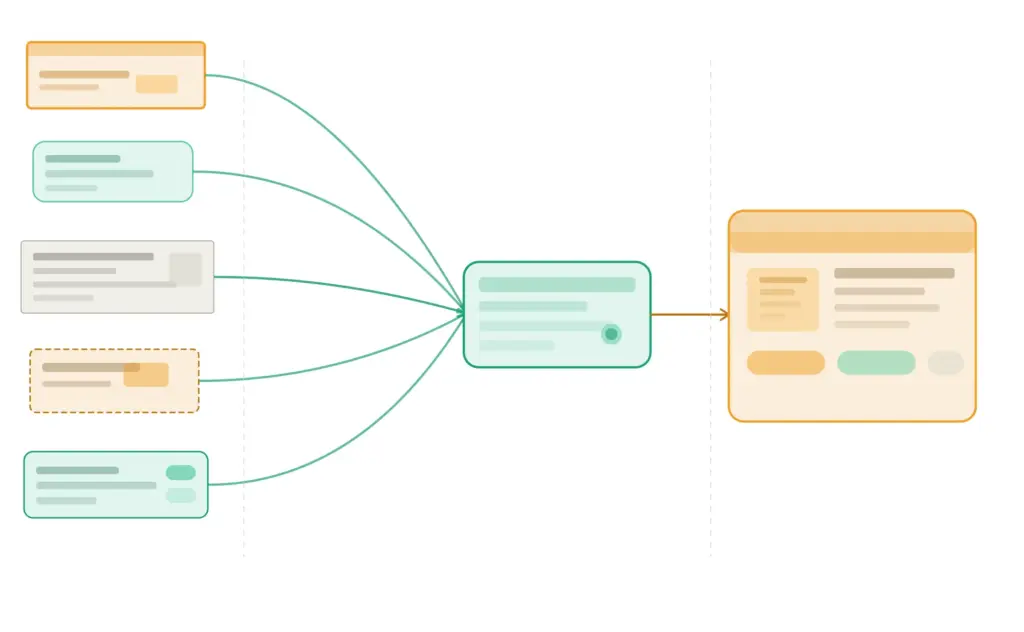
A supplier sends a product feed. Their file calls the category “M-SHIRTS-CASUAL.” Another supplier sends the same type of product under “Men Tops.” A third has it as “Casualwear > Male.” All three should land in your Clothing > Men’s > T-Shirts category. Without mapping rules, someone maps this manually every time. With mapping rules, it’s automated on import.
This is the single biggest source of catalog quality problems in multi-supplier operations. The fix isn’t cleaning up the mess downstream — it’s building mapping rules that prevent the mess from entering the catalog in the first place. The guide on cleaning supplier product data covers the broader data quality side of this.
Products get mapped to the wrong level of specificity
Products mapped too broadly — a pair of trail running shoes classified as just “Footwear” — miss the attribute template that would enforce the right data fields. They arrive in the catalog missing drop height, terrain type, upper material, and pronation guidance. They then get flagged as incomplete. No one knows why because the category assignment looks fine at a glance.
Products mapped too specifically — an “Organic Cotton Relaxed-Fit French-Tuck Blouse” classified into a category that only exists for that one product type — create a taxonomy with hundreds of single-item categories that’s impossible to govern.
The right level is almost always the leaf category that applies a meaningful, shared attribute template to a coherent group of products — specific enough to enforce relevant data, broad enough that multiple products belong in it.
Internal teams use category names inconsistently
Without a style guide and an enforced taxonomy, different team members create their own category interpretations. “Men’s Shoes” and “Mens Shoes” and “Shoe – Men” are three different category IDs in a system and three identical-looking things to a human reviewing a spreadsheet. Over 18 months with a growing team and no governance, this compounds into a catalog where the same product type exists in eight different places under eight slightly different names.
The answer isn’t cleanup campaigns. The answer is building the mapping rules and governance that prevent the problem from recurring. We’ll cover both.
How to build ecommerce category mapping rules that actually hold
Category mapping rules are the translation layer between how the outside world classifies products and how your taxonomy does.
A category mapping rule is a conditional statement: if an incoming product matches this pattern, it goes into this internal category and inherits this attribute template. Rules can be based on the supplier’s category label, keywords in the product title, specific field values in the data, or a combination.
The logic of a mapping rule looks like this:
IF supplier_category CONTAINS "T-Shirt" OR "Tee" OR "M-SHIRTS"
  OR product_title CONTAINS "t-shirt" OR "tshirt" OR "tee"
THEN internal_category = "Clothing > Men's Clothing > T-Shirts"
AND apply_attribute_template = "T-Shirts_Men"
AND flag_for_review = FALSE
And critically, you need a fallback for everything that doesn’t match:
IF no_rule_matches
THEN internal_category = "Unmapped — Needs Review"
AND flag_for_review = TRUE
AND notify = [taxonomy-owner@yourcompany.com]
The unmapped holding category is non-negotiable. Products that don’t match any rule should never be silently placed into a default category — they end up miscategorised, inherit the wrong attribute template, and produce bad data downstream with no visible error.
Building your mapping rules document
Before you encode rules into any system, document them in a mapping spreadsheet. Columns you need:
Supplier Category Input
Match Logic
Internal Category Target
Attribute Template
Last Reviewed
M-SHIRTS-CASUAL, Men Tops, Casualwear > Male
CONTAINS any of
Clothing > Men’s > T-Shirts
T-Shirts_Men
2026-01-15
WOMENS-BLOUSE, Women’s Tops > Formal
CONTAINS any of
Clothing > Women’s > Tops > Blouses
Blouses_Women
2026-01-15
[No match]
Fallback
Unmapped — Needs Review
None
—
This document becomes your taxonomy’s source of truth for supplier onboarding. Every new supplier gets mapped here first, before their data touches the catalog. The effort at onboarding is twenty minutes of mapping work. The cost of skipping it is months of catalog cleanup.
Rules for building good mapping rules
A few principles that separate mapping rules that hold from ones that drift:
Never let supplier categories become your internal categories. Suppliers optimise for their own operations, not yours. Their category names reflect how they organise their warehouse, not how your customers browse or how your data model is structured.
Build rules at the supplier level, not just the category level. Supplier A’s “Tops” and Supplier B’s “Tops” may not mean the same thing. Prefix your rules with supplier ID where the same label appears across multiple sources with different product types behind it.
Log every manual override. If someone manually reassigns a product that the mapping rules should have caught, that’s a signal the rule is wrong or incomplete. Log it. If the same pattern appears three times, create a new rule.
Review rules quarterly. Suppliers change their data formats. Seasonal categories come and go. New product types emerge that your original rules didn’t anticipate. A mapping rule set that was accurate in January may have meaningful gaps by April.
Hierarchy design: how deep is too deep, how broad is too broad
The most common taxonomy design question is about hierarchy depth. Teams building their first proper taxonomy usually either go too shallow (everything in five categories with no subcategory structure) or too deep (seven levels of subcategories that collapse under their own maintenance weight).
The practical guideline for most ecommerce catalogs is 3 to 5 levels maximum. Here’s why that number makes sense and what it looks like in practice:
Level 1 — Department: Clothing, Electronics, Home & Garden, Sports
When you feel the urge to go to Level 5 or deeper, the right question to ask is: does this product type genuinely need a different attribute set, or am I just trying to describe a variation? If it’s a variation — color, size, material, fit, terrain type — that’s an attribute. Attributes are cheap and infinitely flexible. Categories are expensive because every category you add needs naming, governance, a mapping rule, and a channel mapping. Use them only when they’re genuinely warranted.
The test that makes this concrete: if you removed this subcategory and merged its products into the parent, would those products need different fields? If yes — the subcategory earns its place. If no — it’s just label-making.
For a deeper guide on hierarchy architecture, attribute design, and governance models, the scalable taxonomy structure guide covers the structural layer in detail.
Mapping your taxonomy to channel requirements in 2026
Your internal taxonomy and your channel taxonomies are different things that need to stay in sync. Your internal taxonomy is designed around your data model. Channel taxonomies — Google, Amazon, Shopify — are designed around their own requirements, which change independently of you and don’t care about your internal structure.
The right model is a channel mapping layer: a separate table that maps each of your internal leaf categories to the correct category ID in each channel. One internal category might map to different targets across channels, and that’s expected and fine — as long as the mapping is explicit and maintained.
Your internal taxonomy is the hub. Channel category mappings are the spokes — maintained separately so changes in any channel don’t break your internal structure.
Google Product Taxonomy — January 2026 changes (deadline: July 31, 2026)
Google made its most significant product taxonomy update in several years in January 2026. Four new top-level categories were introduced: Smart Home & IoT, Electric Vehicles & Accessories, Sustainable Products, and AI & Robotics. The Electronics and Health & Beauty categories were substantially expanded and reorganised.
Google has set a compliance deadline of July 31, 2026. Products that remain mapped to deprecated or renamed categories after this date may see reduced Shopping visibility or feed rejection. If you sell in any of these affected verticals, audit your Google category mappings now.
The full Google product taxonomy is publicly available and updated with each version. Always reference the official source — there are outdated versions circulating in third-party tools that will cause feed rejections.
Key principle for Google taxonomy mapping: always map to the most specific applicable category, not the nearest parent. Google’s algorithm rewards specificity. A pair of trail running shoes mapped to Apparel & Accessories > Shoes will underperform against a competitor who correctly mapped to Apparel & Accessories > Shoes > Athletic Shoes > Running Shoes.
Shopify Standard Product Taxonomy (v2026-02)
Shopify’s standard taxonomy is newer and actively evolving — the current release is v2026-02. It uses machine learning to suggest categories based on product titles and descriptions, which reduces manual mapping work for simple catalogs. However, the suggestions are not always accurate and should always be verified, particularly for products with ambiguous titles or dual-use cases.
Shopify’s taxonomy is increasingly being adopted as a reference standard beyond the Shopify ecosystem, particularly among mid-market brands building channel-agnostic product data models. It’s worth mapping to even if it’s not your primary channel.
Amazon Browse Tree Guide
Amazon has over 10,000 categories and splits them between open listing categories (anyone can list) and gated categories requiring prior approval. Your internal categories will rarely map 1:1 to Amazon’s Browse Tree — the structures are built with different goals in mind.
The most common Amazon mapping mistake is categorising at too high a level because it’s easier. “Electronics” is valid but useless. “Electronics > Camera & Photo > Digital Cameras > Mirrorless Cameras” is what Amazon’s algorithm expects and what drives relevant placement. Deep, specific mapping consistently outperforms broad mapping in Amazon search visibility.
GS1 as a classification baseline
If you sell B2B, wholesale, or through retail trading partners who require standardised product data exchange, the GS1 Global Product Classification (GPC) standard is worth understanding. GS1 provides a universal language for product classification used by major retailers and distributors globally. It won’t replace your internal taxonomy, but knowing how your categories map to GS1 bricks and segments makes retailer onboarding significantly faster.
Category mapping by role: who maps what, and when
One of the most overlooked dimensions of category mapping is the human side: different roles in an ecommerce organisation interact with the taxonomy at different points and with different goals. When the mapping process isn’t designed with roles in mind, it breaks down at handoff points.
Founder or category manager — strategic mapping
At the strategic level, category decisions are about which product types belong in the catalog, how they relate to each other commercially, and how the top-level taxonomy structure reflects the brand’s positioning. A founder building a DTC brand in a specific vertical needs to make deliberate decisions about category structure early, because those decisions affect everything from navigation UX to attribute standardisation to how Google indexes the site. Getting this right early is dramatically cheaper than restructuring a live catalog later.
Product manager or merchandiser — operational mapping
Product managers and merchandisers are typically the people doing the day-to-day mapping work — classifying new products, reviewing unmapped items, deciding whether a new product type needs a new leaf category or can fit into an existing one. This is where the mapping rules document and the style guide are most critical. Without them, these decisions get made inconsistently across team members and shifts, and the taxonomy drifts.
Supplier onboarding team — import mapping
The supplier onboarding team is the first line of defense against bad category data entering the catalog. Their job is to map each new supplier’s category structure to your internal taxonomy before any product data is imported. This mapping is almost always manual for the first supplier from a given source. Once documented, it becomes a rule set that future imports use automatically. Teams that treat supplier mapping as a one-time setup task rather than a governed process end up re-doing it every time a supplier updates their feed format.
If your supplier data quality is a consistent bottleneck, it’s worth assessing the broader picture with the PIM Readiness Assessment — it surfaces exactly where in the data flow the problems are concentrated.
Taxonomy naming conventions: the part everyone skips
Naming inconsistency is the silent killer of otherwise well-designed taxonomies. “Men’s Running Shoes,” “Mens Running Shoes,” “Running Shoes – Men,” and “Men > Running > Shoes” are four different category IDs in any system and four identical-looking things to a human skimming a spreadsheet. At twenty categories, this is manageable. At two thousand, it’s catastrophic.
Write down these decisions before you build, and enforce them without exceptions:
Singular vs. plural: Pick one and use it at every level. (“Shoe” or “Shoes” — not both.) Most operational taxonomies use singular. Most navigation taxonomies use plural. Decide which model you’re building.
Possessives: “Women’s” or “Women” or “Female”? One form, every time.
Ampersands vs. “and”: “Home & Garden” or “Home and Garden”? One form.
Capitalisation: Title Case or Sentence case? Either works. Inconsistency doesn’t.
Special characters: Avoid them in category names used as system identifiers. Use them only in display labels if needed.
Abbreviations: None in category names. “TV & AV” is opaque. “Televisions & Audio-Visual Equipment” is self-explanatory.
This should live in a one-page taxonomy style guide that every person who touches the catalog has read. It doesn’t need to be complex. It needs to exist and be the single reference point that ends “well I didn’t know we did it that way” conversations.
The attribute template layer: where taxonomy connects to data quality
Category mapping without attribute templates is half a solution. The point of placing a product in the right category isn’t just organisational — it’s so that the correct attribute template applies, which defines what fields are required, what values are acceptable, and what gets validated before the product can be published.
A simple attribute template table for a leaf category looks like this:
Category
Required Attributes
Optional Attributes
Controlled Value Lists
Running Shoes
Brand, Gender, Size, Color, Upper Material
Terrain Type, Drop Height, Pronation
Gender: [Men, Women, Unisex, Kids]
Blouses
Brand, Size, Color, Sleeve Length, Fabric
Occasion, Pattern, Neckline
Sleeve: [Short, Long, 3/4, Sleeveless]
Gaming Laptops
Brand, Processor, RAM, Storage, GPU, Screen Size
Refresh Rate, Weight, Battery Life
RAM: [8GB, 16GB, 32GB, 64GB]
The controlled value lists in the right column are what prevent the “Cotton / 100% Cotton / Ctn / cotton” problem from ever entering the system. When the acceptable values for a field are pre-defined and enforced at input, downstream exports to Google, Amazon, and any other channel become dramatically cleaner.
If you want to see how complete your current product data actually is across categories, the Completeness Checker will show you exactly where the gaps are by category and by field.
For the full picture on what PIM infrastructure you need to enforce this properly at scale, the 2026 PIM guide covers the system requirements end-to-end.
Taxonomy governance: the process that keeps everything from breaking again
You can design a perfect taxonomy today and have it in disarray within twelve months without governance. Governance is the set of rules and processes that control how the taxonomy changes over time — not to prevent change, but to make sure changes are deliberate, documented, and communicated to every system that depends on them.
The minimum governance model for a growing ecommerce operation:
Single owner: One person (or team) is accountable for the taxonomy. Change requests go through them. This doesn’t mean they do all the work — it means there’s no ambiguity about who decides.
Creation criteria: A new category is only created when products in it need a different attribute template OR when customers browse for them distinctly. Everything else becomes an attribute or a tag.
Change log: Every category creation, rename, merge, or deletion is recorded with a date, the requester, and the reason. This is what prevents “I don’t know why we have three categories called Tops” six months from now.
Review cadence: Quarterly taxonomy health checks. Check for orphaned products (not assigned to any category), empty categories, near-duplicate categories, and channel mapping gaps.
Deprecation process: Categories are never hard-deleted. They’re deprecated — products migrated, mapping rules updated, channel maps updated — then archived. Hard deletes break feed exports silently and cause the kind of sudden Google Shopping drop that takes days to diagnose.
If you’re managing product data across multiple team members and want to understand where your data governance currently stands, the free PIM Readiness Score covers taxonomy governance as one of its five assessment dimensions.
Common category mapping mistakes — and what to do instead
Mapping to parent categories instead of leaf categories
Mapping a product to “Electronics” instead of “Electronics > Computers > Laptops > Gaming Laptops” means the product inherits no meaningful attribute template, gets incomplete data, and underperforms in every channel that cares about specificity — which is all of them. Always map to the deepest applicable category.
Treating brand as a category
Brand is an attribute. A Nike running shoe belongs in “Footwear > Athletic > Running Shoes” with Brand = Nike — not in a “Nike” category. The only exception is marketplaces where brand pages function as independent browse destinations, and even then the brand taxonomy is a navigation overlay, not the core classification structure.
Google’s taxonomy has 6,000+ categories and is designed for standardisation across millions of merchants. Amazon’s has even more. Neither was designed for managing your catalog, enriching your product data, or serving your customer navigation experience. Use them as mapping targets, not as your internal model. The relationship is one-way: your internal taxonomy maps to channel taxonomies, not the other way around.
Not updating mappings when channels update their taxonomies
Channel taxonomies change, and they don’t notify you personally when they do. Google’s January 2026 update is a good example — brands that set their Google category mappings years ago and never revisited them may now be mapping to deprecated categories with a July 2026 deadline to fix it. Build taxonomy health checks into your quarterly calendar and specifically include “are all channel mappings current?” as a standing agenda item.
Quick-start taxonomy mapping template
If you’re building or rebuilding your category mapping layer, this is the minimum structure to have documented before you start building in any system:
Category tree document — every category, parent, and leaf level with IDs
Attribute template table — required and optional fields per leaf category with controlled value lists
Supplier mapping rules document — incoming labels mapped to internal categories, with fallback rule
Channel mapping table — internal leaf category to Google, Amazon, Shopify, and any other relevant channel
Governance record — owner, change log, review cadence, deprecation process
These six documents are the complete picture of a functional taxonomy mapping layer. Some teams keep them in a wiki. Some in a shared spreadsheet. The format doesn’t matter as much as the discipline of keeping them current. A PIM handles the enforcement — but the logic has to be designed and documented first, before it’s encoded into any system. If you’re not sure whether your current setup can actually enforce these rules at scale, this comparison of PIM vs spreadsheets covers exactly where spreadsheet-based taxonomy management breaks down.
Frequently asked questions
What is the difference between a product taxonomy and product categories?
A product taxonomy is the complete hierarchical system — all the levels, rules, attributes, and relationships that define how products are classified. Product categories are individual nodes within that taxonomy. Think of the taxonomy as the filing system and categories as the individual folders. You can have categories without a taxonomy (just a flat list of folders), but a taxonomy requires a structured, governed set of categories with defined relationships between them.
How many levels should an ecommerce product taxonomy have?
Three to five levels is the practical range for most ecommerce catalogs. Level 1 is a broad department (Clothing, Electronics). Level 2 is a category (Women’s Clothing, Laptops). Level 3 is a subcategory (Tops, Gaming Laptops). Level 4 is usually the leaf category where products actually live. Going to Level 5 is occasionally justified for very large catalogs with genuinely distinct product types at that depth — but most teams who go that deep would be better served by using attributes instead of adding another level.
Do I need a separate internal taxonomy and a Google Shopping taxonomy?
Yes. Your internal taxonomy should be designed around your data model and your customers’ browsing behaviour. Google’s taxonomy is designed for standardisation across all Google Merchant Center merchants. They rarely align perfectly, and they shouldn’t be forced to. The right approach is to maintain your internal taxonomy and a separate mapping table that maps each of your internal leaf categories to the appropriate Google category ID. When Google updates its taxonomy — as it did in January 2026 — you update the mapping table, not your internal structure.
How do I handle products that fit in multiple categories?
Every product should have one primary category — the one that determines its attribute template and its place in your core data model. Secondary placement (showing the product in multiple navigation locations) is handled through tags, collections, or navigation overlays — not by duplicating the product into multiple categories. Duplicate category assignment creates reporting confusion, inconsistent data, and SEO issues with canonicalisation.
What is the Google product taxonomy deadline for 2026?
Google introduced four new top-level categories in January 2026 (Smart Home & IoT, Electric Vehicles & Accessories, Sustainable Products, AI & Robotics) and expanded the Electronics and Health categories significantly. The compliance deadline for products affected by these changes is July 31, 2026. Products mapped to deprecated or reorganised categories after this date may experience reduced Shopping visibility or feed rejection. Check the official Google taxonomy documentation for the current version.